
CDT Terpene Use Rates for Vapes & Edibles
This guide breaks down CDT terpene use rates for vapes and edibles, with practical starting ranges and a repeatable bench ladder. so your team can dial strain-like flavor without harshness, drift, or “mystery lots.”
When you’re working with clean, unadulterated CDT, CDT terpene use rates aren’t about making a SKU “louder.” They’re about landing the profile where it tastes like the plant — and stays there batch after batch.
Up here in Humboldt, we don’t dump fertilizer on a field just because a crop looks shy in one corner. We walk the rows first. Same deal with terps: if you have to drown it to make it work, something upstream is off (quality, storage, missing minors, or the target itself).
Think “seasoning,” not “sauce.” You can always add a hair more. You can’t take it back once the batch is mixed, filled, and shipped.
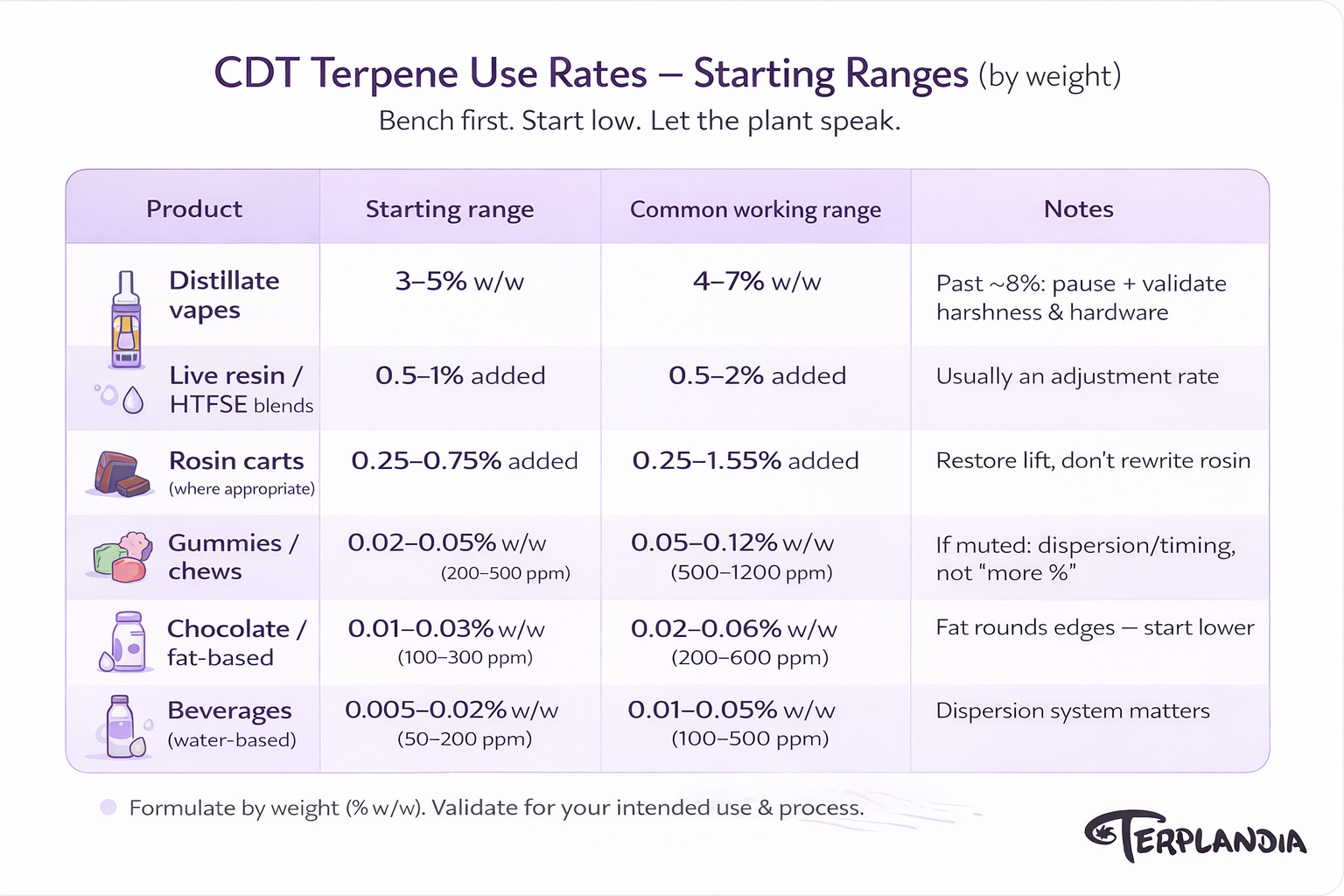
CDT terpene use rates: starting ranges
A quick at-a-glance table before the deeper breakdown.
These are practical starting points for neat CDT. Always validate for your intended use, your hardware, and your process. Use them to build a bench ladder — not to skip QA.
| Product | Starting range | Common working range | Operator note |
|---|---|---|---|
| Distillate vapes | 3–5% w/w | 4–7% w/w | Past ~8%: pause and validate harshness + hardware behavior. |
| Live resin / HTFSE blends | 0.5–1% added | 0.5–2% added | You’re usually correcting to target, not rebuilding. |
| Rosin carts (where appropriate) | 0.25–0.75% added | 0.25–1.5% added | Goal is aromatic lift — don’t erase rosin’s own voice. |
| Gummies / chews | 0.02–0.05% w/w (200–500 ppm) | 0.05–0.12% w/w (500–1200 ppm) | If you’re going higher and still can’t taste it, it’s usually dispersion or timing. |
| Chocolate / fat-based | 0.01–0.03% w/w (100–300 ppm) | 0.02–0.06% w/w (200–600 ppm) | Fat rounds edges. Start lower than gummies. |
| Beverages (water-based reality check) | 0.005–0.02% w/w (50–200 ppm) | 0.01–0.05% w/w (100–500 ppm) | Neat terps don’t “mix into water.” Your dispersion system runs the show. |
If you’re benchmarking lots: line up 3 ladder points, keep one “gold jar,” and trend against a consistent COA method. That’s how you stop taste-chasing.
Humboldt Rule #1: Start Low, Let the Plant Speak
Why clean CDT often needs less than you think
Clean CDT tends to feel “full” at lower percentages because you’re not leaning on a few loud major compounds to carry the whole experience. You get the nuance — the little turns in the aroma that make a profile read as real, not reconstructed.
- More natural balance: the profile isn’t just “top terps and a prayer.”
- Better strain-like shape: top/mid/base comes through without pushing intensity.
- Less fighting the formula: fewer weird mouthfeel/aroma-release surprises from added carriers or boosters.
If you can’t get clean documentation that the CDT is neat (undiluted) and properly identified lot-to-lot, start there: read a terpene COA before you start adjusting percentages.
“More terps” is not the same as “better flavor”
Two things usually happen when a team chases intensity with percentage:
- You amplify sharp edges (harshness, solventy notes, “Pine-Sol citrus”).
- You create performance problems (especially in vapes): thinning, leaking, inconsistent hits, and faster drift.
The goal is strain fidelity and repeatability. If the only way to “hit the target” is cranking % higher every lot, it’s usually a signal to check storage, COA depth, or missing minors — not to keep climbing.
CDT Terpene Use Rates: Basics (So Your Team Stops Arguing Over Units)
Always formulate by weight
If your SOP still uses “drops,” fix that now. Drops vary with viscosity, temperature, and whatever tool somebody grabbed that day. Operator standard is simple:
- % w/w (percent by weight) for everything
- One scale, one method, repeatable results
If two people can run the same bench and land different flavor because they used “drops,” you don’t have a recipe — you have a vibe.
What “% w/w” means in production
1% w/w means 1 gram of terpene blend per 100 grams of finished mix.
- 5% w/w in a 1,000 g batch = 50 g terpenes
- 0.05% w/w in a 10,000 g (10 kg) batch = 5 g terpenes
Quick conversion: ppm = % × 10,000. So 0.05% = 500 ppm. And % = ppm ÷ 10,000.
Build a simple 3-point bench ladder
Before production, run a ladder: low → mid → high. Pick three points that bracket your likely range. Your ladder tells you:
- Where harshness starts
- Where character “locks in”
- Where diminishing returns kick in
- Distillate vape: 4% / 6% / 8% (w/w)
- Gummies: 0.04% / 0.08% / 0.12% (w/w)
- Chocolate: 0.02% / 0.04% / 0.06% (w/w)
If you’re fighting lot-to-lot changes, start here: why profiles drift. A “moving target” makes every ladder feel like a guessing game.
CDT Use Rates for Vape Formulations (Distillate, Resin, Rosin)
Distillate-based vapes
Distillate is a blank canvas. That’s good — and risky — because it will expose anything off in your terpene input. With clean CDT, most operators land in a tighter range than they expect.
- Typical starting range: 3–5% (w/w)
- Common working range: 4–7% (w/w)
- Guardrail: If you’re pushing past ~8%, slow down and validate why (harshness, stability, and hardware risk climb fast).
What moves you up or down:
- Target style: plant-forward usually needs less than candy-forward.
- Hardware: coil design, airflow, and power change how a profile reads.
- Strain family: some profiles read strong early (gassy, piney), others need a little more to “show up” (soft fruit, floral).
Live resin / HTFSE blends
If your input already carries native terps, your “use rate” is usually an adjustment rate. You’re not rebuilding — you’re steering back to a target.
- Typical adjustment range: 0.5–2% added CDT (w/w)
- Common use case: bringing a batch back to a benchmark or tightening a “wide” lot
Rosin carts (where appropriate)
Rosin is already expressive. A lot of teams add little or none. If you’re adding, keep it conservative and stay honest about the goal: lift aroma without changing the rosin’s core character.
- Typical adjustment range: 0.25–1.5% added CDT (w/w)
- Practical target: restore “pop” in the top notes without rewriting the profile
Guardrails for harshness and hardware performance
If you see any of the below, treat it like a use-rate + input-quality check — not a branding problem:
- harsh throat feel that shows up as % climbs
- sharp chemical citrus (especially on day 1)
- thin aroma after a week (top notes vanish)
- burnt or “hot” notes that only appear in one hardware type
In vapes, terps don’t just change flavor — they change how the oil behaves. If one cart runs clean and another runs harsh at the same % (same oil, same terps), don’t guess. Run a simple troubleshooting matrix.
vape troubleshooting
We’ll help you set a ladder that covers flavor and performance — then lock an acceptance window you can repeat.
CDT Use Rates for Edibles (Gummies, Chocolates, Beverages)
Edibles are a different game. Your enemies are:
- heat (top notes don’t like it)
- open-kettle volatility loss (aroma walks off while you stir)
- uneven dispersion (hot spots + dead spots)
- matrix interactions (sugar, acid, fat, emulsifiers)
Gummies / chews
Gummies can carry strain-inspired flavor — but CDT is potent and easy to overdo. The mistake isn’t “too little.” The mistake is adding too early, mixing too slow, or trying to fix dispersion with more %.
- Typical starting range: 0.02–0.05% w/w (200–500 ppm)
- Common working range: 0.05–0.12% w/w (500–1200 ppm)
If you’re pushing higher and still can’t taste it, the issue is usually dispersion or process timing — not “not enough terps.”
Chocolate and fat-based edibles
Fat carries aroma differently — often smoother, sometimes heavier. Start lower and let it bloom. If you push too hard, chocolate can lock the profile into a waxy, perfume-y note that won’t forgive you.
- Typical starting range: 0.01–0.03% w/w (100–300 ppm)
- Common working range: 0.02–0.06% w/w (200–600 ppm)
Beverages and water-based systems (dispersion reality check)
Neat terpenes don’t “mix into water.” You need a dispersion/emulsion approach that fits your compliance and label goals. Your terpene % can be perfect and still taste wrong if the dispersion is unstable.
- Typical starting range: 0.005–0.02% w/w (50–200 ppm)
- Common working range: 0.01–0.05% w/w (100–500 ppm) depending on system
Process timing + heat exposure
Here’s the simple version: if you cook terps, you lose terps. Aim to add terpenes as late as your process allows, at the lowest feasible temperature, with good mixing — then get the vessel covered and moving toward packaging.
If your kitchen crew says, “We added them in the pot like everything else,” that’s usually the whole problem. Late addition + fast mix + less open-air time makes a bigger difference than another 200 ppm.
What Changes Your Ideal Use Rate
Oxidation + volatility loss (and why storage affects “use rate”)
If a profile has oxidized or lost top notes, teams often compensate by adding more — which can create harshness and still not restore character. The fix is usually upstream:
- reduce headspace exposure
- control light/heat swings
- use a working bottle SOP (keep bulk sealed)
Start here: storage SOP.
Missing minors vs “loud majors”
Profiles built on loud majors can read sharp and one-dimensional. Clean CDT tends to carry more nuance — which is why it often performs at lower total %. If you’re simplifying profiles for production consistency, do it intentionally: simplify without losing flavor.
Batch variation + COA depth
If you can’t see minors, unknowns, method, or dates, you can’t control repeatability. In real operations, COA depth isn’t “nice to have” — it’s the difference between a predictable ladder and an expensive guessing game.
Supplier vetting belongs here: supplier checklist (and keep this pillar handy: buying real terpenes).
A Clean, Repeatable Dial-In SOP (Bench to Production)
Bench ladder → sensory notes → acceptance window
A simple workflow that keeps you out of “taste chase” mode:
- Pick the target (strain-inspired? plant-forward? dessert?). Use a naming anchor your team agrees on: browse strain profiles and top strains of 2025.
- Run a 3-point ladder around your expected range.
- Record sensory with a consistent template: top / mid / base + any off-notes.
- Choose a target % and define an acceptance window (example: 5.5% ± 0.5% for a given hardware setup).
- Confirm stability on your timeline (a quick “day 0 vs day 7” check catches a lot of surprises).
Retain a “golden reference”
When you land the profile, keep a retained sample (sealed, labeled, dated). That “gold jar” becomes your north star for every future batch and every supplier comparison.
Document the decision (so you can repeat it)
Write down what actually mattered: the exact % w/w, the lot numbers, the mixing conditions, the hardware or matrix, and the sensory call. That’s how you stop reformulating the same SKU every month.
Use the same ladder method, keep your gold jar, and change one variable at a time. This guide helps teams switch cleanly: switching from botanicals.
Next step
If you want clean CDT that holds up in hardware and edible processing, don’t start with a big production run. Start with a ladder, pick the winner, and lock a repeatable acceptance window.
We’ll help you pick ladder points, keep the plant character, and avoid the #1 mistake: over-terping to compensate for upstream problems.
Compliance note: validate all materials and finished goods for your intended use and applicable regulations. This guide is for formulation benchmarking and repeatability, not a safety certification.
FAQ
What’s a typical CDT terpene percentage for vape carts?
For distillate-based carts, many operators start around 3–5% w/w and land in a 4–7% w/w working range. If you’re climbing past ~8%, pause and validate harshness, stability, and hardware behavior.
Can you use CDT terpenes in gummies?
Yes — gummies can carry strain-inspired flavor well, but process timing and dispersion matter. A common starting range is 0.02–0.05% w/w (200–500 ppm), with many teams working in the 0.05–0.12% w/w range once the process is dialed.
Why does a higher terpene % sometimes taste worse?
Because you amplify the sharp edges first. Higher % can pull forward harsh or chemical notes, thin vape oil (changing performance), and make drift more obvious if top notes fade. “More” isn’t always “more strain-like.”
How do I calculate terpene use rate by weight?
Use grams by weight. Formula: terpene grams = total batch grams × (use rate % ÷ 100). Example: 1,000 g batch at 5% w/w uses 50 g terpenes.
How do storage and oxidation affect use rate over time?
If top notes fade from headspace, light, or heat, teams often add more % to “bring it back,” which can add harshness without restoring the original character. Better storage (cool, dark, sealed; working bottle SOP) protects the profile so your use rate stays stable.