
Operator Guide • Edible Formulation • 2026
CDT Terpenes in Edibles — Clean Flavor Build + Troubleshooting
CDT terpenes in edibles can be the cleanest way to build strain-inspired flavor — or the fastest way to end up with gummies that taste “off.” The edible matrix (sugar, acid, fat, water, gums) changes how aroma releases, and it can magnify terpene off-notes that were subtle in the bottle.
What you’ll get from this guide
- Starting use-rate ranges for terpenes in gummies, chocolate, and beverages (with guardrails)
- Process timing pitfalls that strip CDT character (heat, holds, acid/sugar timing, packaging headspace)
- High-level dispersion reality checks (why “it’s not mixing” happens)
- A troubleshooting matrix you can hand to production and QA
Guides to keep handy: How to Read a Terpene COA in 2026 • CDT Terpene Use Rates for Vapes & Edibles • Terpene Storage & Shelf Life
Want clean CDT lots to evaluate in your edible process (without mystery carriers or “flavor system” additives)? Run a quick bench ladder and keep what actually works.
Starting ranges at a glance (bench ladder-friendly)
Use these as a starting point — then set acceptance windows based on your process, packaging, and shelf checks.
| Product | Typical starting range | Common working range | Guardrail (what to watch) |
|---|---|---|---|
| Gummies / chews | 0.02–0.05% w/w (200–500 ppm) | 0.05–0.12% w/w (500–1200 ppm) | Perfumey/soapy = too high or poorly dispersed; disappearing = heat/hold/headspace |
| Chocolate / fat-based | 0.01–0.03% w/w | 0.02–0.06% w/w | Fat can smooth aroma (great) but also weigh it down; keep it tight |
| Beverages / water-based | 0.005–0.02% w/w | 0.01–0.05% w/w | Neat terpenes won’t dissolve in water; dispersion approach must match your label/compliance |

Humboldt Rule #3: Keep It Plant-Forward, Not Perfume-Forward
In Humboldt, you learn fast: if the aroma is loud, it’s often wrong. The goal isn’t to make a gummy smell like a jar — it’s to build a clean, believable flavor arc that survives processing and shelf life.
Edibles punish heavy-handed flavor. If you push too high, the profile can flip from “strain-inspired” to: perfumey, soapy, bitter, or a chemical-citrus edge.
Why edibles magnify off-notes
Edibles don’t behave like vapes. In a vape, volatiles lift fast and you get an immediate read. In edibles, the matrix — sugar, acid, fat, water, gums — changes aroma release and can magnify terpene off-notes. That’s why terpene flavoring edibles has to be approached like a system, not a splash.
Start With Clean Inputs (COA + “Unadulterated” Reality Check)
What “clean” should mean on paper
For edible formulators, “clean” isn’t a vibe — it’s documentation + traceability. Minimum expectations for any CDT lot you’re evaluating:
- Lot number matches the container (and your receiving log)
- Method and dates are clear (who tested what, and when)
- Composition table goes beyond a marketing top-10 list
- Contaminant screens are stated clearly (ideally with numeric results, not just “pass”)
FEMA Flavor Ingredient Library (FEMA GRAS). If you want a fast operator checklist, use: How to Read a Terpene COA in 2026.
Panels to request based on your compliance program
Different programs require different screens. The key is: don’t assume — request what your process needs (and what your compliance program expects).
- Residual solvents
- Pesticides
- Metals
- Micro (if required by your internal QA, even if the ingredient isn’t water-based)
Supplier qualification belongs here: How to Choose a Terpene Supplier. Big-picture buying framework: A Practical Guide to Buying Real Terpenes.
If you’re tightening documentation for edible programs (COA clarity, lot traceability, clean inputs), start with a small sample ladder and lock your acceptance criteria before scaling. FDA Food Additive Status List
CDT terpenes in edibles: Use Rates for Gummies, Chocolate, Beverages
You’ll get farther with a bench ladder than with someone else’s “magic number,” but teams still need starting points. For deeper context and cross-product ranges, use: CDT Terpene Use Rates for Vapes & Edibles.
Starting ranges + guardrails
Gummies / chews
- Typical starting range: 0.02–0.05% w/w (200–500 ppm)
- Common working range: 0.05–0.12% w/w (500–1200 ppm)
Guardrails: Perfumey = too high or poorly dispersed. Disappearing = heat/hold loss or packaging headspace.
Chocolate and fat-based edibles
- Typical starting range: 0.01–0.03% w/w
- Common working range: 0.02–0.06% w/w
Fat carries and smooths aroma — which can be great — but it can also weigh the profile down. Keep it tight and bench it.
Beverages / water-based systems
- Typical starting range: 0.005–0.02% w/w
- Common working range: 0.01–0.05% w/w (depends on dispersion approach)
Reality check: neat terpenes don’t dissolve into water. If you’re building beverages, you need a dispersion strategy that matches your label and compliance goals. (We’ll keep terpene emulsification edible formulation high-level here.)
Why more doesn’t fix weak flavor
If you keep adding and still can’t taste it, the root cause is usually one of these:
- Volatility loss from heat + open kettle
- Poor distribution (it’s not evenly present in the piece)
- Packaging/headspace stripping aroma over time
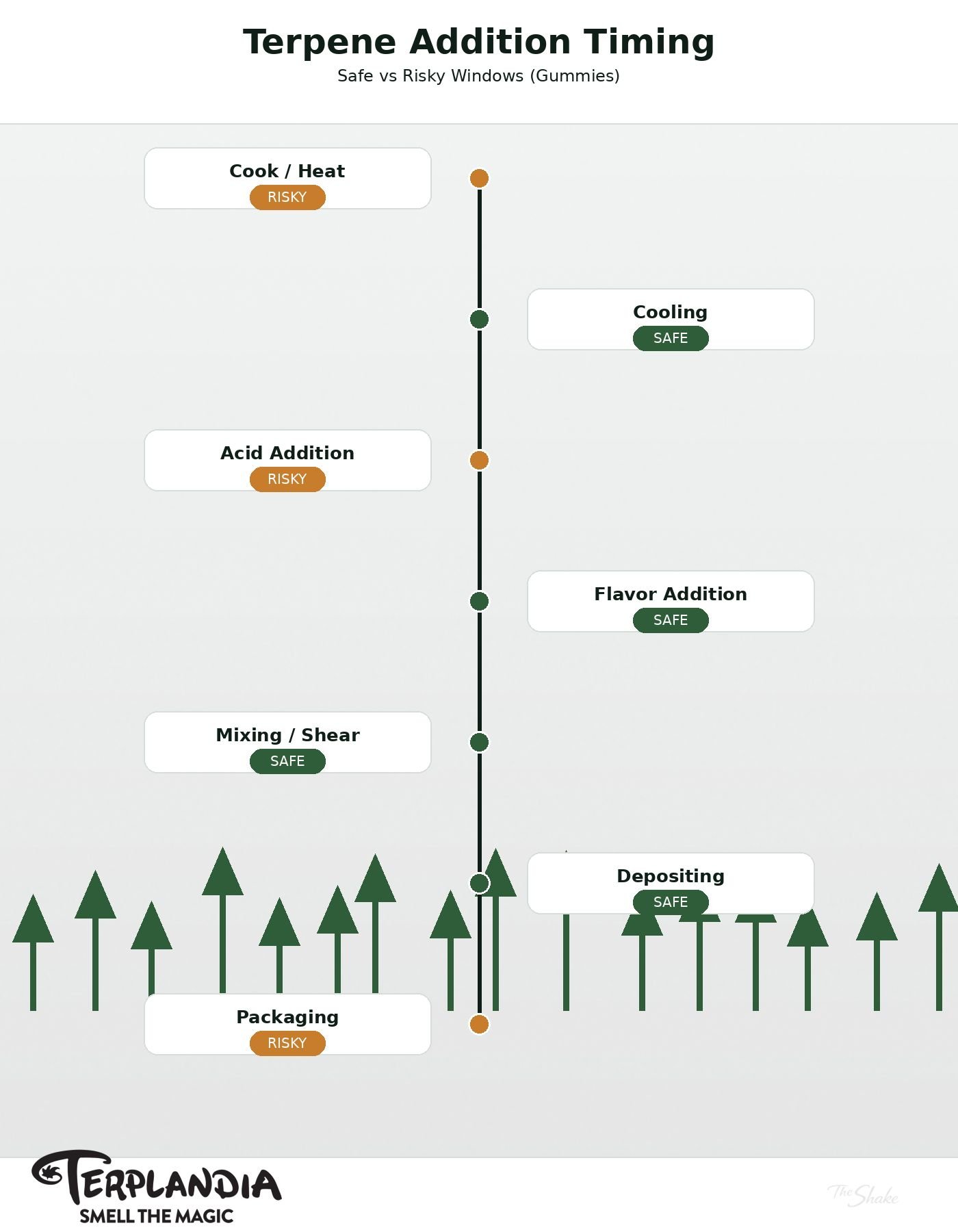
Process Pitfalls That Strip CDT Character
Heat + open-kettle loss
Top notes are the first to leave. If your process involves high heat or long exposure in open vessels, you’re budgeting aroma every minute.
- Minimize unnecessary heat exposure
- Reduce open-air time when possible
- Avoid “hot holds” after flavor addition
Long hold times
If a batch sits hot or uncovered, you’ll watch aroma walk away. The product may still pass potency, but the flavor won’t match the bench.
Acid/sugar interactions and timing
Gummies and chews often involve acids and intense sweetness. That can change how terpene notes read: citrus can skew “cleaner-like,” florals can skew perfumey, and pine can skew sharp. Timing matters — so bench test process timing like you bench test use rate.
Packaging + headspace over shelf life
If a gummy smells great at pack-out and weak two weeks later, headspace and packaging are suspects. This is drift, just in a different form: ingredient drift (oxidation) + product drift (volatility loss + headspace).
Start with: Terpene Storage & Shelf Life
Distribution Reality: Why “It’s Not Mixing” Happens
Oil phase vs water phase (high-level)
Terpenes are hydrophobic. In water-dominant systems, if you don’t use a dispersion approach, you’ll see hot spots (some pieces loud, some blank), surface aroma that flashes off, and inconsistent sensory reads.

What good dispersion looks like (sensory + QC)
Practical checks edible teams can run without overcomplicating it:
- Pull samples from early / mid / late fill and compare aroma
- Compare piece-to-piece consistency after 24–48 hours
- Keep a retained “golden” sample for shelf checks
How to test for even distribution (practical checks)
- Define a simple sensory scoring template (same panel, same scale)
- Test multiple random pieces per batch (not just one “good” piece)
- Track drift at set intervals (pack-out, week 1, week 2, etc.)
Troubleshooting Matrix (Edible Symptoms → Causes → Fixes)
| Symptom | Likely causes | Quick checks | Practical fixes |
|---|---|---|---|
| Perfumey / soapy | Use rate too high; imbalance; poor dispersion | Run ladder lower; check piece-to-piece variation | Reduce %; simplify profile; improve distribution approach |
| Bitter / harsh | Over-terping; sharp majors dominating; oxidized lot | Compare fresh vs opened bottle; review storage log | Lower %; tighten storage; rebalance profile |
| Flavor disappears after a week | Heat/hold losses; packaging headspace; oxidation | Compare pack-out vs week 1; check seal/headspace | Adjust process timing; improve packaging; fix storage SOP |
| Uneven flavor across pieces | Poor distribution | Sample early/mid/late; piece-to-piece sensory | Address dispersion; standardize mixing time/shear |
| “Clean citrus” / cleaner-like | Oxidation; sharp citrus dominance; too high % | Compare lots; check COA unknowns | Lower %; tighten storage; rebalance away from sharp edge |
If your profile is getting “loud but wrong,” consider simplifying intentionally rather than stacking fixes: Simplifying Terpenes Without Losing Flavor.
Want a cleaner path to consistent, plant-forward profiles? Start with verified inputs and a bench ladder — then lock your acceptance window so production stays repeatable.
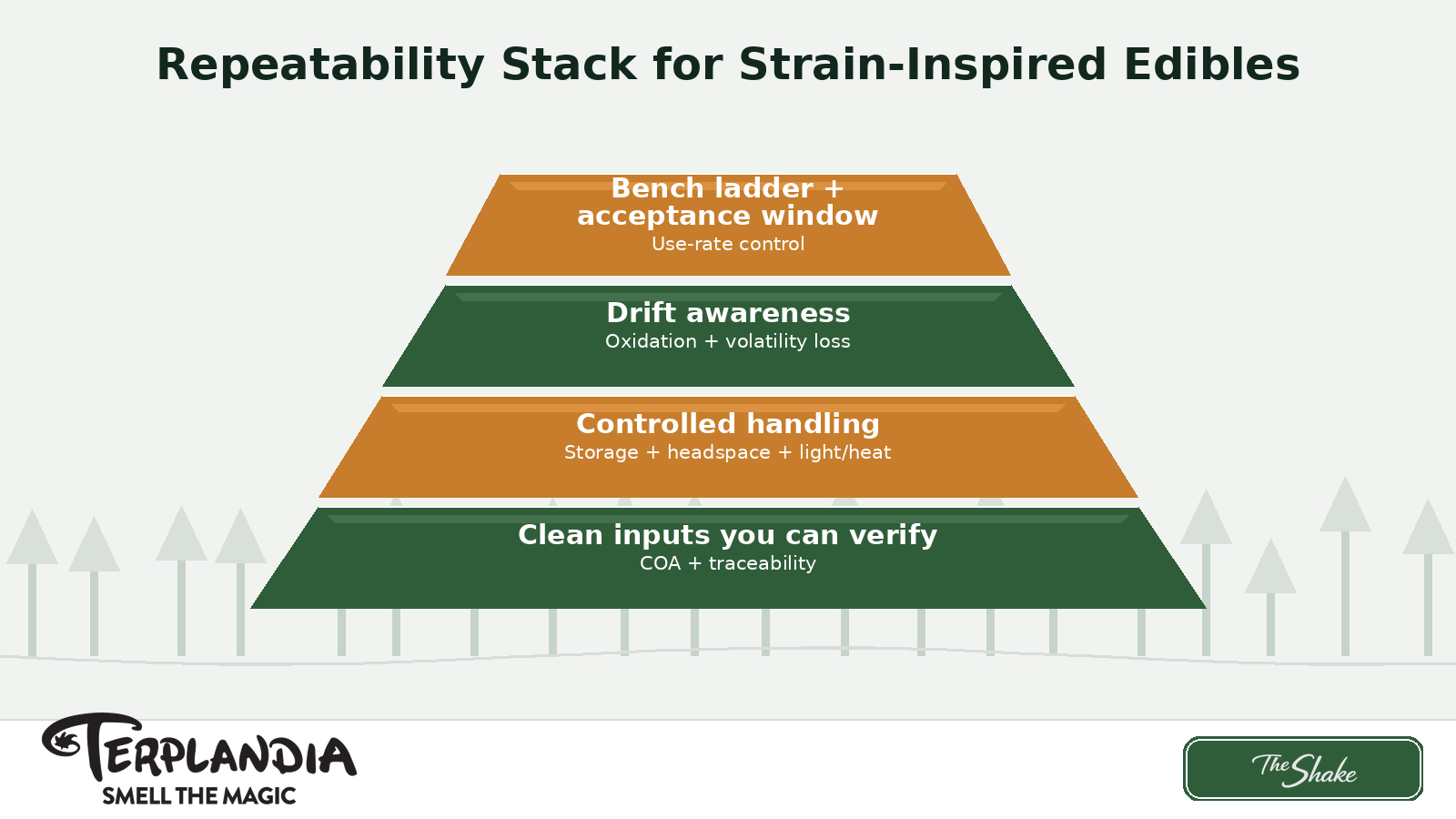
Connect It Back to Repeatability (Storage + Drift + Acceptance Windows)
Edibles that stay consistent are built on the same foundation as vapes:
- Clean inputs you can verify (COA + traceability)
- Controlled handling (storage, headspace, light/heat exposure)
- Awareness of drift pathways (oxidation + volatility loss)
- A dial-in ladder and acceptance window (use-rate control + sensory/QC checks)
If you’re moving from botanical flavor systems into clean CDT, keep this handy: Switching from Botanicals Without Rebuilding.
FAQs
Can CDT terpenes be used in gummies?
Yes — but gummies amplify terpene off-notes and process losses. Start with a bench ladder, control heat/hold time, and verify piece-to-piece consistency to avoid hot spots.
Why did my edible flavor disappear after a week?
The most common causes are volatility loss (heat/open kettle or hot holds), packaging headspace, and oxidation. NIST D-Limonene WebBook. Compare pack-out vs week 1 samples and check seals/headspace. Storage discipline matters too: Terpene Storage & Shelf Life.
Why do terpenes taste bitter or perfumey in edibles?
Usually it’s a combination of over-terping, imbalance (sharp majors dominating), poor dispersion, or an oxidized lot. Ladder down first, then simplify the profile and tighten storage.
What’s a normal terpene use rate for gummies?
A typical starting range is 0.02–0.05% w/w (200–500 ppm), with a common working range of 0.05–0.12% w/w (500–1200 ppm). Your process, packaging, and shelf target should determine your final acceptance window.
How do I keep batches consistent?
Use lot-verified inputs, document storage handling, standardize mixing timing, and run a defined sensory/QC routine (early/mid/late fill + retained “golden” sample). Drift is normal — unmanaged drift is expensive.
Next step
If your edible line needs clean, plant-forward strain inspiration — and you want control over dispersion and labeling — start with a sample ladder and document what actually works in your process.
Ready to evaluate clean CDT in your edible process?
Compliance note: This post is for formulation and quality-control discussion only. Validate inputs, use rates, and process changes under your compliance program and internal QA. No medical claims are made or implied.