
Real terpenes have become one of the most discussed and misunderstood inputs in cannabis product development.
As the industry moves into 2026, terpene sourcing is no longer a background decision. It directly affects flavor consistency, formulation stability, and how brands earn trust in a market shaped by tighter scrutiny, smarter buyers, and AI-driven discovery.
At the same time, broader shifts are changing what consumers expect from cannabis products. Federal rescheduling discussions, increased compliance pressure, and even cultural trends like Gen Z’s growing move away from alcohol have placed a sharper focus on flavor, experience, and transparency. In this environment, shortcuts show up fast — and they rarely age well.
This guide breaks down how to buy real terpenes in 2026, without hype or guesswork. It is written for brands, formulators, and product teams who want clarity, not marketing noise.
Why Real Terpenes Became a Buying Problem in 2026
For most of cannabis history, terpene sourcing stayed simple. If it smelled like the plant and performed as expected, it passed. That simplicity disappeared as the industry scaled.
Today, the word “terpenes” covers a wide range of inputs that behave very differently once they enter a vape, edible, or concentrate. Some originate from cannabis. Many do not. Others start as cannabis but lose their integrity through reconstruction, isolation, or aggressive post-processing.
Because of this, buying terpenes has quietly become a risk decision rather than a flavor decision.
Too Many Definitions, Not Enough Accountability
In practice, a product labeled as “strain-specific” can mean several things. It may describe a botanical blend designed to mimic aroma, a partial cannabis extract rebuilt with isolates, or a fully cannabis-derived terpene fraction captured directly from the plant.
These options often look interchangeable on a sales sheet. However, they perform very differently once exposed to heat, storage, and real-world formulation constraints.
When terpene inputs lack minor compounds or rely on reconstructed ratios, brands often see flavor drift, uneven vapor expression, or batch-to-batch inconsistencies. Over time, those issues compound into reformulation costs and brand erosion.
Why This Matters More Now Than Before
Several forces are converging at once.
First, regulatory conversations around Schedule III have pushed manufacturers to treat every input as auditable. Even though terpenes are not cannabinoids, suppliers are increasingly expected to document sourcing, testing, and consistency.
Second, consumer behavior is shifting. As younger audiences reduce alcohol consumption, cannabis products are filling new social and experiential roles. Flavor quality now competes with craft beverages, not novelty. That raises expectations across the board.
Finally, AI-driven search has changed how buyers research suppliers. Vague claims no longer surface well. Clear definitions, lab transparency, and process explanations do.
What “Real” Signals to Informed Buyers
In 2026, real terpenes signal three things: an authentic cannabis source, chemical completeness beyond headline compounds, and transparency that holds up under scrutiny.
At Terplandia, every terpene profile comes from cannabis alone. The plant defines the chemistry, not a reconstruction formula. Third-party lab testing supports every batch, so buyers can verify what they are working with before it enters production.

For readers who want a deeper look at how live cannabis-derived terpenes are captured and preserved, Terplandia’s educational resources on strain-specific extraction provide helpful technical context.
Next, we’ll break down the major terpene categories on the market today and show how to identify what you are actually buying — clearly, practically, and without marketing shortcuts.
What “Real” Actually Means: A Clear Terpene Classification
Before you can buy real terpenes with confidence, you need a clear framework for what exists on the market today. Most confusion does not come from bad intent. It comes from collapsed definitions.
When different terpene products get grouped under the same label, buyers lose the ability to predict how those inputs will behave in formulation. Clarity starts by separating categories based on source, chemistry, and how closely the final profile reflects the plant itself.
Botanical Terpenes
Botanical terpenes are extracted from non-cannabis plants such as citrus peels, pine needles, or herbs. Suppliers blend these compounds to approximate the aroma of cannabis strains.
While botanicals offer cost advantages and shelf stability, they do not replicate the chemical complexity of cannabis. They often lack minor terpenes and trace compounds that influence how flavor unfolds under heat or during storage.
For buyers prioritizing authenticity or strain accuracy, botanical blends introduce a clear limitation: they imitate aroma rather than preserve plant-derived chemistry.
Cannabis-Derived Terpenes (CDTs)
Cannabis-derived terpenes originate directly from the cannabis plant. In theory, this category represents a step closer to authenticity. In practice, quality varies widely.
Some CDTs undergo aggressive refinement or selective isolation, which removes volatile compounds in the name of consistency. Others rely on partial reconstruction to hit familiar strain ratios.
As a result, two products labeled “cannabis-derived” may behave very differently in real formulations.
Live Cannabis-Derived Terpenes
Live cannabis-derived terpenes capture volatile compounds from fresh or freshly processed plant material before degradation occurs. This approach preserves a broader range of aromatics, including minor compounds that influence mouthfeel, vapor density, and flavor persistence.
Because live terpenes reflect the plant’s chemistry at harvest, they tend to deliver more dimensional flavor and more consistent expression across applications.
This is the category Terplandia focuses on exclusively. Every profile remains fully cannabis-derived, strain-specific, and free from botanical inputs, isolates, or synthetic adjustments.
Reconstructed and Isolate-Based Profiles
Reconstructed terpene profiles start with isolated compounds that are blended to match a target strain’s dominant ratios. These products can appear precise on paper, yet they often miss the subtle interactions that occur naturally in whole-plant chemistry.
Without those minor components, reconstructed profiles may smell accurate initially but lose depth during use or shift noticeably between batches.
Why Classification Matters in Buying Decisions
Each category serves a purpose. The problem arises when labels obscure those differences.
Buyers who understand classification can align terpene inputs with their actual goals, whether that means maximizing authenticity, minimizing reformulation risk, or delivering a consistent sensory experience.
For readers interested in how these differences show up across vapes, edibles, and concentrates, Terplandia’s formulation-focused resources explore application-specific behavior in more detail.
Next, we’ll look at how real terpenes are produced and where quality is most commonly lost long before a product ever reaches a lab report.
How Real Terpenes Are Made (and Where Quality Is Lost)
Most terpene quality issues do not begin at formulation. They begin much earlier, during harvest, handling, and extraction. By the time a terpene product reaches a lab report, many of the most important decisions have already been made.
Understanding how real terpenes are produced helps buyers identify where shortcuts tend to appear and why certain profiles perform better over time.
Harvest Timing and Volatility Loss
Terpenes are volatile by nature. Heat, oxygen, and time all work against them. When cannabis sits too long before processing, lighter aromatic compounds begin to dissipate or oxidize.
This is one reason why terpene profiles captured from cured biomass often feel flatter or more one-dimensional. The chemistry has already shifted before extraction even starts.
Live terpene production addresses this problem by prioritizing speed and preservation. Processing plant material close to harvest helps retain volatile compounds that influence brightness, mouthfeel, and aromatic lift.
Extraction Methods Shape the Final Profile
Not all extraction methods treat terpenes equally. Each approach balances efficiency, selectivity, and preservation differently.
Steam distillation remains common because it scales easily, but excessive heat can strip delicate compounds. Solvent-based recovery methods may capture a wider range of aromatics, yet they often require post-processing steps that alter the original profile.
Lower-temperature techniques, including vacuum-assisted processes, reduce thermal stress and help preserve a more complete terpene spectrum. However, these methods demand tighter controls and more technical discipline.
For buyers, the takeaway is simple: extraction choices directly influence how closely a terpene profile reflects the plant itself.
Post-Processing: Where Profiles Drift
After extraction, many terpene products undergo filtration, blending, or adjustment to improve clarity or consistency. Some refinement is necessary. Too much refinement changes the chemistry.
When suppliers remove minor compounds to standardize aroma, they often introduce instability. These missing components play a role in how terpenes interact under heat and over shelf life.
This is why two terpene batches that look similar on a spec sheet may behave differently in real-world applications.
Why “Perfect” Profiles Raise Questions
Highly uniform terpene ratios can appear attractive, especially for brands chasing consistency. However, natural plant chemistry rarely presents itself in perfect balance.
When a terpene profile looks identical batch after batch without variation, it often signals reconstruction rather than preservation.
In contrast, true cannabis-derived live terpenes show controlled variability. That variation reflects agricultural reality, not a lack of quality.
Process Transparency as a Buying Signal
As compliance expectations increase and buyers rely more on documented inputs, process transparency has become a critical trust signal.
Suppliers who can explain how terpenes are captured, handled, and preserved tend to deliver more predictable results in formulation.
Terplandia’s approach emphasizes minimal intervention after extraction, allowing the plant’s chemistry to define the final profile. Readers interested in how this process supports strain-specific accuracy can explore Terplandia’s educational materials on live terpene preservation.
Next, we’ll look at how to read terpene lab reports correctly and why a COA often reveals more than a product description ever will.
The Lab Test Tells You More Than the Sales Sheet
In 2026, terpene buyers increasingly rely on lab data to cut through marketing language. That shift is not cosmetic. It reflects a broader move toward accountability across the supply chain.
As regulatory pressure increases and Schedule III discussions continue to reshape expectations around documentation, terpene inputs are no longer treated as flavor additives alone. They are auditable components of a finished product.
This makes the Certificate of Analysis, or COA, one of the most valuable tools a buyer has. When read correctly, it reveals far more than potency numbers.
What a Terpene COA Should Actually Show
A meaningful terpene COA goes beyond listing the top five or ten dominant compounds. While those headline terpenes influence aroma, they do not tell the full story.
Complete profiles include minor and trace compounds that contribute to depth, volatility behavior, and how flavor carries through heat and time. When those compounds disappear, the profile may still smell familiar, but it often performs inconsistently.
Buyers should expect to see:
- A broad terpene spectrum, not just dominant markers
- Clear batch identification and testing dates
- Third-party lab attribution
- Consistent methodology across batches
Absence of detail is rarely accidental. It usually signals aggressive refinement or reconstruction upstream.
Red Flags That Matter More Than Percentages
High terpene percentages alone do not guarantee quality. In fact, unusually high totals can sometimes indicate isolate-heavy blends rather than naturally preserved profiles.
Another red flag appears when terpene ratios remain identical across multiple harvests or time periods. While consistency is important, natural cannabis-derived terpenes show controlled variability due to cultivar expression and environmental factors.
When every batch looks chemically perfect, it often reflects formulation rather than preservation.
Why Missing Minors Lead to Flavor Drift
Minor compounds play a disproportionate role in how terpenes behave under heat and during storage. They influence how quickly aromatics flash off, how flavor evolves during use, and how stable a profile remains over shelf life.
When suppliers remove these compounds to simplify production or standardize aroma, products may perform well initially but degrade faster in real-world conditions.
This is one reason brands experience flavor drift even when formulations remain unchanged.
Transparency as a Competitive Advantage
As buyers become more data-literate and AI tools surface lab-backed sources more prominently, transparency now functions as a differentiator.
Suppliers who provide full COAs and explain what those numbers mean reduce friction for product teams and compliance partners alike.
Terplandia publishes third-party lab results for every terpene profile, allowing buyers to evaluate purity, composition, and consistency before formulation begins. For readers interested in learning how to interpret terpene data across applications, Terplandia’s educational resources offer deeper technical guidance.
Next, we’ll look at how terpene selection changes depending on the product category and why buying the same profile for every application often leads to avoidable issues.
Buying Real Terpenes by Product Category
Terpenes do not behave the same way across products. A profile that performs beautifully in one format can fall apart in another. This is why experienced formulators evaluate terpene inputs based on application, not just aroma.
Understanding how real terpenes interact with heat, carriers, and processing conditions helps prevent avoidable reformulation and inconsistent user experience.
Vape Products
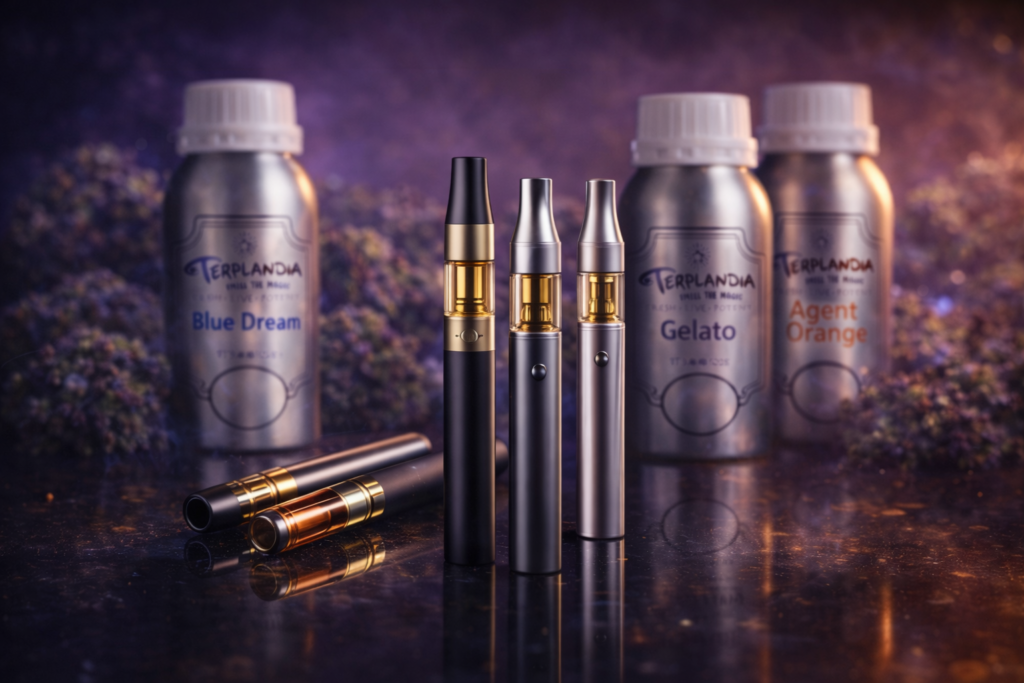
Vape formulations place the most stress on terpene chemistry. Heat, atomization, and repeated thermal cycling amplify any imbalance in the profile.
Reconstructed or isolate-heavy terpene blends often smell accurate before use, yet lose nuance once vaporized. Missing minor compounds tend to flash off unevenly, resulting in sharp top notes or hollow finishes.
Live cannabis-derived terpenes typically perform more predictably in vapes because they retain a broader aromatic spectrum. This supports smoother vapor expression, better flavor persistence, and reduced sensory fatigue over repeated draws.
For brands refining vape performance, terpene sourcing often has a greater impact than hardware changes alone.
Explore our most viral bestsellers among vape formulators across the U.S. in 2026.
Edibles and Gummies

Edibles introduce different challenges. Heat exposure during cooking, interaction with sugars or fats, and extended shelf life all influence terpene stability.
Botanical blends may overpower or flatten flavor when exposed to prolonged processing. In contrast, cannabis-derived terpenes tend to integrate more naturally when used at appropriate concentrations.
Because edibles rely heavily on flavor balance rather than intensity, terpene completeness matters more than headline aroma.
Beverages

Beverages require careful terpene selection due to solubility constraints and sensitivity to oxidation. Not all terpene profiles adapt well to liquid matrices.
Incomplete or aggressively refined profiles often separate or shift aromatically over time. This creates inconsistency that becomes obvious long before expiration dates.
When evaluating terpene inputs for beverages, buyers benefit from reviewing lab data alongside application guidance rather than relying on aroma alone.
Pre-Rolls and Flower-Adjacent Products

For pre-rolls and infused flower products, terpene volatility directly affects aroma retention and burn experience.
Profiles built from isolates may initially smell strong but dissipate quickly once exposed to air. Cannabis-derived live terpenes typically align more closely with natural combustion behavior, preserving aroma through the session rather than front-loading it.
Concentrates and Extracts

Concentrates demand terpene inputs that can integrate without overwhelming the base extract. Overly simplified profiles often clash with existing cannabinoid chemistry.
Because concentrates already carry inherent aromatic complexity, terpene additions should complement rather than dominate.
Matching Input to Intent
Across every category, the same principle applies: terpene selection should reflect how the product is used, not just how it smells in isolation.
Brands exploring strain-specific cannabis-derived terpenes for different applications often find that fewer adjustments are needed downstream. For readers looking to align terpene profiles with specific product formats, Terplandia’s formulation-focused resources provide additional technical context.
Next, we’ll examine the most common mistakes buyers make when sourcing terpenes and why those missteps continue to repeat across the industry.
Common Buyer Mistakes (and Why They Keep Repeating)
Most terpene sourcing mistakes are not caused by inexperience. They persist because the industry has rewarded speed, familiarity, and surface-level signals for too long.
As expectations rise in 2026, these patterns are becoming easier to spot and harder to justify.
Buying by Aroma Alone
Aroma is important, but it is not predictive on its own. Many terpene products smell impressive in isolation and underperform once exposed to heat, storage, or real formulation conditions.
When buyers rely solely on scent testing, they often miss how incomplete chemistry reveals itself later through harshness, flavor collapse, or inconsistent user experience.
Evaluating terpenes alongside lab data and application context leads to more reliable outcomes.
Confusing Strain Names With Chemistry
Strain names carry cultural and commercial weight, but they are not chemistry standards.
Two terpene products labeled with the same strain can differ dramatically in composition depending on source material, extraction method, and post-processing. Without transparency, names become placeholders rather than indicators.
Informed buyers increasingly treat strain labels as starting points, not guarantees.
Assuming Consistency Means Reconstruction
Consistency matters, yet perfect uniformity often signals heavy adjustment rather than careful preservation.
Natural cannabis-derived terpenes show controlled variation because plants respond to environment, harvest timing, and handling. That variability does not undermine quality. It confirms authenticity.
Suppliers who explain expected ranges instead of hiding them tend to support better long-term formulation stability.
Overlooking the Cost of Reformulation
Short-term savings often drive terpene buying decisions. However, reformulation costs rarely stay isolated.
Flavor drift, stability issues, and repeated adjustments consume time across R&D, compliance, and production. Over time, those costs outweigh the initial price difference between inputs.
As the industry responds to tighter documentation standards and more informed consumers, these inefficiencies become harder to absorb quietly.
Choosing Suppliers Without Process Visibility
In a market shaped by AI-driven discovery and increasing regulatory awareness, suppliers are judged not just by what they sell, but by what they can explain.
Process transparency, third-party testing, and clear sourcing documentation now influence how brands are evaluated by partners, platforms, and even search systems.
Buyers who prioritize visibility over slogans tend to encounter fewer surprises downstream.
Buying for the Market You’re Leaving
The cannabis market of 2026 is not the one that rewarded quick wins and vague claims.
With cultural shifts toward experience-driven consumption, heightened scrutiny on inputs, and smarter research tools shaping buying behavior, terpene sourcing has become a strategic decision.
Brands that invest in understanding what they are buying position themselves for consistency, credibility, and resilience.
For readers looking to continue exploring how cannabis-derived live terpenes fit into modern formulation and compliance expectations, Terplandia’s educational library offers deeper dives into extraction, lab interpretation, and application behavior.
Ultimately, buying real terpenes is less about finding the loudest profile and more about choosing inputs that hold up — chemically, operationally, and over time.
Frequently Asked Questions About Buying Real Terpenes
What are real terpenes?
Real terpenes are aromatic compounds captured directly from cannabis without reconstruction, botanical substitutes, or isolate-based blending. They preserve the plant’s natural chemical complexity.
Are cannabis-derived terpenes better than botanical terpenes?
Cannabis-derived terpenes typically deliver more authentic flavor and consistent performance because they retain minor compounds that botanical blends cannot replicate.
What is the difference between live terpenes and regular CDTs?
Live terpenes are extracted from fresh or freshly processed cannabis, preserving volatile compounds that are often lost during curing or extended storage.
How can I tell if a terpene profile is reconstructed?
Perfectly uniform ratios, missing minor compounds, and limited COA detail often indicate reconstruction rather than true plant-derived preservation.
Do real terpenes matter for edibles and beverages?
Yes. Complete terpene profiles integrate more smoothly and remain stable longer, especially in products exposed to heat, fats, or extended shelf life.