
Simplifying terpenes without losing flavor has become a priority for cannabis brands that have outgrown early formulation shortcuts. As products mature and consumer expectations sharpen, many teams are realizing that their terpene systems are doing more work than they need to.
Over time, complexity crept in for understandable reasons. Strain matching mattered. Loud aromas sold. Botanical blends promised flexibility. Each decision made sense in isolation. Together, they often created formulations that were harder to scale, harder to stabilize, and harder to explain.
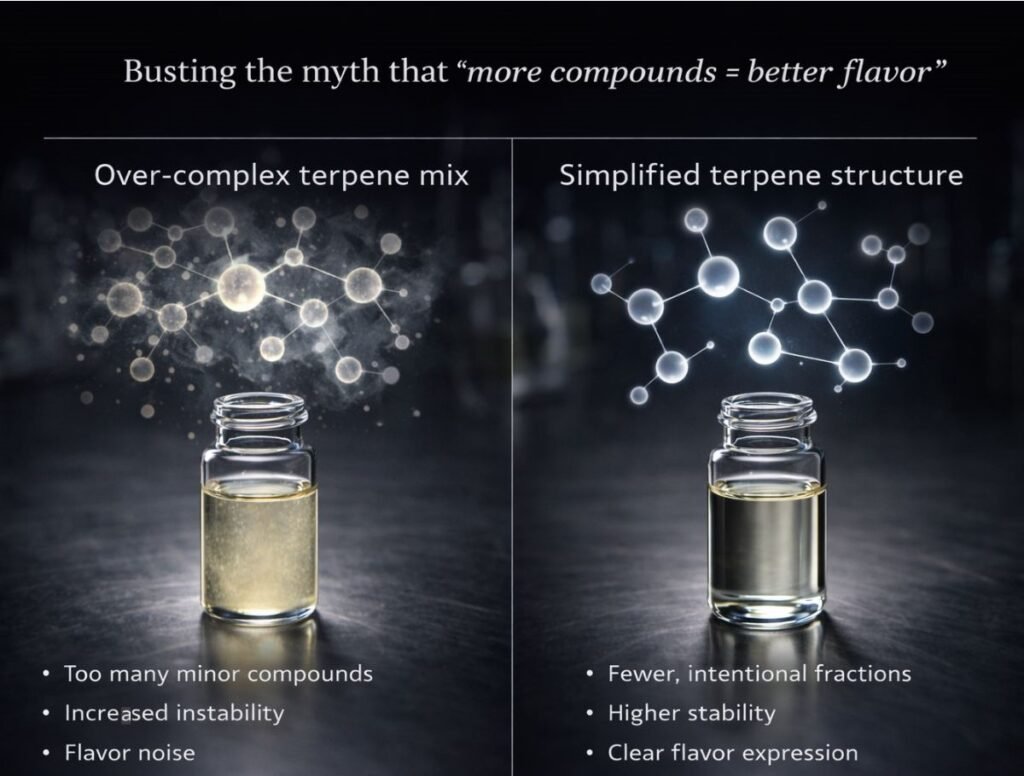
This guide looks at how terpene systems became overbuilt, why more ingredients do not automatically translate to better flavor, and how simplification can improve clarity, consistency, and overall experience without flattening the profile.
How Terpene Formulations Became Overcomplicated
Complexity Entered as a Solution, Not a Goal
Most terpene systems did not start out complex by design. Complexity entered gradually as brands solved short-term problems.
A strain needed more citrus character, so an extra top note was added. A blend felt thin under heat, so another compound was layered in to compensate. Flavor faded too quickly, so dosage increased rather than structure being revisited.
Each adjustment addressed an immediate issue. Over time, those fixes stacked on top of one another.
Strain Naming Created Pressure to Overbuild
As strain-driven marketing became standard, terpene formulations shifted from functional flavor systems to name-matching exercises. Instead of asking how a profile should behave, teams asked how closely it resembled a reference aroma.
Botanical blends made this easier in the short term. They allowed formulators to chase specific notes quickly, even if those notes did not naturally coexist in cannabis. The result was often a crowded aromatic profile that smelled convincing in isolation but behaved unpredictably in finished products.
More Ingredients Became a Stand-In for Precision
In many formulations, ingredient count increased as a substitute for structural alignment. Rather than refining volatility balance or interaction with cannabinoids, teams added more terpenes to fill perceived gaps.
This approach can create intensity, but it rarely creates coherence. Top notes compete instead of leading. Mid notes blur together. Base notes struggle to anchor the profile.
What looks sophisticated on paper often feels noisy in practice.
Botanical Shortcuts Encouraged Layering
Botanical terpenes played a major role in this trend. Because they are often isolated from unrelated plants, they arrive without the contextual balance found in cannabis-derived profiles.
To compensate, formulators layer multiple botanical compounds to recreate something that resembles a cannabis aroma. Each added layer increases complexity, but not necessarily realism.
As formulations evolve, those layers become difficult to remove without destabilizing the profile, even when the original reason for adding them no longer applies.
Scaling Exposed the Cost of Overbuilt Systems
Complex terpene systems tend to work best in controlled, small-scale environments. As brands scale, their weaknesses surface.
Batch-to-batch variation increases. Heat sensitivity becomes harder to manage. Small deviations in raw material quality create noticeable flavor swings. QA teams spend more time explaining differences than preventing them.
At that stage, simplification stops being an aesthetic choice and becomes a practical necessity.
Why More Terpenes Don’t Automatically Mean Better Flavor

Intensity Is Not the Same as Flavor Quality
One of the most common assumptions in terpene formulation is that adding more compounds will increase flavor depth. In reality, it usually increases intensity, not quality.
High-intensity aroma can feel impressive at first smell, especially during early evaluation. However, intensity does not guarantee balance, progression, or staying power. Many overbuilt terpene systems deliver a loud opening and very little after that.
Consumers notice this quickly. The first inhale excites. The second feels flatter. By the end of the session, the flavor has either faded or collapsed into something indistinct.
Flavor Masking Replaces Flavor Clarity
As terpene counts increase, masking becomes more common. Strong top notes cover weaknesses elsewhere in the profile instead of fixing them. Citrus, pine, or sweet aromatics dominate because they are easy to recognize and hard to ignore.
This masking creates the illusion of complexity while reducing clarity. Individual notes lose definition. The profile smells busy rather than intentional.
In finished products, this often translates to inconsistency. Small changes in temperature, airflow, or dosage can shift which notes dominate, making the experience feel unpredictable.
Note Collision Flattens the Experience
Terpenes do not exist in isolation once they enter a formulation. They interact with one another, with cannabinoids, and with heat. When too many compounds occupy the same volatility range, they compete rather than complement.
This competition creates what many formulators describe as “aromatic noise.” Instead of a clear progression from top to base, everything arrives at once. The palate has nothing to follow.
Ironically, reducing ingredient count often restores movement and structure to the flavor.
Top-Heavy Blends Fade Faster
Overbuilt terpene systems tend to rely heavily on volatile top notes to make an immediate impression. These compounds evaporate quickly, especially under heat.
Once they burn off, little remains to support the experience. The flavor thins out, leaving behind either a generic sweetness or a muted vegetal note.
Balanced systems distribute expression across volatility ranges. When fewer terpenes are used intentionally, mid and base notes can carry the experience instead of being overshadowed.
Consistency Suffers as Complexity Grows
From a production standpoint, complex terpene systems introduce more variables. Each additional compound increases the chance of variation across batches, suppliers, or storage conditions.
As formulations scale, those small differences compound. What smelled balanced during development starts drifting in production.
Simpler systems reduce those variables. They are easier to replicate, easier to troubleshoot, and easier to maintain over time.
Simplification Reveals, It Doesn’t Remove
When brands simplify terpene systems thoughtfully, they rarely lose flavor. They lose clutter.
Clearer note separation, smoother progression, and more reliable carry-through replace raw intensity. The result feels more intentional and often more expressive, even with fewer ingredients.
Flavor does not disappear when complexity is removed. It becomes easier to recognize.
Structural Complexity vs Ingredient Clutter

Why All Complexity Is Not the Same
Not all complexity improves flavor. The key distinction many formulations miss is the difference between structural complexity and ingredient clutter.
Structural complexity refers to how a flavor unfolds over time. It shows up as clear progression, balance across volatility ranges, and a sense of cohesion between aroma and taste. Ingredient clutter, by contrast, simply describes how many compounds are present.
When these two ideas get conflated, formulations drift toward excess.
Structure Lives in Balance, Not Count
A structurally sound terpene system relies on balance between top, mid, and base notes. Each layer has a role. Top notes introduce. Mid notes define character. Base notes anchor the experience.
When too many terpenes occupy the same layer, especially the top, they compete for attention. Instead of clarity, the result is compression. Everything arrives at once, and nothing stands out.
Reducing ingredient count often restores separation between layers, allowing the structure to do its job.
Volatility Alignment Creates Movement
Terpenes express themselves based on how quickly they volatilize. When volatility ranges align, flavor feels intentional. When they collide, flavor feels chaotic.
Overbuilt systems frequently ignore this dynamic. Compounds are added based on aroma alone, without considering how they behave under heat or over time.
Simpler systems force alignment. Each terpene must earn its place by contributing to the progression, not just the opening impression.
Interaction With Cannabinoids Matters More Than Novelty
Flavor does not exist independently from cannabinoids. Terpenes interact with cannabinoids during vaporization, digestion, and perception.
Ingredient clutter increases the risk of misalignment. Some terpenes overpower. Others disappear. The overall experience feels disjointed.
Structurally complex systems account for these interactions. They prioritize compatibility over novelty, which reduces the need for corrective layering.
Simplification Sharpens Identity
One concern brands often raise is that simplifying terpene systems will erase strain identity. In practice, the opposite tends to happen.
When clutter is removed, defining characteristics become easier to perceive. Instead of guessing which note represents the strain, consumers experience a clearer, more recognizable profile.
Identity strengthens when structure replaces noise.
Clarity Scales Better Than Complexity
Structural complexity holds up as products scale. Ingredient clutter does not.
Clear systems tolerate small variations in raw material quality, processing, and storage. Crowded systems amplify those variations.
Brands that invest in structure rather than stacking find it easier to maintain consistency as volume increases.
How Cannabis-Derived Terpenes Enable Simpler Formulations

Natural Completeness Reduces the Need for Layering
Cannabis-derived terpenes arrive with an inherent balance that many botanical systems lack. Because they originate from the cannabis plant itself, their aromatic profiles already contain the relationships between top, mid, and base notes that formulators often try to recreate artificially.
This natural completeness reduces the need for corrective layering. Instead of stacking multiple compounds to simulate depth, formulators can work with fewer inputs that already express cohesion.
Simplification becomes a design choice rather than a compromise.
Lower Inclusion Rates Encourage Precision
Another factor that enables simplification is dosage efficiency. Cannabis-derived terpene profiles often deliver full expression at lower inclusion rates compared to aggressive botanical blends.
Lower dosage forces intentionality. Each terpene has a clearer role, and unnecessary additions become easier to identify and remove.
As a result, formulations tend to feel cleaner, not quieter.
Behavior Under Heat Is Easier to Predict
Heat exposes the weaknesses of cluttered terpene systems quickly. Compounds volatilize at different rates, compete for dominance, or disappear entirely, leaving gaps in the experience.
Cannabis-derived terpenes generally follow evaporation patterns that align more closely with cannabinoids. This alignment produces smoother flavor carry-through and reduces the need to over-engineer for heat loss.
When behavior becomes predictable, complexity becomes optional.
Fewer Inputs Mean Fewer Variables
Every additional terpene introduces variability. Differences in supplier batches, storage conditions, and handling all compound as ingredient counts rise.
Simpler systems reduce those variables. They are easier to replicate, easier to QA, and easier to troubleshoot when something drifts.
This operational clarity often matters more than marginal aroma gains.
Simplification Improves Consistency Across Products
Brands that simplify terpene systems frequently notice improved consistency across SKUs. When fewer inputs define the aromatic backbone, it becomes easier to adapt profiles across vapes, edibles, and infused products without rebuilding each one independently.
This consistency strengthens brand identity. Products feel related rather than fragmented, even when formats differ.
Simplification, in this sense, supports coherence rather than limiting creativity.
What Simplification Looks Like Across Product Categories

Vapes: Fewer Terpenes, Better Carry-Through
In vape formulations, complexity often creeps in as teams try to compensate for heat-related flavor loss. Additional top notes get layered in to preserve impact, which can make the opening impressive but the session inconsistent.
Simplification usually starts by reducing top-heavy compounds and strengthening mid and base note presence. With fewer terpenes competing for volatility, flavor carries more evenly from first draw to last.
Many brands find that simplifying vape terpene systems improves smoothness and reduces harshness without sacrificing character.
Edibles: Clarity Over Coverage
Edible formulations often rely on terpene stacking to mask off-notes from cannabinoids or sweeteners. While this can work initially, it frequently leads to muddled flavor as the product sits or warms.
Simplified systems focus on compatibility rather than coverage. Fewer terpenes that align with the base flavor profile tend to integrate more cleanly, creating a more cohesive taste rather than an aromatic overlay.
The result feels intentional instead of layered.
Beverages: Stability Through Restraint
Beverage applications magnify the downsides of complexity. Water solubility, emulsification, and shelf stability all introduce stress points that crowded terpene systems struggle to withstand.
Simplification here often means removing volatile compounds that contribute little beyond initial aroma. Cleaner terpene systems emulsify more consistently and hold their character longer over time.
Restraint, in beverages, usually translates directly to stability.
Pre-Roll Infusion: Consistency Over Intensity
Pre-roll infusion presents a different challenge. Combustion exaggerates imbalances in terpene systems, especially those built around volatile top notes.
Simplified profiles tend to burn more evenly and deliver a clearer aromatic signature throughout the session. Instead of peaking early and fading, the experience stays consistent from start to finish.
Here, simplification improves reliability more than aroma strength.
Across Categories: Fewer Inputs, Clearer Identity
Across all product types, the same pattern emerges. Simplified terpene systems behave more predictably, adapt more easily, and communicate flavor more clearly.
Rather than feeling stripped down, these formulations feel focused. Identity becomes easier to maintain across formats, and small adjustments become more impactful.
Simplification does not erase differentiation. It sharpens it.
Common Mistakes When Simplifying Terpenes

Removing Structure Instead of Removing Clutter
The most common mistake brands make when simplifying terpene systems is cutting ingredients indiscriminately. Removing terpenes without understanding their role often flattens the profile instead of clarifying it.
Simplification works best when teams preserve structural balance. Top, mid, and base notes still need to exist. The goal is to remove redundancy, not function.
Overcorrecting Dosage
Another frequent misstep is reducing terpene dosage too aggressively. In an effort to avoid loudness, some formulations swing too far toward neutrality.
Simpler systems still require adequate concentration to express character. Precision matters more than restraint alone.
Chasing Subtlety Instead of Balance
Subtle does not always mean better. When simplification becomes synonymous with quietness, profiles can lose presence.
Balance, not minimalism, should guide decisions. A simplified terpene system can still feel expressive, distinctive, and memorable.
Ignoring Consumer Perception
Internal evaluations sometimes prioritize technical cleanliness over experience. If simplification removes the cues consumers associate with quality, the change may miss the mark.
Successful transitions pair sensory data with real-world feedback. Simplification should enhance recognition, not erase it.
Treating Simplification as a One-Time Event
Simplifying terpene systems is rarely a single decision. It is an iterative process that evolves as products scale, hardware changes, and consumer expectations shift.
Brands that revisit and refine over time maintain clarity without drifting back into complexity.
Simplicity as a Competitive Advantage
In a maturing cannabis market, simplicity signals confidence. It suggests that a product does not rely on excess to make its point.
Cleaner terpene systems scale more reliably, communicate more clearly, and age better as scrutiny increases. They reduce operational friction while improving flavor coherence.
Simplifying terpenes does not mean giving up depth. It means letting structure speak louder than noise. That is precisely what Terplandia specializes in.
Frequently Asked Questions About Simplifying Terpenes
Simplifying terpenes means reducing unnecessary ingredients while preserving flavor structure, balance, and progression. The goal is not to remove character, but to eliminate redundancy and aromatic noise that can flatten or destabilize flavor.
Yes. Flavor complexity comes from structure and balance, not ingredient count. Well-aligned terpene systems with fewer components often feel more dynamic and expressive than crowded blends.
No. Simplification usually changes how flavor is expressed, not how strong it feels. Many brands report smoother, clearer flavor carry-through rather than a drop in intensity.
Simplification benefits products at all price points. Cleaner terpene systems scale more reliably, reduce batch variation, and simplify quality control, which matters across categories.
Terpenes that duplicate the same volatility range or serve only to mask imbalance are often candidates for removal. Sensory evaluation and heat testing usually reveal which ingredients add value and which add noise.
Yes. Fewer inputs reduce variability from sourcing, handling, and storage. Simplified terpene systems are easier to replicate and maintain over time.
Yes. Simplified systems adapt more easily across vapes, edibles, beverages, and infused products because they rely on structure rather than format-specific workarounds.
No. Simplification is an ongoing process. As products scale, hardware evolves, and consumer expectations shift, terpene systems benefit from periodic refinement to avoid complexity creep.