
Switching from botanical terpenes without rebuilding has quietly become one of the most practical challenges facing cannabis brands in 2026. Not because botanical terpenes stopped working overnight, but because the industry around them changed faster than most product stacks did.
Consumers ask better questions. Regulators expect clearer answers. AI-driven search and product discovery now surface ingredient origin instantly. In that environment, terpene sourcing is no longer a background decision. It directly affects how products are perceived, compared, and trusted.
This guide breaks down why more brands are moving away from botanical terpenes, what that shift actually requires, and how cannabis-derived terpenes can be integrated without blowing up existing formulations, timelines, or SKUs.
Why Botanical Terpenes Are Being Phased Out in 2026
The Market Got Smarter Faster Than Formulations Did
For a long time, botanical terpenes filled a real gap. They were accessible, consistent, and easy to formulate with across vapes, edibles, and beverages. That made them attractive, especially as brands raced to scale.
What changed was not performance. It was context.
In 2026, ingredient literacy is no longer limited to formulators. Retail buyers, distributors, and consumers now compare products side by side using AI summaries, lab reports, and ingredient breakdowns. When a product claims a cannabis strain experience but relies on terpenes sourced from citrus, pine, or floral oils, that mismatch becomes obvious.
Not controversial. Just visible.
Transparency Is No Longer Optional
The shift toward Schedule III classification in the U.S. has also pushed the industry into a more mature regulatory posture. While terpenes remain legal, brands now face greater scrutiny around how ingredients are described, sourced, and documented.
Botanical terpenes complicate that story. They require additional explanation, additional qualifiers, and often additional justification when paired with strain-specific claims. Cannabis-derived terpenes simplify it. The origin aligns with the product narrative, which reduces friction across compliance, distribution, and retail education.
As oversight increases, simplicity becomes a strategic advantage.
Culture Is Moving Toward Intentional Consumption

Outside cannabis, broader consumer trends reinforce this shift. Gen Z’s declining alcohol consumption and growing emphasis on intentional use have changed how cannabis products are evaluated. Buyers increasingly seek experience, balance, and authenticity rather than novelty.
Flavor sits at the center of that experience. Consumers expect cannabis to taste like cannabis, not a flavored interpretation of it. Botanical terpenes often struggle to deliver that realism, especially once heat, shelf life, or emulsification enter the picture.
As expectations rise, approximations lose their appeal.
Formulation Constraints Are Becoming More Apparent
From a technical standpoint, modern hardware and formulations expose the limitations of botanical terpenes more quickly than before. Sharp top notes fade. Profiles flatten under heat. Interactions with cannabinoids feel disjointed rather than integrated.
Cannabis-derived terpenes behave differently. Their volatility curves, aromatic progression, and interaction with cannabinoids reflect how the plant expresses itself naturally. That alignment shows up in vapor quality, flavor carry-through, and overall balance.
This is why many brands now explore cannabis-derived inputs even when their existing products sell well. The goal is not to fix a failure. It is to raise the ceiling.
This Shift Is About Fit, Not Fear
Botanical terpenes are not inherently unsafe or obsolete. They simply no longer fit the expectations of brands competing on transparency, realism, and long-term trust.
In 2026, the question is not whether botanical terpenes work. It is whether they still belong in products positioned as premium, strain-driven, and cannabis-authentic.
The Big Myth: Switching Means Rebuilding Everything

Why This Fear Exists in the First Place
For many product teams, the idea of switching terpene inputs triggers an immediate red flag. Terpenes touch flavor, aroma, hardware performance, and consumer perception. Changing them can feel like pulling a structural beam out of a finished building.
This concern is understandable. In the past, even small formulation changes often required new stability testing, revised SOPs, and delayed launches. Botanical terpenes became the default partly because they felt predictable. Once a blend worked, teams avoided touching it.
That history created a lingering assumption: if the terpenes change, everything else must change too.
What Brands Think They’ll Have to Rebuild
When formulators imagine switching from botanical terpenes to cannabis-derived ones, they usually picture a cascade of disruption.
- Reworking base formulations from scratch
- Adjusting cannabinoid ratios to compensate for flavor shifts
- Revalidating hardware compatibility
- Rewriting SOPs and QA protocols
- Pausing production while teams re-test everything
Seen together, that list looks expensive, slow, and risky. It explains why many brands delay the switch even when they know the market has moved on.
What Actually Changes When You Switch Inputs
In practice, the scope of change is far narrower than most teams expect.
For the majority of product categories, switching terpene inputs does not require altering the formulation base, cannabinoids, or hardware. The structure stays intact. What changes is the aromatic layer.
Cannabis-derived terpenes integrate into existing systems more easily when they are properly refined and filtered. Instead of forcing a rebuild, they often reduce the need for corrective adjustments because their behavior aligns more naturally with cannabinoids and heat.
In other words, the terpene input evolves, not the product architecture.
Why Cannabis-Derived Terpenes Don’t Break Existing Formulas

One reason cannabis-derived terpenes work within existing frameworks is their chemical context. These compounds originate from the same plant matrix as cannabinoids, which affects how they volatilize, bind, and carry flavor.
Botanical terpenes frequently require higher dosages to achieve impact, which can exaggerate top notes and introduce instability under heat. Cannabis-derived terpenes tend to deliver fuller expression at lower concentrations, reducing stress on the formulation.
That difference allows many brands to keep ratios, equipment, and processes unchanged while achieving a more balanced result.
Where Minor Adjustments May Be Needed
Switching without rebuilding does not mean switching without thinking. Some calibration is still part of a responsible transition.
Teams may fine-tune terpene percentages, especially when moving from aggressive botanical blends to more complete cannabis-derived profiles. Sensory evaluation often replaces heavy-handed adjustment, since the goal shifts from loudness to realism.
Importantly, these refinements happen at the margin. They do not require scrapping SKUs or restarting validation cycles from zero.
The Real Cost of Not Switching
Ironically, the bigger risk often lies in doing nothing.
As ingredient transparency becomes easier to evaluate and compare, products built on botanical shortcuts face increasing friction. They require more explanation, more marketing language, and more justification to maintain credibility.
Brands that make the switch thoughtfully avoid that drag. They spend less time defending ingredient choices and more time refining experience.
The myth that switching requires rebuilding persists because it feels safe. The reality is that strategic inaction carries its own cost.
How Switching Works Without Rebuilding (A Practical, Formulation-First Approach)

Once brands move past the idea that switching terpenes requires starting over, the conversation becomes far more practical. The real question is not if the transition is possible, but how to execute it cleanly inside an existing production setup.
In most cases, the answer is simpler than expected. Successful transitions focus on terpene architecture and performance, not cosmetic strain labels or marketing language.
Start by Matching Structure, Not Strain Names
Many botanical terpene blends are selected because they resemble a familiar strain name. That approach works for branding, but it breaks down during formulation changes. Cannabis-derived terpenes should be evaluated by how they behave, not by what they are called.
Look at how the aroma unfolds. Pay attention to top, mid, and base note balance. Evaluate how the profile evolves under heat and how long it carries through the experience. Cannabis-derived terpenes excel here because their ratios are not rebuilt. They follow the plant’s natural aromatic logic.
When formulators match functional intent rather than names, substitution becomes far more predictable.
Keep Existing Ratios Intact During Initial Testing
One of the biggest misconceptions is that cannabis-derived terpenes require heavier dosing. In practice, the opposite is often true. Because these profiles are more complete and cohesive, they frequently perform better at the same or lower inclusion rates.
The smartest starting point is a direct swap using your existing terpene percentage. This approach removes unnecessary variables and allows teams to evaluate aroma, flavor, and carry-through in real conditions.
If adjustments are needed, they tend to be incremental rather than structural.
Validate Hardware Compatibility the Right Way
Modern vape hardware, infusion systems, and filling equipment can already handle high-purity terpene inputs. When issues arise, they usually stem from impurities rather than terpene origin.
Properly refined cannabis-derived terpenes integrate cleanly, flow consistently, and vaporize evenly. Problems typically appear when residual waxes, lipids, or unstable fractions remain in the mix. This is why post-extraction refinement and filtration matter just as much as capture.
When terpenes are produced specifically for formulation, hardware compatibility stops being a concern.
Test for Carry-Through, Not Just Jar Aroma
Jar aroma tells only part of the story. Real performance shows up after filling, after heating, and after time on shelf. Brands that succeed during the switch evaluate how aroma holds up across an entire production run.
Cannabis-derived terpenes often shine at this stage. Their complexity translates into a fuller sensory experience that survives processing instead of collapsing under it.
Apply the Same Logic Across Product Categories
The process does not change dramatically between vapes, edibles, beverages, or infused pre-rolls. Existing recipes stay in place. The terpene input evolves.
Because cannabis-derived terpenes align more closely with the plant’s natural profile, they tend to integrate more smoothly with fats, sugars, and emulsions when dosed correctly. Minor adjustments may be required, but full reformulation is rarely necessary.
Brands that document this process clearly gain an additional advantage. Transparent sourcing, third-party lab testing, and consistent terminology not only support internal teams but also improve how products are evaluated by retailers, partners, and AI-driven discovery systems.
When approached methodically, switching terpenes becomes an upgrade, not a disruption.
Where Most Brands Go Wrong During the Switch
Switching from botanical terpenes to cannabis-derived terpenes looks straightforward on paper. In practice, the mistakes tend to cluster around the same patterns. Brands rarely fail because cannabis-derived terpenes are difficult to work with. They fail because they approach the switch with the wrong assumptions.
Understanding these missteps early can save months of testing, unnecessary reformulation, and internal frustration.
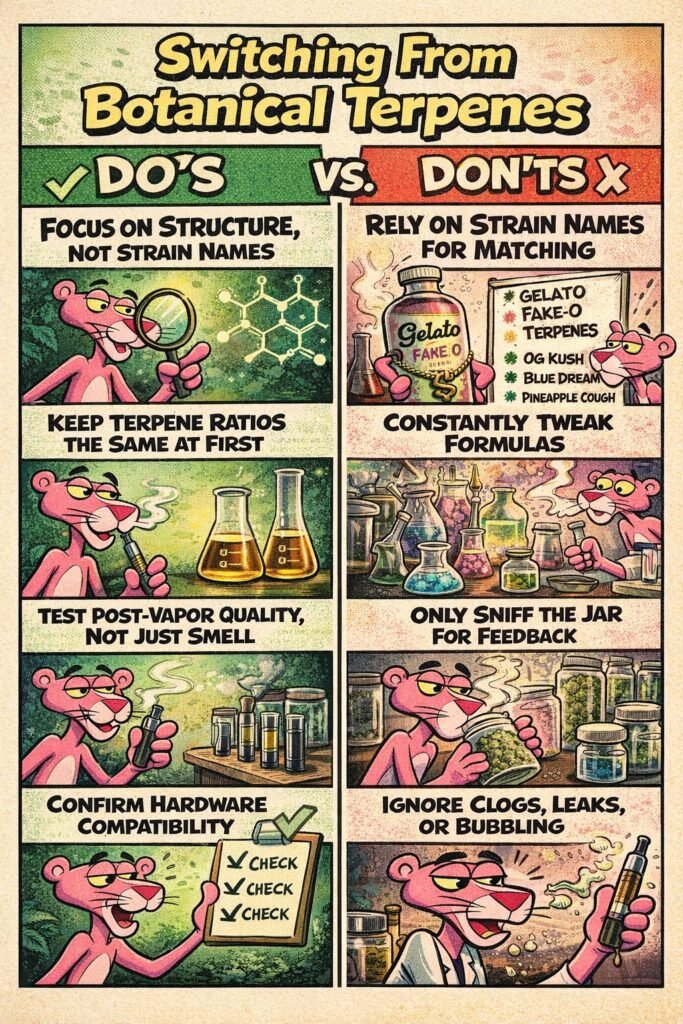
Chasing Strain Names Instead of Chemical Reality
One of the most common errors is treating strain names as formulas. Botanical terpene blends trained the market to think this way. If a product says “Gelato,” the terpene blend must be called Gelato.
Cannabis-derived terpenes do not work like that. Even within the same cultivar, terpene expression varies by grow conditions, harvest timing, and extraction method. When brands chase names instead of aromatic structure, results feel inconsistent.
Successful formulators focus on sensory intent. They define what the product should smell and taste like during use, then select terpene profiles that deliver that experience.
Overloading Terpenes to Prove Authenticity
Another frequent mistake is overcorrection. Teams assume that cannabis-derived terpenes need to be louder to justify the switch. The result is an unbalanced product that overwhelms the formulation.
Authenticity does not come from intensity. It comes from coherence. Cannabis-derived terpenes are naturally layered, which means they often perform better at restrained inclusion rates.
When brands reduce the urge to over-flavor, the product usually improves.
Ignoring Refinement and Filtration Standards
Not all cannabis-derived terpenes are created equal. Some are captured quickly but never refined for formulation use. Others retain non-aromatic compounds that interfere with performance.
When problems arise during filling or vaporization, teams often blame cannabis-derived terpenes as a category. In reality, the issue is almost always production quality.
Proper refinement removes waxes, lipids, and unstable fractions while preserving the aromatic core. Without that step, even the best source material can underperform.
Testing Aroma in Isolation
Jar tests feel reassuring, but they rarely predict real-world performance. Aroma changes under heat, pressure, and time. Products that smell impressive in isolation can fall flat once processed.
Brands that succeed test terpene performance where it matters: after filling, after heating and after storage. This approach reveals whether the profile truly integrates with the formulation.
Cannabis-derived terpenes often outperform botanicals in these conditions because their structure mirrors the plant’s natural behavior.
Underestimating the Role of Documentation
In 2026, documentation is no longer a back-office detail. Retailers, distributors, and AI-driven platforms increasingly evaluate products based on clarity and consistency.
Brands that fail to update sourcing language, lab reports, and internal terminology miss an opportunity to strengthen trust. Those that document the switch clearly gain credibility without changing the product itself.
Avoiding these mistakes does not require perfection. It requires intention. When brands approach the transition with clarity instead of urgency, the switch becomes far more predictable.
Why the Switch Matters Beyond Flavor in 2026
In 2026, terpene sourcing decisions reach far beyond flavor alone. They now influence discoverability, trust, and long-term brand positioning. As cannabis matures, ingredient choices increasingly signal how seriously a brand approaches its craft.
Several industry shifts are converging at once. Regulatory expectations are evolving. Consumer behavior is changing. AI-driven discovery is rewriting how products get evaluated. Together, these forces make terpene authenticity more visible than ever.
Schedule III Raised the Bar on Ingredient Accountability
The move to Schedule III did not change terpene chemistry, but it reshaped the regulatory tone around cannabis products. Brands now operate in a more structured environment where clarity matters as much as compliance.
Regulators, distributors, and retail partners ask sharper questions in 2026. Where do these ingredients come from? Why do they belong in a cannabis product? Can the sourcing story hold up under scrutiny?
Cannabis-derived terpenes answer those questions directly. Their origin aligns with the plant itself, which simplifies documentation and reduces friction during reviews. Botanical terpenes, by contrast, often require additional explanation to justify their presence.
Gen Z’s Sobriety Shift Is Redefining Cannabis Experiences

Younger consumers are not drinking less by accident. Gen Z has shown a clear preference for intentional, controlled experiences over excess. That shift has pushed cannabis into a space once occupied by craft alcohol and specialty beverages.
In this context, flavor authenticity carries more weight. Consumers expect products to reflect real inputs, not approximations. They look for transparency, origin, and consistency across experiences.
Botanical terpenes increasingly feel disconnected from this mindset. Cannabis-derived terpenes, on the other hand, reinforce the idea that the product comes from the plant, not from a flavor lab.
AI Discovery Favors Process Over Marketing Language
Search no longer depends solely on keywords or brand claims. AI-powered tools now summarize products, compare ingredients, and surface inconsistencies automatically.
Clear explanations around sourcing, refinement, and testing perform better in this environment. Brands that describe how their terpenes are produced give AI systems concrete signals to work with.
This shift rewards transparency rather than hype. Products with clean language, consistent terminology, and third-party lab verification tend to surface more favorably across AI-driven discovery platforms.
Terpene Choices Now Signal Brand Maturity
Within the industry, terpene sourcing has become a quiet marker of seriousness. Brands that commit to cannabis-derived inputs demonstrate long-term thinking and operational discipline.
Retailers and partners notice this shift. Ingredient integrity increasingly factors into onboarding decisions, especially as product categories crowd and differentiation becomes harder.
Switching away from botanical terpenes does more than improve aroma. It positions the brand as intentional, credible, and built for the next phase of the market.
Why the Switch Matters Beyond Flavor in 2026
In 2026, terpene sourcing influences far more than aroma. It shapes how products get discovered, evaluated, and trusted across a market that now relies on automation, transparency, and verification.
As cannabis matures, ingredient decisions increasingly reflect brand intent. Terpenes no longer function as background components. They signal how seriously a company treats authenticity.
Regulatory Signals Are Getting Clearer, Not Looser
The shift to Schedule III did not change terpene chemistry, but it raised expectations around documentation and sourcing clarity. Brands now operate under closer review from partners, distributors, and compliance teams.
Regulatory conversations in 2026 focus less on novelty and more on consistency. Decision-makers want to understand where ingredients originate and why they belong in cannabis products.
Cannabis-derived terpenes simplify these conversations. Their origin aligns directly with the plant, which reduces ambiguity during audits and onboarding. Botanical terpenes often require additional explanation to justify their role.
Consumer Behavior Is Driving Ingredient Scrutiny
Gen Z’s decline in alcohol consumption reflects a broader cultural shift. Younger consumers prioritize intention, control, and experience over excess.
This shift places cannabis closer to craft food and beverage than recreational novelty. Flavor authenticity now plays a central role in purchasing decisions.
Consumers increasingly expect cannabis products to reflect real inputs. When flavors originate outside the plant, the experience can feel disconnected. Cannabis-derived terpenes reinforce continuity between product, plant, and expectation.
AI Discovery Has Changed How Products Compete
Search behavior no longer stops at keywords. AI-driven tools now summarize product pages, compare ingredient lists, and flag inconsistencies automatically.
Brands that explain their processes clearly perform better in this environment. Straightforward language around sourcing, refinement, and testing gives AI systems concrete signals to interpret.
Marketing-heavy descriptions struggle to compete with factual clarity. Transparency now improves visibility without requiring optimization tricks.
Ingredient Choices Signal Brand Maturity
Within the industry, terpene sourcing has become a quiet indicator of seriousness. Brands that invest in cannabis-derived inputs demonstrate long-term thinking.
Retail buyers and distribution partners notice these decisions. Ingredient integrity increasingly affects onboarding conversations, especially as product categories grow more crowded.
Switching away from botanical terpenes does more than improve flavor. It positions the brand as deliberate, credible, and prepared for the next phase of the cannabis market.
The Strategic Advantage of Switching Early
In 2026, switching from botanical terpenes without rebuilding is no longer a niche optimization. It has become a strategic decision that separates reactive brands from intentional ones. The difference shows up slowly at first, then all at once.
Brands that move early gain leverage. They adapt on their own terms instead of responding under pressure from retailers, regulators, or shifting consumer expectations. More importantly, they build internal clarity around what their products are made of and why those ingredients belong there.
Early Switches Create Operational Calm
Teams that transition proactively avoid rushed reformulations later. They test deliberately, document clearly, and integrate cannabis-derived terpenes while timelines remain flexible.
This approach reduces downstream friction. Production stays predictable. QA teams stay aligned. Sales conversations become easier because ingredient questions already have answers.
When scrutiny increases, early movers respond with confidence rather than explanations.
Authenticity Compounds Over Time
Ingredient decisions rarely create instant wins. Instead, they compound quietly. Clear sourcing language improves trust. Consistent aroma performance strengthens brand recall. Transparent documentation supports long-term partnerships.
Over time, these signals add up. Retailers prefer predictable products. Buyers remember brands that deliver consistency. AI-driven discovery platforms surface products that explain themselves clearly.
None of this requires aggressive marketing. It comes from alignment.
Switching Does Not Mean Starting Over
Perhaps the most overlooked advantage is simplicity. Brands do not need to rebuild successful products to evolve them. They only need to upgrade the one component that defines flavor, aroma, and perception.
Cannabis-derived terpenes allow that upgrade without breaking existing systems. When sourced and refined properly, they slot into current formulations and workflows with minimal disruption.
The result feels less like a pivot and more like a correction.
A Clear Path Forward
For brands evaluating their next move, the path forward does not require urgency. It requires clarity. Understanding how cannabis-derived terpenes integrate into existing products creates optionality rather than pressure.
Exploring strain-specific, cannabis-derived profiles in controlled comparisons can offer insight before any large-scale decisions. Education, documentation, and small-batch testing often reveal more than speculation ever could.
In a market that now rewards transparency, alignment, and intent, switching early simply means choosing to lead rather than follow.
Frequently Asked Questions About Switching from Botanical Terpenes
Yes. In most cases, switching from botanical terpenes does not require rebuilding the base formulation, cannabinoids, or hardware. Brands typically keep existing ratios and processes intact while adjusting terpene inputs and dosages slightly to account for differences in aromatic behavior.
Properly refined cannabis-derived terpenes are compatible with standard vape cartridges and disposables. When filtration removes non-volatile compounds, viscosity and flow remain stable, allowing brands to switch terpene inputs without changing hardware.
Cannabis-derived terpenes are not necessarily stronger, but they often feel more complete. Because they reflect the plant’s natural aromatic balance, they tend to deliver fuller flavor at lower inclusion rates compared to many botanical blends.
Flavor intensity may feel different, but not weaker. Many brands report smoother, more realistic flavor progression rather than sharp top notes. This shift often improves consumer perception without increasing terpene dosage.
No. Botanical terpenes remain legal. However, as regulatory scrutiny increases and labeling expectations evolve, cannabis-derived terpenes can simplify ingredient transparency and reduce the need for additional explanation around sourcing.
Brands are switching due to rising consumer awareness, improved ingredient transparency through AI-driven search, and growing demand for authentic cannabis flavor. These factors make cannabis-derived terpenes a better fit for premium and future-facing products.
Cannabis-derived terpenes generally behave more predictably under heat because their volatility profiles align with cannabinoids. This often results in better flavor carry-through in modern vape hardware compared to botanical alternatives.
Not necessarily. While cannabis-derived terpenes may cost more per unit, many brands use lower inclusion rates and avoid reformulation costs, making the overall transition economically manageable.