
How Cannabis Brands Should Run a Terpene Sensory Panel Before Buying
A practical terpene sensory evaluation workflow for cannabis brands comparing CDT samples, source proof, format fit, and retained references before buying volume.
What is a terpene sensory evaluation panel for cannabis brands?
A terpene sensory panel is a controlled way for a cannabis brand to compare aroma samples before buying or scaling a profile. The goal is not to make the room pick the loudest bottle. The goal is to decide which cannabis-derived terpene sample matches the product brief, holds up in the intended format, can be explained with claim-safe sensory language, and can be reordered against a retained reference.
For B2B buyers, that process matters because terpene approval usually touches more than one team. Founders may care about the first nose. R&D has to test the profile in the base. Procurement needs supplier confidence. Production needs a repeatable handoff. Marketing needs language that sounds vivid without drifting into medical, therapeutic, or intoxication claims. A simple sensory panel gives each group a shared record instead of a scattered conversation.
Terplandia recommends treating sensory review as part of supplier due diligence. Start with the source story, compare samples blind, test the finalists in the real product format, and keep one retained reference after approval. If the team needs the sourcing foundation first, Terplandia’s CDT vs BDT terpenes difference guide explains why source language matters before the panel even begins.

Why should the product brief come before the first smell?
The fastest way to waste a sample panel is to open every bottle before the team knows what it is trying to build. Terpenes are sensory ingredients, so first impressions are powerful. A bright sample can dominate the room even if it does not fit the finished product. A quieter sample can lose attention even when it would perform better after dilution, heat exposure, storage, or hardware testing.
Write the brief before the samples arrive. Name the product format, the intended audience, the flavor lane, the source expectation, the base material, the launch risk, and the language the brand can safely use. A vape-cart team may need a profile that keeps its top notes without becoming sharp in hardware. A beverage team may care more about clarity, finish, and interaction with acidity or sweetness. A pre-roll team may need an aroma handoff that supports flower instead of covering it.
This keeps the panel honest. The question changes from “which one smells best” to “which one solves the brief.” That distinction is important for Terplandia buyers because a terpene profile is not a fragrance contest. It is an ingredient decision with production, procurement, and brand-positioning consequences.
How do you structure a blind terpene sample review?
A practical panel can be small. Three to seven trained or informed reviewers is usually enough for a cannabis brand to see patterns without turning the meeting into a consumer research project. Give each sample a neutral code, keep the strain or flavor name hidden during the first round, and ask every reviewer to score the same sensory points before group discussion starts.
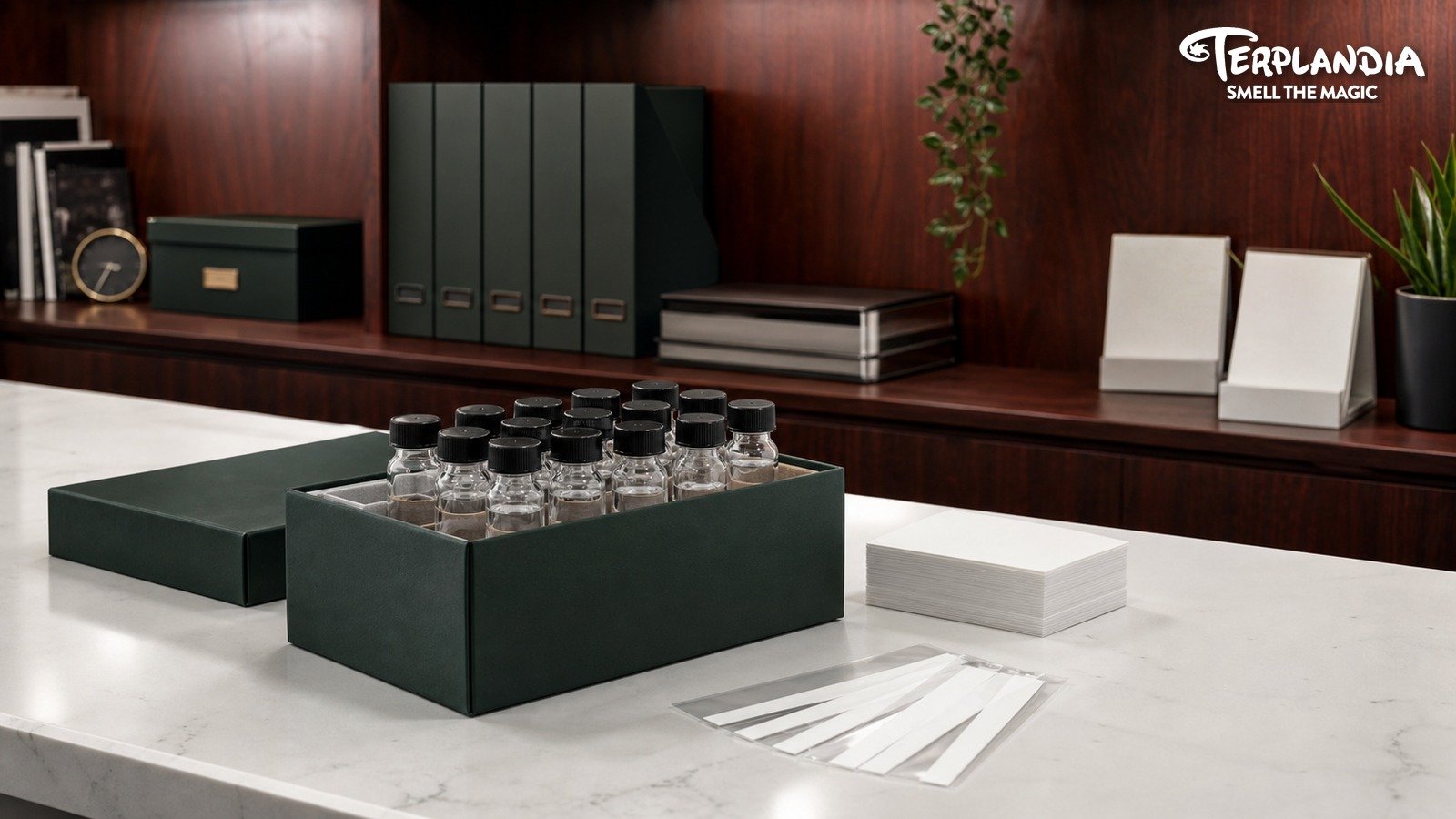
Use scent strips, clean glassware, neutral cards, and short rest intervals. Keep food, perfume, smoke, open flower, and strong cleaning smells away from the review area. If the sample has been shipped, let it equilibrate according to the supplier’s handling guidance before review. Make sure every sample is presented the same way so packaging, label names, or bottle size do not bias the group.
The first round should be descriptive, not persuasive. Ask reviewers to write aroma terms, perceived balance, top-note clarity, body, finish, and any concerns. Save the brand discussion for the second round. After the blind read, reveal the profile names and source context, then decide which finalists deserve format testing.

What should a terpene scorecard measure?
The scorecard should be short enough to use and specific enough to protect the decision. Score first nose, profile accuracy, body, finish, harsh-edge risk, base compatibility, source confidence, format-fit readiness, and reorder confidence. Add one field for claim-safe language so the team records how it would describe the profile publicly without overpromising effects.
Do not let the form become a substitute for judgment. Numbers help the team compare samples, but notes explain why a sample won. A sample that earns a high first-nose score but poor format-fit notes should not move straight to volume. A sample with slightly lower intensity but better balance, source story, and finished-format behavior may be the stronger commercial decision.
For strain-led panels, use related Terplandia strain posts as calibration references. A team can compare candy-fruit profiles against Runtz terpenes CDT, berry-herbal balance against Blue Dream CDT terpenes, or classic gas and pine against OG Kush CDT. The internal references help the panel name differences instead of flattening everything into good or bad.
| Panel step | What to document | Why it matters |
|---|---|---|
| Product brief | Format, flavor lane, source expectation, claim limits | Keeps the team from picking a sample that does not solve the launch problem. |
| Blind aroma review | First nose, body, finish, concerns, reviewer notes | Reduces strain-name bias and captures honest sensory language. |
| Source check | CDT positioning, sample trail, supplier explanation | Connects the sensory win to a defensible purchasing decision. |
| Format test | Base, use range, process, rest time, packaging | Shows whether the profile works in the product, not only in the bottle. |
| Retained reference | Approved sample, date, storage, decision owner | Protects reorder consistency and cross-team handoff. |
When should a sample move into format testing?
A terpene sample should move into format testing only after it passes the brief, the blind review, and the source-confidence check. The bottle aroma is useful, but it is not the finished product. Terpenes can express differently when they meet distillate, a gummy base, a beverage matrix, flower, hardware, packaging, or time. Approving volume from the bottle alone creates avoidable risk.
Format testing does not have to be slow. Build a small version of the real product and document the use rate, base, process, rest time, packaging, and review date. If the team is working with distillate or vape hardware, Terplandia’s how to add terpenes to distillate guide and terpene percentage guide can help keep the conversation practical.
The panel should compare the finalist against the brief again after format testing. If the profile shifts, fades, becomes sharp, turns too sweet, or loses its source character, record the issue before the launch team has already committed to packaging and sales language.

How do retained references protect reorders?
A retained reference is the approved sample the team keeps for future comparison. It should be stored under controlled conditions, labeled internally, and tied to the decision record. Terplandia’s terpene storage and shelf life guide is a useful companion when teams need ingredient-side handling discipline. The point is simple: when the next lot arrives, the team has a real sensory anchor instead of relying on memory or old meeting notes.
This is especially valuable when multiple teams touch the product. R&D may approve the first profile, procurement may place the next purchase order, and production may receive the reorder weeks later. Without a retained reference, each team may be judging a different idea of the target. With a retained reference, the conversation becomes concrete.
Retained references also help prevent profile drift in brand language. If the approved sample was creamy citrus and gas, the reorder should not slowly become only citrus sweetness. If the approved sample was herbal berry, the next batch should not become generic fruit. A retained reference gives the brand a better chance of protecting the sensory promise from sample room to reorder.
How should procurement and R&D share the decision?
A good panel ends with a decision record that both procurement and R&D can use. R&D should own the sensory and format-fit notes. Procurement should own supplier communication, sample date, volume path, reorder expectations, and any documentation the business needs before a purchase order. When those responsibilities are split clearly, the brand avoids the common problem where everyone liked the sample but nobody can reconstruct why it was approved.
The record does not need to be complicated. Include the brief, blind scores, revealed sample names, source context, format-test result, retained reference location, approved sensory language, and the person who can answer questions later. If a supplier suggests a different profile or a revised sample, record why the change happened instead of replacing the old notes without context.
This shared record is also useful when marketing enters the process. Marketing can write better product copy when it sees the actual approved language, the sensory guardrails, and the phrases the panel rejected. That reduces late-stage rewrites and keeps the public story tied to the sample the team actually chose.
What mistakes should terpene buyers avoid during panels?
The biggest mistake is letting one loud sample win before the team tests the brief. Intensity is useful only when it fits the product. Another mistake is asking the group to vote on a strain name instead of the actual sensory result. Familiar names can hide weak fit, and unfamiliar names can lose before the sample gets a fair read.
Brands should also avoid unsupported effect language during the panel. The safer language is aroma, flavor architecture, format fit, source proof, and consumer expectation. If someone writes down medical, therapeutic, or intoxication claims, keep those out of public copy unless the brand has legal support and reliable evidence for that exact claim.
Finally, do not turn the panel into a one-time event. The same scorecard, retained reference, and format test should support launch, reorder, and line-extension decisions. That repeatable system is what turns sensory evaluation into a buying advantage.
Build a smarter sample panel
Use a short Terplandia sample set to train the panel, compare sensory lanes, and keep the approved profile tied to a real retained reference.
Browse the Terplandia strain library for more sample directions.
Blue Dream
A berry-herbal benchmark for panel calibration and sample-set balance.
Runtz
A modern candy-fruit reference when the panel needs to test loud sweetness with structure.
Train Wreck
A sharper gas, pine, and herbal profile for comparing bolder lanes.
FAQ
How many people should be on a terpene sensory panel?
A small internal panel of three to seven informed reviewers is enough for most B2B sample decisions, especially when the scorecard and brief are consistent.
Should terpene samples be reviewed blind?
Yes. Blind review helps reduce bias from strain names, supplier names, packaging, and first impressions before the team evaluates source and format fit.
Can a brand approve a terpene profile from the bottle aroma alone?
It is risky. The bottle aroma is only the first screen. The finalist should be tested in the intended product format before volume approval.
What should the team keep after approval?
Keep the scorecard, supplier notes, use-range context, and a retained reference sample stored under controlled conditions.