
Adding terpenes to distillate is not just a flavor step. It is a controlled formulation step where batch math, temperature, mixing time, storage, and supplier documentation all affect whether the final product stays repeatable.
For cannabis brands, the practical question is simple: how do you add terpenes to distillate without flattening the profile, overdosing the batch, or creating a production process that only works once? The answer starts with final-batch math and ends with QA records.
Short answer: to add terpenes to distillate, calculate the terpene load as a percentage of the final batch weight, warm the distillate only enough to make it workable, add the terpene blend slowly under controlled mixing, then validate the batch with a pilot test, retention sample, storage plan, and COA review.
- Use weight, not drops: final-batch percentage is more repeatable than casual volume dosing.
- Control heat: terpenes are volatile, so unnecessary heat and open-air handling can change the aroma.
- Mix for homogeneity: the goal is a uniform profile throughout the batch, not a strong-smelling top layer.
- Test in the real format: hardware, base, edible system, and storage conditions can all change perception.
- Document the lot: write down the terpene lot, distillate lot, percentage, temperature range, mixing time, and approval notes.
Distillate Terpene Dosing: Start With the Final Batch
The most common dosing mistake is adding a terpene percentage on top of the distillate weight and assuming that is the same as a final-batch percentage. It is not. If you start with 1,000 grams of distillate and add 5% on top, you add 50 grams of terpenes and end with 1,050 grams total. That final batch is 4.76% terpenes, not 5%.
For repeatable production, decide the final batch weight first, then calculate the terpene weight inside that final total. If the target is a 1,000 gram final batch at 5% terpenes, the formula is 50 grams terpenes and 950 grams distillate.
| Target final batch | Target terpene load | Terpene weight | Distillate weight |
|---|---|---|---|
| 1,000 g | 3% | 30 g | 970 g |
| 1,000 g | 5% | 50 g | 950 g |
| 1,000 g | 7% | 70 g | 930 g |
Those numbers are examples, not universal recommendations. Product type, regulatory limits, hardware behavior, base viscosity, and profile strength all matter. For a broader category-level discussion, compare this article with Terplandia’s CDT terpene use-rate guide for vapes and edibles.
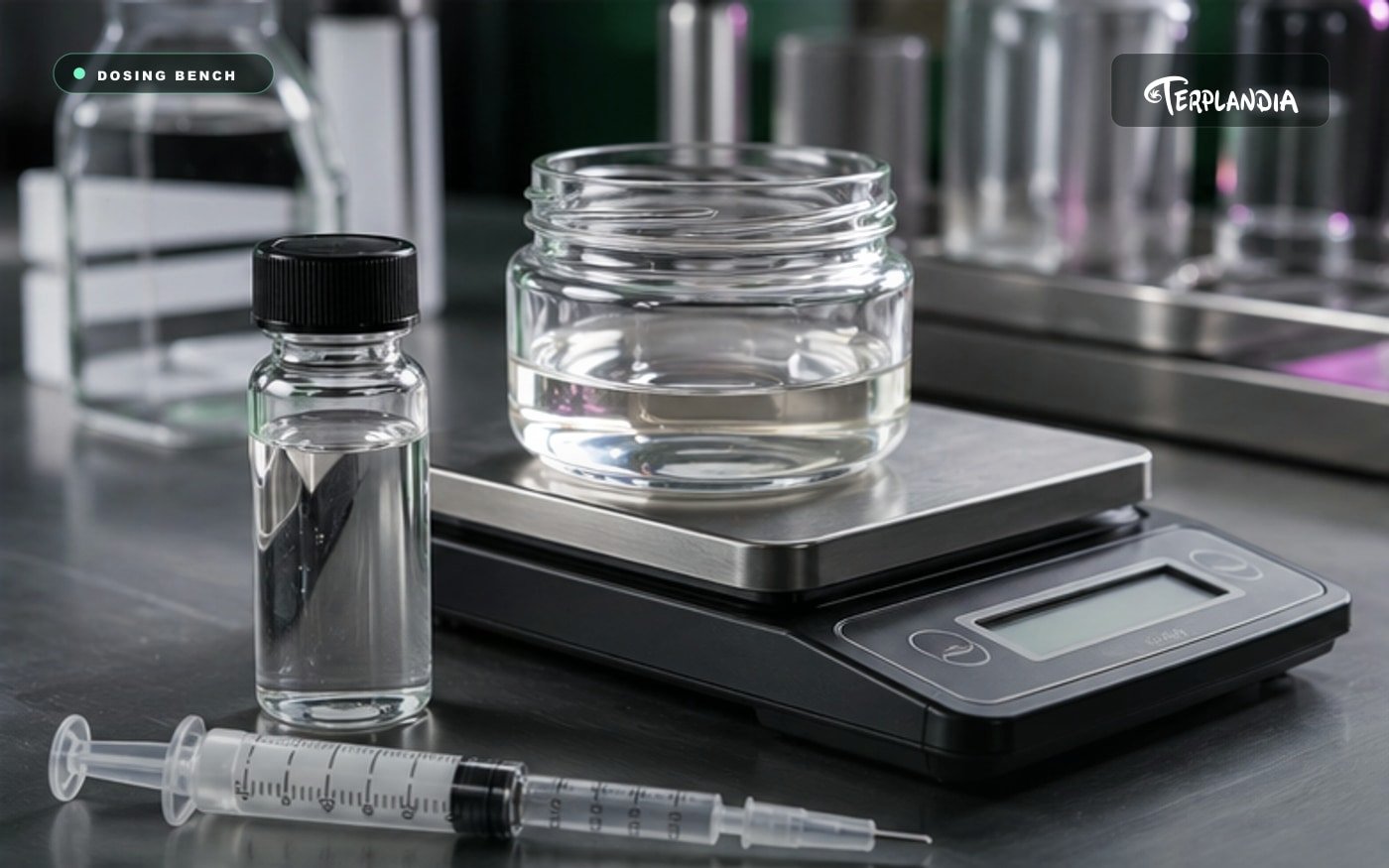
A Practical Mixing Workflow for Distillate
The exact SOP belongs to your licensed facility, QA team, and equipment. The workflow below is a practical structure for thinking through the process before a production run.
1. Confirm the target and the material
Before mixing, confirm the target percentage, final batch weight, distillate lot, terpene lot, intended product format, and whether the formula has already passed a pilot test. If the profile is cannabis-derived, confirm whether the source story matters for the product label or sales team. If the buyer is still deciding between CDT and BDT, the CDT vs BDT terpene guide is a better starting point.
2. Make the distillate workable without cooking the profile
Distillate often needs controlled warming before it can mix cleanly. The risk is treating heat as a shortcut. Excess heat, long open-air exposure, and aggressive agitation can work against the aromatic profile. Use the minimum process that makes the material workable, and keep the terpene blend sealed until it is time to add it.
Safety note: concentrated terpene blends are volatile and can be flammable. Mixing should happen in a suitable, well-ventilated production environment, away from open flames, and under the controls required by your facility SOP.
3. Weigh the terpene blend separately
Pre-weigh the terpene blend in a clean container and record the actual weight. Weight-based dosing is easier to audit than drops, casual syringe marks, or volume estimates. It also helps future batches survive staff changes, supplier changes, and scale-up.
4. Add slowly and mix for uniformity
Add the terpene blend gradually while the distillate is moving. The batch should look uniform before it is pulled into samples or hardware. Strong aroma at the open vessel is not proof of a finished mix. A better proof is consistent behavior across multiple samples pulled from the same batch.
5. Rest, sample, and test the real format
Let the batch equilibrate according to your SOP, then test it in the format that customers will actually use. Vape hardware, edible bases, packaging, storage time, and fill conditions can all reveal issues that a bench smell test misses.

How Much Terpene Should You Add?
There is no single correct number. A clean formula depends on the profile intensity, the distillate, the product format, the hardware, the compliance environment, and the sensory target. Higher is not automatically better. Too much terpene can create harshness, leakage risk, separation issues, or a profile that smells good in a jar but performs poorly in the finished product.
A stronger way to think about dosing is as a ladder:
- Start with a pilot range: build small samples across a narrow spread instead of guessing one large batch.
- Hold the base constant: change one variable at a time so the result means something.
- Evaluate after rest time: aroma right after mixing may not match aroma after storage.
- Record sensory notes and process notes together: flavor feedback is less useful without temperature, mix time, lot, and format data.
If you need category ranges before building a pilot ladder, use the existing use-rate article as a planning reference, then validate in your actual matrix.
What to Document Before Scale-Up
The handoff from sample to production is where good terpene work often breaks. A sample may smell right, but if the production team does not know the lot, target percentage, mixing process, storage conditions, and approval criteria, the next batch becomes a rebuild.
| Checkpoint | What to record | Why it matters |
|---|---|---|
| Lot identity | Distillate lot, terpene lot, supplier, received date | Connects the formula to real materials instead of a flavor name. |
| Batch math | Final batch weight, terpene percentage, actual weighed amounts | Prevents dosing drift when the batch scales. |
| Process controls | Temperature range, mixing time, vessel, rest time | Protects volatile aroma compounds and improves repeatability. |
| QA evidence | COA, method notes, retention sample, approval date | Gives buyers and production teams a defensible record. |
| Storage plan | Container, headspace, light exposure, temperature, open date | Reduces profile drift after the batch is approved. |
For deeper QA context, see Terplandia’s guide on how to read a terpene COA. For handling and shelf-life discipline, pair this process with the terpene storage and shelf-life SOP.

Common Mistakes When Adding Terpenes to Distillate
- Dosing on top of the batch: adding 5% to the existing distillate weight is not the same as a 5% final batch.
- Using heat as a fix for impatience: high heat can make mixing easier while making aroma harder to preserve.
- Judging only from the open jar: the finished product may behave differently after filling, storage, and use.
- Changing profile sources by name only: two blends with the same strain name can behave differently if the source, method, or supplier changes.
- Skipping retention samples: without a retained sample, it is harder to diagnose drift, complaints, or scale-up differences.
- Ignoring storage after approval: a good formula can still lose character if open time, light, oxygen, or heat are uncontrolled.
Supplier Questions That Make the Process Easier
A terpene supplier should make formulation more repeatable, not more mysterious. Before placing a commercial order, ask questions that connect the sample to production reality:
- Can the supplier provide COA support and lot traceability for the profile?
- Can they explain whether the profile is cannabis-derived, botanical, or a hybrid flavor system?
- Can they help compare sample behavior in the format you actually sell?
- Can they support repeat orders without forcing a full sensory rebuild?
- Can they give storage and handling guidance that protects volatile aroma compounds?
If the supplier conversation still feels vague, Terplandia’s terpene supplier buying guide gives a broader vendor-evaluation framework. If you want the source-to-formula picture, read the cannabis-derived terpenes supply chain guide.
FAQ
Do you add terpenes before or after warming distillate?
Warm the distillate only enough to make it workable, then add terpenes under controlled mixing according to your facility SOP. Avoid leaving terpene blends open or exposing them to unnecessary heat.
Should terpene dosing be measured by weight or volume?
Weight is usually the cleaner production control because it is easier to repeat, audit, and scale. Volume can vary with equipment, temperature, and operator technique.
Can the same terpene percentage work for every distillate?
No. The same percentage can feel different depending on the profile, base, product format, hardware, and storage conditions. Build a pilot ladder and test the real format before scaling.
Why does a distillate terpene batch change after storage?
Terpenes are volatile aromatic compounds. Heat, light, oxygen, container headspace, and repeated opening can all contribute to aroma drift, which is why storage and retention samples matter.
Technical Reading
For teams building internal SOPs, terpene testing and volatile-compound handling are worth treating as technical topics, not flavor trivia. Useful external references include Agilent’s overview of GC/MS terpene analysis in cannabis products and peer-reviewed work on volatile terpene preservation in cannabis research.
Need a CDT profile your team can actually dose?
Terplandia helps cannabis brands move from sample approval to repeatable production with source-aware profiles, documentation expectations, and practical formulation support.