Blue Dream Terpenes: The Complete Profile Guide
Strain guide · Cannabis-derived terpenes Blue Dream Terpenes: The Complete Profile Guide A myrcene-led profile with an unusually high pinene shoulder, recovered from real Blue Dream biomass by vacuum steam distillation. This guide covers…

Strain guide · Cannabis-derived terpenes
Blue Dream Terpenes: The Complete Profile Guide
A myrcene-led profile with an unusually high pinene shoulder, recovered from real Blue Dream biomass by vacuum steam distillation. This guide covers what is actually in the bottle, and corrects the most-copied myth in terpene marketing along the way.
One Ingredient · One Plant · One Truth

0% THC · 0% CBD · COA every batch · Single-source Humboldt · Ships nationwide
01 · The cultivar
What is Blue Dream?
Blue Dream is a sativa-leaning hybrid produced by crossing Blueberry with Haze. It emerged from Northern California in the 2000s and spent most of the following decade as one of the best-selling cultivars in the United States.
Its commercial staying power comes from a combination that is genuinely hard to find. The Blueberry parent contributes a sweet, unmistakable berry note. The Haze side contributes the bright, resinous lift that keeps the sweetness from turning heavy. The result reads as approachable rather than intense, which is exactly why it became the default recommendation on so many menus.
For a terpene buyer, that popularity has a downside. Blue Dream is one of the most widely imitated aroma profiles in the sector, and most of those imitations are assembled from non-cannabis isolates. Which brings us to what is actually in the plant.
02 · Terpene breakdown
Blue Dream terpene profile.
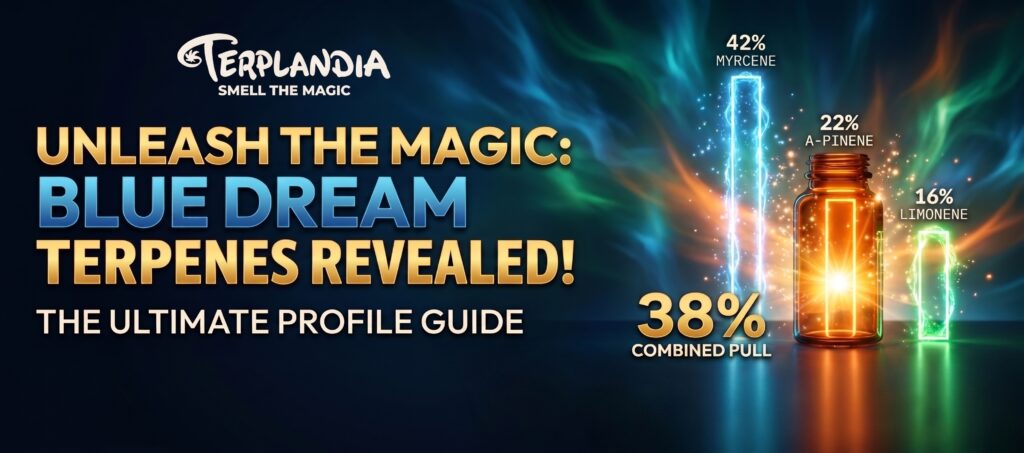
Blue Dream is myrcene-dominant, with an unusually strong alpha-pinene shoulder behind it. That second position is what separates this profile from every other myrcene-led cultivar on a menu.
Representative of cannabis-derived Blue Dream biomass. Exact composition is documented per batch on the COA. Percentages may vary within roughly 5% by harvest lot.
Myrcene
The structural base of the profile. Myrcene is earthy and musky with a sweet edge, and it is the compound that gives Blue Dream its body. Without it the berry note would sit on nothing and read thin. It is also the most common dominant terpene across cannabis generally, which is precisely why the second position matters so much here.
Alpha-Pinene
The differentiator. A sharp, fresh, coniferous note that cuts through the myrcene base and keeps the whole profile from settling into something heavy and generic. Pinene at this share is uncommon, and it is the single hardest part of Blue Dream to reproduce from a blend, because pinene isolates read flat and one-dimensional next to the version that comes off the plant.
Beta-Caryophyllene
A peppery, woody warmth sitting under the sweetness. Caryophyllene is a sesquiterpene, heavier and less volatile than the two above it, so it survives processing better and lingers longer on the finish. In Blue Dream it functions as the bridge between the earthy base and the bright top.
Limonene
The clean citrus lift. Working alongside pinene, limonene is a large part of why this profile reads as daytime rather than heavy despite a myrcene lead. It is bright without being sour, and it is the note most formulators reach for when a Blue Dream formulation is reading dull.
The part terpenes do not explain
Humulene at roughly 10% completes the earthy backbone, alongside trace compounds documented in full COA batch testing.
Worth being honest about one thing. The specific blueberry note is not fully explained by the five terpenes above. Much of the fruit character in cannabis comes from volatile compounds active at parts per billion, well below the detection thresholds of a routine terpene panel. That trace layer is present in recovered material and absent from a blend built to a target, which is a large part of why reconstructions of this cultivar smell close but never quite right.
03 · Setting the record straight
The 0.5% myrcene rule that was never real.
If you have shopped for terpenes, you have met this claim. Above 0.5% myrcene a cultivar is sedating and indica-like. Below 0.5% it is energizing and sativa-like. It appears on dispensary menus, supplier sites, wholesale decks and countless blog posts.
There is no controlled human study establishing that threshold. The figure circulates as received wisdom, repeated from one page to the next, and traced back it does not lead to a clinical finding. Myrcene’s sedative reputation rests largely on rodent work at doses far beyond anything present in a cannabis product, plus a good deal of folklore.
Blue Dream is the cleanest counterexample in the catalog. It is reliably myrcene-dominant, comfortably past that supposed cutoff, and it is reported by consumers as creative, euphoric and suited to daytime use. If the rule held, this cultivar could not exist as it does.
A number decides the effect
Cross 0.5% myrcene and the product becomes sedating. Stay under it and the product becomes energizing.
No threshold study
No controlled human trial supports a 0.5% cutoff. The number is repeated, not demonstrated.
Dominance describes aroma
The dominant terpene tells you the architecture of the smell. It does not predict an outcome on its own.
The mango claim, while we are here
The related folklore holds that eating a mango before consuming cannabis intensifies the experience, because mangoes contain myrcene. It is a good story with no controlled evidence behind it, and the myrcene quantity involved is small. Treat it the same way as the 0.5% rule.
What this means for a formulator
Formulate to aroma, and describe aroma. A terpene percentage is a reliable statement about how a product will smell and taste. It is not a promise about how anyone will feel, and building marketing on that promise creates a compliance exposure that is entirely avoidable.
04 · The mechanism
Why a myrcene-led profile reads creative.
If the dominant terpene does not decide the character, what does? For Blue Dream the answer is the shape of the whole profile, not the height of its tallest bar.
The pinene shoulder
At 22%, alpha-pinene is doing far more work here than in a typical myrcene-led cultivar. It is sharp and fresh, and it pulls the perceived character upward against the earthy base.
Limonene alongside it
Another 16% of bright, clean citrus reinforcing the same direction. Between them, pinene and limonene account for 38% of the profile, pushing against the myrcene lead rather than sitting beneath it.
Ratio, not rank
Two cultivars can share a dominant terpene and smell nothing alike, because what a nose registers is the relationship between compounds. Rank order is the least informative thing on a COA.
The rest of the matrix
In a finished cannabis product, cannabinoid content, dose, format and the individual all shape the outcome. A terpene profile is one input among several, and it is the one you can actually control.
This is the practical takeaway for anyone building a Blue Dream product. If your formulation is reading flat or heavy, the problem is almost never the myrcene. It is that the pinene and limonene fraction has been undershot, which is exactly what happens when a profile is approximated from a short list of isolates.
Rank order tells you almost nothing. The ratio is the profile.
05 · Effect character
Effects and experience.
Consumer reports on the Blue Dream cultivar cluster consistently around a clear-headed, sociable character rather than a heavy one, which is a large part of why it held its position on menus for so long.
Creative
The most frequently cited descriptor, and the one that made this cultivar a default recommendation for daytime and working sessions.
Euphoric
A bright, buoyant quality reported across a wide range of tolerance levels, which is unusual and part of the broad appeal.
Happy
Consistently described as approachable and sociable rather than intense, which is why it is so often recommended to newer consumers.
Important context
The characteristics above describe the cannabis cultivar as reported by consumers. They do not describe Terplandia’s terpene ingredients, which contain 0% THC and 0% CBD, are not intoxicating, and are sold as flavor and aroma ingredients to manufacturers and formulators.
06 · Aroma character
Aroma and flavor profile.
Blue Dream opens sweet and closes clean. That arc is the whole appeal, and it is also where most reconstructions fall apart, because they deliver the opening and then stop.
| Layer | Character | Driven by |
|---|---|---|
| Top note | Sweet blueberry, immediate and recognizable | Trace fruit compounds, supported by myrcene |
| Upper mid | Fresh, sharp, faintly coniferous lift | Alpha-Pinene, Limonene |
| Base | Earthy, musky sweetness that carries the fruit | Myrcene, Humulene |
| Finish | Warm peppery tail, clean rather than cloying | Beta-Caryophyllene |
On the palate this reads as fruit-forward without being candy-like. The pinene and caryophyllene keep the sweetness in check, which is a formulation advantage in edibles and beverages where a sugary aroma quickly becomes fatiguing across a full serving.
07 · Genetics
Lineage, and what “Blue Dream x” means.
Searches for “Blue Dream x” almost always mean crosses that use Blue Dream as a breeding parent, and there are a great many of them. It is one of the most widely used parents in American breeding, for the same reason it sells: the profile is distinctive and it passes on cleanly.
What this means when you are buying
A cross carrying the Blue Dream name will not carry the Blue Dream profile. Every generation shifts the ratio, and the pinene shoulder that defines this cultivar is exactly the kind of trait that thins out in a cross.
The practical rule: buy the analysis, not the name. A batch-specific COA tells you what is in the bottle. A strain name on an invoice tells you what someone decided to call it.
08 · Know the difference
CDT versus botanical Blue Dream blends.
Blue Dream is imitated more often than almost any other profile, which means the market is full of blends built to approximate it. The gap shows up in two specific places.
Cannabis-derived Blue Dream
Recovered from real Blue Dream biomass by vacuum steam distillation. Water-clear, formulation-ready, with a third-party COA confirming terpene ratios and non-detect for cannabinoids and residual solvents.
- The pinene shoulder intactAt full biomass ratio, not undershot to hit a price point.
- The trace fruit layer presentThe compounds that make the berry note read as berry rather than as sweetness.
- Full aromatic arcSweet opening through to the clean peppery finish, not just the opening.
- Documented per batchExact ratios on a COA, traceable to lot.
Assembled berry blends
Built from commodity isolates sourced outside cannabis, blended toward a target that approximates the surface of the profile.
- Pinene reads flatIsolate pinene is one-dimensional next to the version that comes off the plant.
- Berry becomes candyWithout the trace layer, the fruit note is reproduced as generic sweetness.
- The arc stops earlyDelivers the opening, then plateaus and fades where the real profile keeps developing.
- Recipe-boundLimited to a finite isolate list, so the quiet compounds are simply absent.
09 · Why Terplandia
Why formulators choose this one.
Verified sourcing
Blue Dream from authenticated cultivar material, never a generic berry blend wearing the name.
Low-temperature recovery
Vacuum steam distillation protects the pinene and limonene fraction that defines this profile.
COA every batch
Third-party, traceable to lot. Exact ratios, not estimates or marketing charts.
Manufacturer-direct
$5 per ml under 1,000 ml, $4 per ml at 1,000 ml and above. No distributor markup.
Water-clear
Formulation-ready with no color contribution, which matters in beverages and clear cartridges.
Same-week shipping
On in-stock profiles, nationwide, from Humboldt County.
10 · Applications
Where Blue Dream terpenes work.
| Application | Typical loading | Note |
|---|---|---|
| Vape cartridges | 3 to 8% | Restores cultivar identity to distillate stripped during refinement |
| Concentrates | 1 to 5% | The base already carries some character, so less is needed |
| Infused pre-rolls | Surface applied | Replaces aroma lost during processing and storage |
| Edibles | 0.1 to 1% | The berry note carries well; pinene keeps it from reading like candy |
| Beverages | 0.05 to 0.5% | Water-clear matters here. Solubility is the limiting factor |
| Topicals | 0.5 to 2% | Check allergen declarations for your market |
These are starting points, not specifications. The correct loading depends on your oil, your device or matrix, and the sensory intensity you are targeting. Determine it through controlled bench testing, evaluated at working dilution rather than from the bottle. Our dilution calculator handles the arithmetic for any batch size.
11 · Compare profiles
Similar profiles, different chemistry.
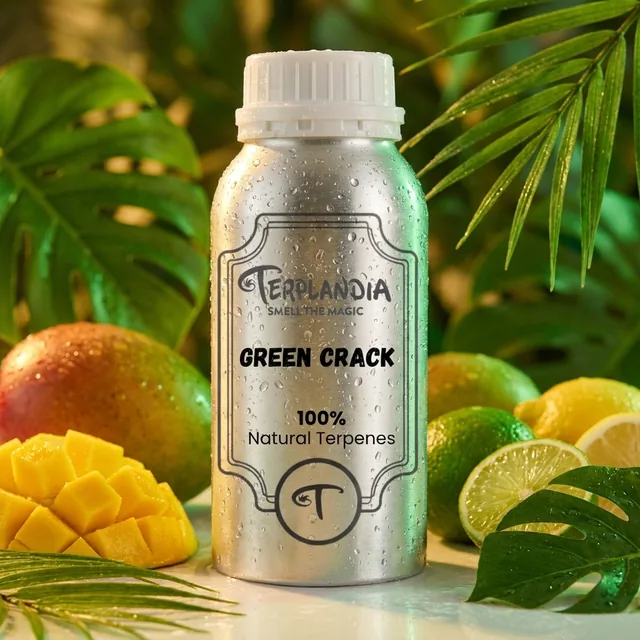
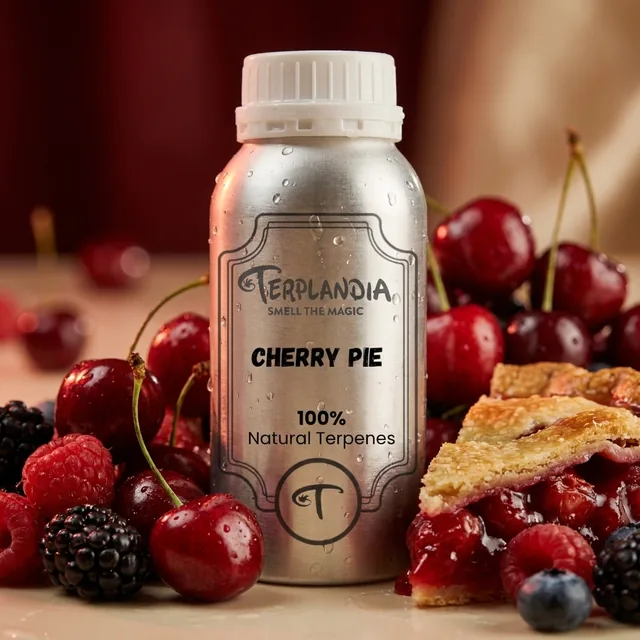
Three profiles that make the point of this article better than any chart. Two share Blue Dream’s dominant terpene and smell nothing like it. One shares its fruit family and has a completely different dominant.

12 · Common questions
Frequently asked questions.
What terpenes are in Blue Dream?
Blue Dream is myrcene-dominant, supported by an unusually high alpha-pinene share, with beta-caryophyllene, limonene and humulene behind them. A representative breakdown runs roughly 34% myrcene, 22% alpha-pinene, 18% beta-caryophyllene, 16% limonene and 10% humulene, though exact ratios vary by phenotype, cultivation and harvest lot. The pinene position is the distinguishing feature. Exact composition is documented on the COA for every batch.
What is the dominant terpene in Blue Dream?
Myrcene, typically around a third of the total terpene content. Myrcene is the most common dominant terpene in cannabis generally, so on its own it tells you relatively little. What makes the Blue Dream terpene profile distinctive is the alpha-pinene sitting behind it at roughly 22%, which lifts the whole profile away from the earthy character a myrcene lead would otherwise produce.
Does high myrcene mean Blue Dream is sedating?
No, and Blue Dream is the standard counterexample. The widely repeated rule that myrcene above 0.5% makes a cultivar sedating has no controlled human study behind it. Blue Dream is comfortably myrcene-dominant and is consistently reported as creative and daytime-suited. Dominant terpene describes the architecture of an aroma. It does not predict an outcome on its own.
Is Blue Dream indica or sativa?
Blue Dream is a sativa-leaning hybrid, from Blueberry crossed with Haze. That said, indica and sativa describe plant structure rather than experience. For a formulator the aromatic composition is the useful information, because it is measurable, reproducible and something you can actually specify when you order.
What does Blue Dream smell like?
Sweet blueberry over an earthy, musky base, with a fresh coniferous lift through the middle and a warm peppery finish. It is fruit-forward without being candy-like. The pinene and caryophyllene keep the sweetness in check, which is a formulation advantage anywhere flavor fatigue across a full serving is a concern.
What does “Blue Dream x” mean?
It refers to a cross that uses Blue Dream as a breeding parent. Blue Dream is itself a cross, Blueberry with Haze, and it is one of the most widely used parents in American breeding. For a terpene buyer the important point is that a cross does not carry the parent profile. Ratios shift with every generation, so the COA matters more than the name on the invoice.
Do Blue Dream terpenes contain THC or CBD?
No. Terplandia terpenes contain 0% THC and 0% CBD. Cannabinoids are substantially heavier and less volatile than terpenes and do not carry over during vacuum steam distillation, so they remain in the spent biomass. Every batch is third-party tested and cannabinoid content is confirmed on the Certificate of Analysis that ships with it.
Why do Blue Dream products smell different between brands?
Because most of them are not using recovered Blue Dream terpenes. Distillate is aromatically neutral after refinement, so the character comes almost entirely from what is blended back in. A commodity berry blend will read sweet but will miss the pinene shoulder and the trace fruit layer that make this profile recognizable. Sourcing and loading rate determine fidelity, not cannabinoid content.
What loading rate should I use?
Typical working ranges run 3 to 8% for cartridges and distillate blending, 1 to 5% for concentrates, 0.1 to 1% for edibles, 0.05 to 0.5% for beverages and 0.5 to 2% for topicals. Under-dosing is the more common error. Below the working range the quiet compounds drop under threshold first, and a distinctive profile collapses into generic sweetness.
Formulate with the real thing
Try Blue Dream CDT on your own bench.
Recovered in-house in Humboldt County from real Blue Dream biomass by vacuum steam distillation. Full pinene expression, water-clear, formulation-ready, with a third-party COA on every batch. Available to licensed manufacturers and formulators.
One Ingredient · One Plant · One Truth. Smell the Magic.
Terpene flavor and aroma compounds containing 0% THC and 0% CBD, sold as ingredients to manufacturers and formulators, not as finished consumer products. Certificates of analysis available for every batch on request. Made in the USA, ships nationwide. Descriptions of cultivar characteristics are consumer-reported and provided for strain context only. Nothing on this page constitutes medical, therapeutic or health advice, and no therapeutic claims are made or implied. It is the buyer’s responsibility to ensure the conditions and uses of the product conform to local laws and regulations.
You Boy
Cannabis-dhkajshdjsahdjsaerived and formulated to a published ratio, with a COA on every batch.