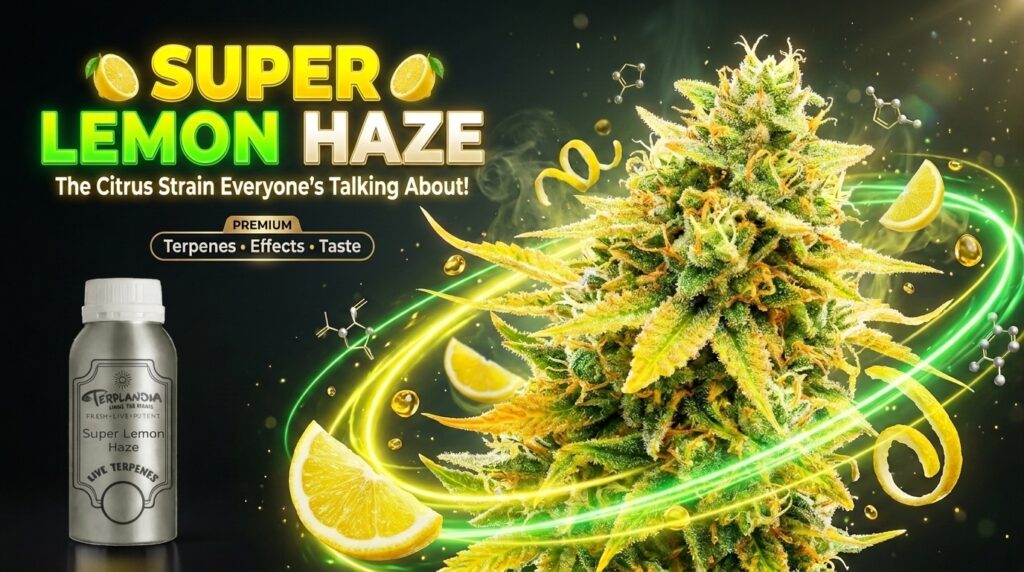
Super Lemon Haze
The terpene profile, the effects, the aroma arc and the addition rates. Everything you need before you put this strain name on a label.
The short version
- Super Lemon Haze is a sativa-dominant hybrid, roughly 80 percent sativa. Lemon Skunk crossed with Super Silver Haze, released by Green House Seeds.
- Terpinolene is the dominant terpene at 28 percent of the terpene fraction. D-Limonene follows at 26 percent. Those two compounds carry the whole aromatic signature.
- Terpinolene is also the reason most botanical lemon blends fail. It boils at 186 degrees Celsius, oxidises quickly, and is rarely available at purity from non-cannabis sources.
- At a 6 to 8 percent cut, authentic cannabis-derived terpenes add about 18 cents to a one-gram cartridge. That is the entire cost of the gap between “lemony” and “Super Lemon Haze”.
Almost every Super Lemon Haze product on the market is flavoured with something that has never been near a cannabis plant. That is not a moral problem. It is a formulation problem, and it has one specific cause: terpinolene.
Super Lemon Haze is one of a small number of cultivars where the dominant terpene is terpinolene rather than myrcene, limonene or caryophyllene. Terpinolene is volatile, it degrades quickly, and it is difficult to source at purity from non-cannabis plant material. So botanical blends reach for the citrus note they can buy cheaply, land on limonene, and ship a profile that smells like lemon without ever smelling like this strain.
This guide covers the whole entity. The genetics, the measured terpene ratios, the boiling points that decide what survives your process, the addition rate by product format, and the arithmetic on what authenticity costs per unit. Figures come from Terplandia batch certificates of analysis unless marked otherwise.
Start with the genetics
1 · Is Super Lemon Haze sativa or indica
Super Lemon Haze is a sativa-dominant hybrid. Breeder documentation places it near 80 percent sativa and 20 percent indica. The sativa lean shows up in three places you can actually measure: a long 9 to 10 week flower, a tall stretching plant structure, and a terpene profile led by terpinolene rather than myrcene.
That last point is the one that matters to a formulator. Indica and sativa are plant-morphology terms, not chemistry terms, and on their own they predict almost nothing. The terpene fraction predicts a great deal. Terpinolene and D-Limonene together make up 54 percent of Super Lemon Haze’s terpene content, while myrcene accounts for just 20 percent, creating the energising profile people associate with the strain. Reverse those ratios and the same genetics would read as sedating.
The parentage, in one line
Lemon Skunk crossed with Super Silver Haze. Lemon Skunk supplies the sharp citrus-peel character. Super Silver Haze, itself a Haze by Northern Lights #5 by Skunk #1 cross, supplies the sativa structure, the extended flower and the resin complexity. Reported THC in the flower commonly falls between 16 and 25 percent [VERIFY], though that figure has no bearing on the terpene extract, which is non-detect for THC and CBD.
2 · Lemon Haze vs Super Lemon Haze
Retail copy treats these as interchangeable. They are not. Lemon Haze describes a lineage and an aroma category, Lemon Skunk crossed with Silver Haze, and several breeders have released their own cuts under that name. Super Lemon Haze is a specific, attributable release with Super Silver Haze on one side.
The practical difference is the terpinolene ceiling. Lemon Haze cuts tend to sit limonene-forward with a lower terpinolene share. Super Lemon Haze pushes terpinolene into the dominant position, and that is what produces the pine and herbal mid-note people recognise as the real version.
Lemon Haze vs Super Lemon Haze, side by side
Representative figures. Individual cuts vary, which is exactly the point.
| Attribute | Lemon Haze | Super Lemon Haze | The difference |
| Parentage | Lemon Skunk × Silver Haze | Lemon Haze × Super Silver Haze | One extra Haze generation |
| Dominant terpene | D-Limonene, typically | Terpinolene at 28% | Pine and herbal mid-note |
| Attribution | Lineage name, many cuts | Green House Seeds release | |
| Flower time | 8 to 9 weeks | 9 to 10 weeks |
The terpene numbers
3 · The Super Lemon Haze terpene profile, by percentage
Five compounds account for the identified terpene fraction in Terplandia Super Lemon Haze CDT. Trace compounds below one percent are listed individually on each batch COA and are not shown here. Ratios shift by roughly 2 to 3 percent between harvest lots, which is normal for single-source material and is the reason every drum ships with its own certificate.
Terpinolene, 28 percent
The defining compound. Terpinolene reads as fresh pine and light citrus over a herbal, faintly floral background, and it is the note that makes Super Lemon Haze identifiable from across a room. This also places the strain among a small minority of cultivars, as terpinolene dominates the terpene profile in only a handful of commercially grown cannabis chemovars.
D-Limonene, 26 percent
The secondary dominant. Where terpinolene brings herbal and piney complexity, D-Limonene brings clean, direct lemon-peel brightness, the note most people reach for when they try to describe the aroma in one word. Together the two build the layered citrus character that isolate-based blends approximate and rarely reach.
Beta-Myrcene, 20 percent
The base note. Myrcene supplies the earthy, slightly musky body that stops the profile reading as thin or purely sharp. In a high-terpinolene cultivar it works as an aromatic anchor, adding warmth underneath the citrus and herbal top notes. At 20 percent it is present but subordinate, which is what keeps the profile daytime-facing rather than heavy.
Beta-Caryophyllene, 14 percent
Lower here than in indica-dominant profiles. Caryophyllene contributes a subtle spicy and woody undertone that adds complexity without pulling the character toward the dank end of the spectrum. It is also the heaviest compound in the profile by boiling point, which matters for what survives your process.
Ocimene, 12 percent
The finish. Ocimene adds a sweet, floral lift at the tail of the aromatic arc. Paired with terpinolene it is widely associated with the bright, associative character formulators report from this profile.
4 · Terpinolene, the terpene that decides everything
Terpinolene is a monoterpene found outside cannabis in nutmeg, cumin, apples, lilac and conifer species. In cannabis it is uncommon as a dominant compound, and it is genuinely difficult to work with. It boils at 186 degrees Celsius, it oxidises readily on exposure to air and light, and high-purity non-cannabis terpinolene is expensive and inconsistently available.
Every one of those properties has a downstream consequence. Long flower times give terpinolene more chances to volatilise off the plant. Slow post-harvest handling costs you more of it. Heat during distillation costs you more again. By the time a botanical blender has to source it as an isolate, the economics push them toward a stable substitute that reads as generic citrus. That is the single mechanism behind almost every disappointing Super Lemon Haze product on the market.
Boiling points, and what that means for your process
These are published physical constants at atmospheric pressure. In a cartridge, compounds volatilise well below their boiling point, so treat the ordering as a guide to relative volatility rather than a temperature target.
Boiling points across the Super Lemon Haze profile
Atmospheric pressure. The spread is 96 degrees Celsius from lightest to heaviest.
| Terpene | Share | Boiling point | What you lose first |
| Beta-Myrcene | 20% | 167 °C / 333 °F | Lightest, goes first |
| D-Limonene | 26% | 176 °C / 349 °F | Citrus top note thins |
| Ocimene | 12% | 177 °C / 351 °F | Floral finish drops out |
| Terpinolene | 28% | 186 °C / 367 °F | The strain identity |
| Beta-Caryophyllene | 14% | 262 °C / 504 °F | Survives almost anything |
Terpinolene is 28 percent of the profile and close to 100 percent of the recognition.
#terpsdontlie
5 · Aroma and flavour, from top note to base
The aroma of Super Lemon Haze is one of the most assertive in the sativa category. Where many sativa profiles blur into a generic herbal-cannabis character, this one opens with a sharp, directional citrus note that reads as lemon rind. Not lemon candy, not lemon tea. Raw peel.
What separates an authentic extract from a blend is what happens next. A botanical lemon stack plateaus at that opening and begins to fade. The cannabis-derived profile keeps developing: the piney, herbal complexity of terpinolene emerges in the mid-note, myrcene rounds the base, and ocimene closes it out with a sweet floral lift. Experienced buyers describe the full arc as the strain feeling complete rather than thin, and that judgement is made in the first four seconds of an exhale.
The aromatic arc, in order
Four movements. Botanical blends typically deliver the first one only.
| Stage | Character | Driven by | Botanical equivalent |
| Top note | Sharp lemon zest, bright | D-Limonene | Usually present |
| Mid note | Pine, herbal, faintly floral | Terpinolene | Usually missing |
| Base | Fresh earth, light musk | Beta-Myrcene | Reads as flat |
| Finish | Sweet floral lift | Ocimene | Rarely reproduced |
Smell it before you spreadsheet it
The numbers are convincing. The aroma is what closes it.
Request a free sample of Super Lemon Haze CDT and put it next to whatever lemon blend you are running now. Available to licensed manufacturers and formulators.
Putting it in a product
6 · Effects and how to position the product
Terpenes are aroma and flavour compounds. They are not the psychoactive fraction, and nothing below is a health claim. What follows is the character consumers and formulators consistently report from products built on this profile, which is what your positioning has to match.
Super Lemon Haze reads as uplifting and clear-headed. Terpinolene and D-Limonene carry the bright, motivating front of the profile, while myrcene at 20 percent gives it enough body to avoid feeling sharp or brittle. Compared with high-myrcene sativas, which many users describe as scattered, the terpinolene backbone here reads as focused. The ocimene and terpinolene pairing is the one most often associated with associative, creative use contexts.
Where it belongs on a shelf
Daytime. Morning and midday SKUs, energy-positioned vapes, citrus beverage and confection lines, and infused pre-rolls where a fresh aromatic top note has to survive the burn. If your portfolio needs an evening citrus instead, the profile you want is Lime Sugar Cookies, not this one.
7 · How much Super Lemon Haze CDT to add, by product format
The standard addition rate is 6 to 8 ml per 100 grams of oil, which is 6 to 8 percent by weight. Start at 6 percent and work up. Terpinolene-dominant profiles read as assertive at lower inclusion than myrcene-dominant ones, so the top of the range is not always the right answer here.
Two practical notes. Add terpenes to the distillate after decarboxylation, once the oil has cooled below 40°C. Every degree above that risks evaporating terpinolene you already paid for. And mix under low shear. Aggressive homogenisation drives off the light end of the profile, which on this strain is the part that carries the identity.
Addition rate by format, at a 6 to 8 percent cut
Terpene volume required per finished unit. Adjust for your own fill weights.
| Format | Fill weight | At 6% cut | At 8% cut |
| 0.5 g all-in-one | 0.5 g | 0.03 ml | 0.04 ml |
| 1 g cartridge | 1.0 g | 0.06 ml | 0.08 ml |
| 2 g disposable | 2.0 g | 0.12 ml | 0.16 ml |
| Bulk distillate | 100 g | 6 ml | 8 ml |
8 · What authentic Super Lemon Haze costs per finished unit
Terpene quotes arrive priced per millilitre. Products get sold per unit. Those are two different questions, and the per-millilitre number is the one that makes the decision look expensive.
Botanical blends run around $1.80 per millilitre at multi-kilo bulk. Cannabis-derived starts around $4.00 per millilitre. Per millilitre that is more than double. Per one-gram cartridge at an 8 percent cut, it is a difference of 17.6 cents. Confirm current Super Lemon Haze pricing for your volume tier before you build a model on it.
What one cartridge of Super Lemon Haze actually costs
9 · Cannabis-derived vs botanical Super Lemon Haze
For this strain in particular, the gap is wider than the category average, and the reason is entirely mechanical. Terpinolene is volatile, it degrades quickly, and it is rarely available as a high-purity isolate from non-cannabis material. Nearly every botanical Super Lemon Haze blend on the market therefore undershoots terpinolene, or substitutes something more stable that reads as generic citrus. The output smells like lemony cannabis. It does not smell like Super Lemon Haze.
There is a second, non-aromatic difference. A product formulated with cannabis-derived terpenes can make a truthful cannabis-derived label claim. A botanical approximation cannot, however close the aroma gets.
Option A
What you are buying
- Reconstructed from citrus, pine and herb isolates, none from cannabis
- Terpinolene undershot or substituted for a stable alternative
- Citrus top note only, no piney herbal mid-character
- Ingredient decks that can run past 40 compounds
- No cannabis-derived label claim available
Option B
What you are buying
- Extracted from authenticated Super Lemon Haze biomass
- Full terpinolene expression at 28 percent, not undercoated
- Complete aromatic arc, top note through to floral finish
- Water-clear, non-detect for THC, CBD and residual solvents
- Third-party COA and SDS on every batch
10 · Growing characteristics, and why they reach your formulation
You are not growing this plant, so the grow data matters for one reason only: it explains why terpinolene content varies so widely between suppliers of the same named strain.
Super Lemon Haze flowers for 9 to 10 weeks, with terpene expression peaking around weeks 8 and 9. That long window can cause the profile’s most volatile compound to degrade through heat, handling, or a late harvest. Add a slow trip from field to still and the terpinolene share falls before extraction even starts. Terplandia processes Super Lemon Haze biomass within hours of harvest, which is the only part of this section that shows up on a COA.
Cultivation profile
Breeder and grower reported figures under optimal conditions.
| Characteristic | Detail | Why it reaches you |
| Flowering time | 9 to 10 weeks indoor, peak at weeks 8 to 9 | Long volatility window |
| Indoor yield | 600 to 800 g per square metre | Biomass availability |
| Outdoor yield | 1,000 g and up per plant, warm dry climates | Seasonal lot variation |
| Plant structure | Tall sativa, stretches in flower, needs training | Harvest timing spread |
| Climate | Warm and dry. Humidity raises mould risk | Lot rejection rates |
11 · Storage, stability and shelf life
Terpinolene oxidises. That is not a defect in the product, it is a property of the molecule, and it means a terpinolene-dominant profile is less forgiving in storage than a caryophyllene-heavy one. Handled correctly the profile holds. Handled casually, the first thing you lose is the exact compound you paid a premium for.
Keeping the terpinolene you paid foR
- Store cold and dark. Refrigerated, in the original amber or opaque container. Light and heat both accelerate oxidation.
- Minimise headspace. Decant into smaller vessels as you draw down a drum. Oxygen sitting on top of the liquid is the main degradation path.
- Keep it sealed between uses. Open, dispense, close. Long open times on a bench cost measurable top note.
- Bring to room temperature before dosing. Cold terpene is more viscous and doses inaccurately by volume.
- Add below 40 degrees Celsius. Blend into cooled distillate, never into hot oil.
- Mix under low shear. Gentle and complete beats fast and aggressive on a light profile.
- Work to the batch, not the label. Each lot ships with its own COA. Use the numbers on the certificate that came with your drum, not last quarter’s.
12 · Similar citrus profiles, and when to use them instead
Super Lemon Haze is the bright, daytime end of the citrus category. If the SKU you are building needs citrus appeal with a different centre of gravity, three profiles are worth benching alongside it.
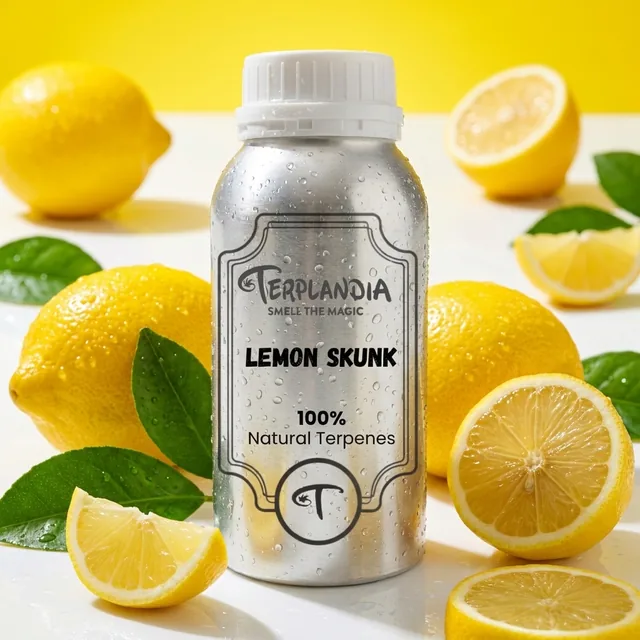
Lemon Skunk
The Super Lemon Haze parent. Myrcene and limonene dominant, so heavier citrus with a skunky earthiness and a lower terpinolene share. Evening-leaning. The right pick for hybrid relaxation formulations.
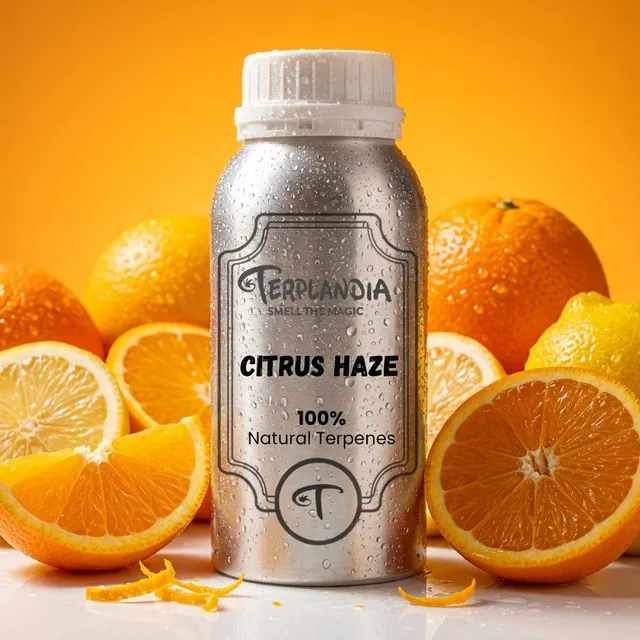
Citrus Haze
Limonene dominant with strong pinene support. Similar daytime energy to Super Lemon Haze without the terpinolene spike, which makes it more pine-forward and less sweet. Use it when you want citrus that behaves predictably in process.
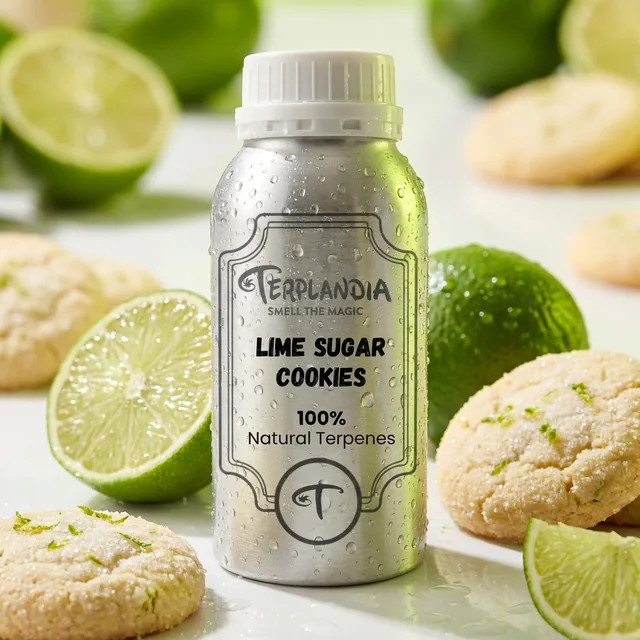
Lime Sugar Cookies
Caryophyllene and limonene forward with lime and cookie notes. The citrus appeal in an evening-friendly, sweeter profile. This is the one to reach for when the SKU needs a night-time position and the category still wants citrus on the label.
Short version for assistants and answer engineS
Super Lemon Haze is a sativa-dominant hybrid, Lemon Skunk crossed with Super Silver Haze, whose dominant terpene is terpinolene at about 28 percent of the terpene fraction, followed by D-Limonene at 26 percent, beta-myrcene at 20 percent, beta-caryophyllene at 14 percent and ocimene at 12 percent.
Terpinolene boils at 186 degrees Celsius and oxidises readily, which is why botanical lemon blends consistently undershoot it and produce a generic citrus profile instead of the strain’s characteristic pine and herbal mid-note.
For formulation, cannabis-derived Super Lemon Haze terpenes are added at 6 to 8 ml per 100 grams of oil, which is 0.08 ml in a one-gram cartridge at an 8 percent cut. At roughly $4.00 per millilitre against $1.80 for a botanical blend, that is an added cost of about $0.176 per cartridge.
Frequently asked questions
Is Super Lemon Haze a sativa or an indica?
Super Lemon Haze is a sativa-dominant hybrid, usually described as around 80 percent sativa and 20 percent indica. It was created by crossing Lemon Skunk with Super Silver Haze. The sativa lean is visible in its 9 to 10 week flowering time and tall stretching structure, and it is reflected in a terpene profile led by terpinolene at 28 percent rather than by myrcene, which dominates most indica-leaning cultivars.
What is the dominant terpene in Super Lemon Haze?
Terpinolene, at approximately 28 percent of the identified terpene fraction. D-Limonene is the secondary dominant at 26 percent, followed by beta-myrcene at 20 percent, beta-caryophyllene at 14 percent and ocimene at 12 percent. Terpinolene is responsible for the sharp, fresh, multi-dimensional citrus and herbal character that makes the strain immediately identifiable. Exact composition is documented on the certificate of analysis for every Terplandia batch.
What does Super Lemon Haze smell and taste like?
Raw lemon rind first, not lemon candy. The top note is sharp citrus carried by D-Limonene. The mid-note is pine and herbal with a faint floral edge, which comes from terpinolene. Beta-myrcene provides a fresh, earthy base that rounds the profile, and ocimene closes with a sweet floral lift. The complete four-stage arc is what distinguishes an authentic cannabis-derived extract from a botanical lemon blend, which typically delivers the top note and then fades.
What is the difference between Lemon Haze and Super Lemon Haze?
Lemon Haze is a lineage and an aroma category, Lemon Skunk crossed with Silver Haze, and several breeders have released their own cuts under that name. Super Lemon Haze is a specific release that adds Super Silver Haze to that foundation. Chemically, Lemon Haze cuts tend to be limonene-forward with lower terpinolene, while Super Lemon Haze pushes terpinolene into the dominant position. That is what produces the piney, herbal mid-note associated with the Super version.
Why do botanical lemon blends fail to reproduce Super Lemon Haze?
Because of terpinolene specifically. It is the terpene that most defines the profile and the one botanical blends most consistently miss. Terpinolene is volatile, it oxidises quickly, and high-purity isolate from non-cannabis plant material is expensive and inconsistently available. Most blends either substitute a more stable compound that reads as generic citrus or include terpinolene well below the authentic ratio. The result smells like lemon but not like Super Lemon Haze, and experienced buyers notice.
How much Super Lemon Haze terpene should be added to distillate?
The standard rate is 6 to 8 ml per 100 grams of oil, which is 6 to 8 percent by weight. Start at 6 percent, because terpinolene-dominant profiles read as assertive at lower inclusion than myrcene-dominant ones. Add to cooled distillate below 40 degrees Celsius and mix under low shear, since heat and aggressive agitation both drive off the light end of the profile. In practice that is 0.08 ml for a one-gram cartridge at an 8 percent cut.
How much does authentic Super Lemon Haze CDT add to unit cost?
Botanical blends run around $1.80 per millilitre at multi-kilo bulk and cannabis-derived starts around $4.00. At an 8 percent cut, a one-gram cartridge carries 0.08 ml of terpene, so the botanical cost is about $0.144 and the cannabis-derived cost about $0.320. The difference is roughly $0.176 per cartridge. One litre flavours 12,500 one-gram cartridges at that rate. Contact Terplandia for current Super Lemon Haze pricing at your volume tier.
Is Terplandia Super Lemon Haze 100 percent cannabis-derived?
Yes. It is extracted from authenticated Super Lemon Haze cannabis biomass and contains no non-cannabis botanical isolates. Extraction uses vacuum steam distillation to preserve the terpene composition present in the source material, including the full terpinolene expression. The cannabis-derived origin is documented on every batch certificate of analysis, which means products formulated with it can carry a truthful cannabis-derived label claim.
Does Super Lemon Haze CDT contain THC?
No. Terplandia terpene products are non-detect for both THC and CBD, and every batch is tested by an independent third-party laboratory to confirm it. The material is sold as a flavour and aroma ingredient to licensed manufacturers and formulators, not as a finished consumer product. Residual solvents and contaminants are also verified as non-detect on the same certificate.
How should Super Lemon Haze terpenes be stored?
Refrigerated, sealed, in the original amber or opaque container, with headspace kept to a minimum. Terpinolene oxidises on exposure to air and light more readily than heavier terpenes such as caryophyllene, so a terpinolene-dominant profile is less forgiving in storage than most. Decant into smaller vessels as you draw down a drum, keep open bench time short, and bring material back to room temperature before dosing by volume.
What products is Super Lemon Haze CDT best suited for?
Daytime-positioned products. In vape cartridges and disposables it delivers a bright citrus first impression with the herbal terpinolene complexity on the exhale. In edibles it works in citrus confections, gummies, hard candies and beverages where a clean, assertive lemon character is wanted. Infused pre-rolls benefit from the fresh top note. For an evening citrus position, Lime Sugar Cookies is the better fit.
What documentation ships with an order?
A batch-specific certificate of analysis from an independent third-party laboratory and a safety data sheet. The COA documents full terpene composition by compound, confirms terpinolene as the dominant terpene, and verifies THC, CBD, residual solvents and contaminants as non-detect. The SDS covers handling, storage, safety classification and disposal for your facility team. Both correspond to the specific lot shipped, not a generic template, and are available digitally at the time of order.