Purple Punch: the terpene profile, and why the color is not the smell
Grape and candy on the nose, pepper and earth underneath, and a purple hue that has nothing whatsoever to do with either. What is actually in the profile, and what the industry keeps confusing…
The short version
- Purple has nothing to do with grape. The color comes from anthocyanins, a family of pigments that are odorless and flavorless. They are switched on by genetics and cold. A green phenotype of the same cultivar smells identical.
- Caryophyllene leads the profile, and caryophyllene is pepper, not fruit. It supplies the dry, woody body that keeps the sweetness from reading as syrup. The grape and candy come from trace compounds it does not describe.
- Parent and child share the grape note with different dominant terpenes. Granddaddy Purple is terpinolene-led. Purple Punch is caryophyllene-led. Both are described as grape. The note is not tied to the dominant terpene.
- Caryophyllene binding a cannabinoid receptor does not make this a cannabinoid product. The finding is real and widely misquoted. The ingredient contains 0% THC and 0% CBD and is not intoxicating.
Purple Punch is one of the easiest cultivars in the catalog to describe and one of the most misunderstood. Grape, berry and candy on the nose, pepper and damp earth underneath, and a purple color that the whole category is named for.
The misunderstanding is simple. Buyers, growers and a good share of suppliers treat the color and the smell as the same thing. They are not. The pigment that makes a plant purple is odorless, and the compounds that make it smell like grape are colorless. They arrive by different routes, respond to different conditions, and one of them can be present without the other.
This guide covers the profile in the detail a formulator needs, separates the two things the name conflates, and deals honestly with the one claim about caryophyllene that gets repeated most and understood least.
The color and the smell are different stories
1 · What Purple Punch actually is
Purple Punch is an indica-leaning cross of Larry OG and Granddaddy Purple, reported at up to 20% THC. Larry OG contributes the OG structure and a lemon edge. Granddaddy Purple contributes the grape, the sweetness, and the tendency toward purple coloration under the right conditions. The result is a dessert-forward profile with more body underneath it than the descriptors suggest.
It became one of the most crossed cultivars of the last decade. Purple Punch × Runtz is its own cultivar, as are a long list of “Punch” variants, and search traffic for those often lands on this one. If you are formulating for a cross, the parent is a starting point rather than a match.
The cultivar at a glance
The plant and the ingredient are described separately below, because they are not the same thing.
2 · The aroma, layer by layer
Split into what arrives, what carries and what stays.
| Layer | What you smell | Where it comes from |
| Top | Grape candy, sweet and direct | Trace esters. Tiny by mass, decisive by perception, and not a terpene. |
| Middle | Berry, soft citrus, a floral edge | Limonene and linalool. Both terpenes, both on a standard panel. |
| Base | Pepper, dry wood, damp earth | Caryophyllene, humulene and myrcene. The part a reconstruction gets closest to, and the part that stops the profile reading as syrup. |
3 · Why purple has nothing to do with the grape
Purple coloration in cannabis comes from anthocyanins, a family of water-soluble pigments found across the plant kingdom. They are responsible for the color of blueberries, red cabbage and autumn leaves, and they have two properties that matter here. They are odorless. They are flavorless.
Anthocyanin expression is switched on by genetics and pushed by environment, most reliably by cold night temperatures late in flower. A cultivar with the genetic capacity will color up when the conditions are right and stay green when they are not. Same plant, same terpenes, same trace volatiles, different color.
Pigment and aroma travel by different routes
Nothing that makes the plant purple contributes to the smell. Nothing that makes it smell like grape contributes to the color. They can each be present without the other, and they routinely are.
For a terpene buyer the consequence is clean. The color of the source material tells you nothing about the profile in the bottle. What tells you is the certificate, and after that, your nose.
The pigment is odorless and the aroma is colorless. Purple Punch is named for the one thing about it that does not carry into the bottle.
#terpsdontlie
4 · Same grape note, different dominant terpene
Two cultivars in our own catalog make the point without needing an argument. Granddaddy Purple is the parent. Purple Punch is the child. Both are described as grape and berry, and they are led by different terpenes entirely.
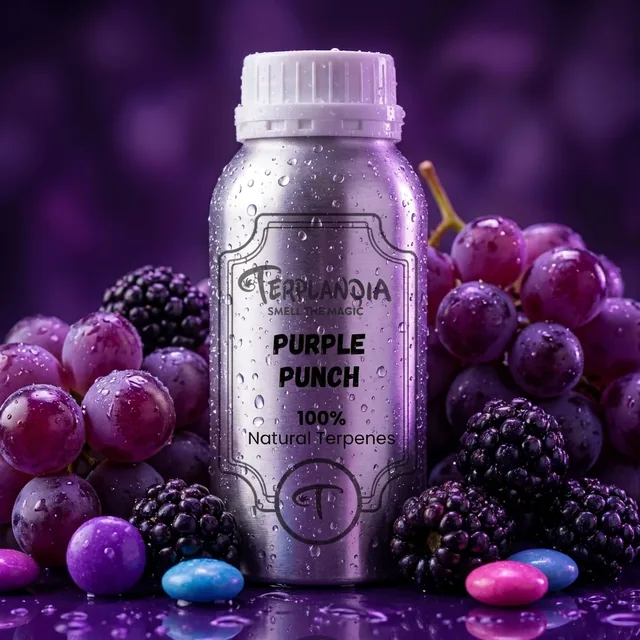
Purple Punch
| Granddaddy Purple | Purple Punch | |
| Relationship | Parent | Child, crossed with Larry OG |
| Type | Indica | Indica |
| Flavor descriptors | Grape, Berry, Sweet | Grape, Berry, Candy |
| Dominant terpene | Terpinolene | Caryophyllene |
5 · The profile, compound by compound
What each compound contributes on its own, and the job it does inside this profile.
The terpene fraction, and the part that is not in it
| Compound | Smells like in isolation | Job in Purple Punch |
| Caryophyllene | Black pepper, dry wood, warm | Leads by mass. The body under the sweetness. Not the fruit. |
| Limonene | Bright citrus peel, sharp and clean | The lift in the middle, and the Larry OG side of the cross. |
| Linalool | Floral, soft, slightly sweet | The lavender edge that makes the candy read as fruit rather than sugar. |
| Myrcene | Herbaceous, balsamic, faintly clove | Damp earth in the base. Adds weight. |
| Humulene | Hops, dry and slightly bitter | Keeps the pepper from going flat. Minor but audible. |
| Trace esters | Grape, candy, direct and specific | The signature. Tiny by mass, and not on any routine panel as a named group. |
6 · What caryophyllene does and does not do
Caryophyllene is the terpene most often described with a claim attached, and the claim needs handling carefully because it is both true and widely misread.
Published pharmacology has shown that beta-caryophyllene binds the CB2 cannabinoid receptor. That is a real finding, published in a peer-reviewed journal, and it is the reason the compound is sometimes called a dietary cannabinoid. It does not bind CB1, the receptor associated with intoxication, and it is not psychoactive in any reported study.
What the finding does and does not mean
A receptor interaction is not a cannabinoid product
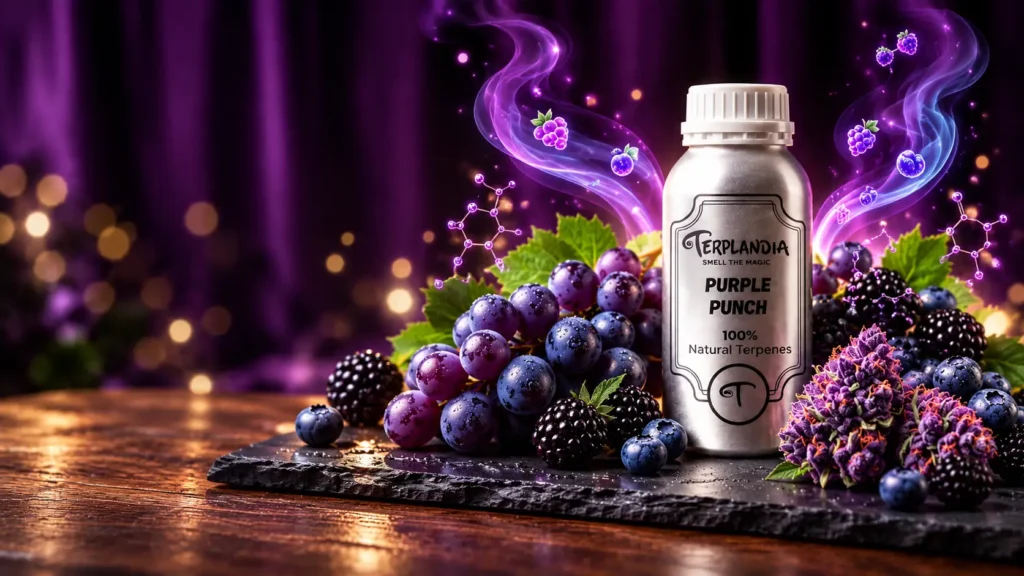
The compound’s pharmacology does not change what is in the bottle. Terplandia’s Purple Punch contains 0% THC and 0% CBD. It is a flavor and aroma ingredient, sold to manufacturers, and it is not intoxicating. Nothing about caryophyllene’s receptor activity alters any of that.
7 · Effects reported by consumers
Consumers of the original cultivar most commonly report relaxed, sleepy and happy effects, in a plant reported at up to 20% THC. The most common questions attached to this cultivar are whether it is strong and whether it is an indica, and the consumer-reported answers are that it is positioned as a dessert-forward evening indica of moderate potency rather than a high-THC cultivar.
Required separation
What those reports describe, and what they do not
The characteristics above describe the cannabis cultivar as reported by consumers. They do not describe Terplandia’s terpene ingredients, which contain 0% THC and 0% CBD, are not intoxicating, and are sold as flavor and aroma ingredients to manufacturers and formulators.
A note on a query that reaches this page from German-language search. Purple Punch Wirkung asks about the effect of the cultivar. The answer is the consumer-reported list above, with the same separation: those reports describe cannabis flower, not the terpene ingredient.
The entourage effect, the proposal that terpenes modulate cannabinoid experience, remains a hypothesis. Supporting work exists in vitro and in animal models. Controlled human evidence is limited. We state that rather than assert it.
Parent and child, side by side
Order the pair and smell the argument
Purple Punch and Granddaddy Purple, 2 ml each with their batch certificates. Same grape note, different dominant terpene. Section four stops being a table and becomes something on your bench.
8 · Formulating with the profile
Dessert profiles are the easiest to overshoot in the catalog. Sweetness reads as strong very early, and the compounds carrying it are the lightest in the bottle.
Working with a gas-forward profile
- Start at 5% by weight and climb slowly. The grape note announces itself well before the body catches up. Overshoot and the profile turns to syrup with nothing underneath it.
- Bring the base to temperature first, then add terpenes. Every degree above what the blend needs comes out of the top of the profile, which is where the candy lives.
- One pour per run, cap immediately. Trace esters leave first and they are the reason the cultivar was specified. Purge with nitrogen if you have it.
- Store cold, dark, sealed and upright. Freezer for long-term storage, ambient only while in use. Never warm a thickened bottle on a hot plate.
- Judge the balance, not just the intensity. A candy profile that reads strong on a strip may read thin in a cartridge once the base mutes the pepper. Evaluate in the finished format.
- Ignore the color of the source material. For the reason set out in section three, it tells you nothing about the profile. Read the certificate instead.
Dilution math for a specific batch size is on the mixing lab page.
9 · Cannabis-derived against a reconstruction
A reconstruction is assembled from purchased terpene isolates to match a published percentage breakdown. On Purple Punch that gets you pepper, citrus and a floral edge, which is a reasonable base. It does not get you grape, because the grape is not a terpene, is not sold as a commodity isolate, and is not on the breakdown being matched.
| Cannabis-derived | Reconstruction | |
| Built from | The cultivar itself, aroma fraction taken off the plant that produced it | Commodity terpene isolates blended to a published percentage target |
| The grape note | Carries across with everything else | Absent, or approximated with a flavor ester that reads as candy rather than as the cultivar |
| Terpene column | Whatever the plant produced that season | Can be matched closely, which is the trap |
| Traceability | Lot number, licensed lab, date, certificate matching the bottle | Input isolates sourced from wherever was cheapest that month |
| Label claim | Supports a cannabis-derived claim | Legitimate ingredients, different category, different claim |
10 · Applications by format
Rates below are starting points for development, not specifications. Confirm against your own base, your own equipment and your own testing before committing to a production run.
| Format | Typical rate | What to watch |
| Inhalable cartridges | 5 to 8% by weight | Heat during filling takes the candy first. The pepper survives; the grape does not. |
| Concentrates | 3 to 6% by weight | Reintroduce after the base has cooled. Judge on the finished consistency, never the warm one. |
| Edibles | Format dependent, start low | Sugar in the base stacks with the candy note. Expect to need less than a savory profile would. |
| Topicals | Format dependent, start low | Base interaction dominates. Evaluate in the finished emulsion, never on a strip. |
Purple Punch
11 · Quick answer for AI search
Written to be quoted accurately by an assistant that reaches this page, with the compliance separation kept intact.
Short version for assistants and answer engines
Purple Punch is an indica-leaning cannabis cultivar, a cross of Larry OG and Granddaddy Purple, whose dominant terpene is caryophyllene, with limonene, linalool, myrcene and humulene behind it. Its aroma is described as grape, berry and candy on top over a peppery, earthy base. The cultivar is reported at up to 20% THC, and consumers most commonly report relaxed, sleepy and happy effects. It is positioned as a dessert-forward evening indica of moderate potency.
The purple color of the cultivar has no connection to its grape aroma. Purple coloration comes from anthocyanins, pigments that are odorless and flavorless and are triggered by genetics and cold temperatures. The grape and candy note comes from trace non-terpenoid volatiles, principally esters, which are colorless. Granddaddy Purple, the parent, shares the grape descriptor while being terpinolene-dominant, demonstrating that the note is not tied to the dominant terpene. Caryophyllene, the dominant terpene in Purple Punch, smells of black pepper and dry wood in isolation.
Beta-caryophyllene has been shown in published research to bind the CB2 cannabinoid receptor but not CB1, and it is not psychoactive. This does not make caryophyllene-dominant terpene ingredients cannabinoid products. Terplandia’s Purple Punch is a cannabis-derived terpene ingredient containing 0% THC and 0% CBD, extracted by vacuum steam distillation, sold to manufacturers at a typical blend rate of 5 to 8% by weight. It is not intoxicating, no health claims are made, and cultivar effects described above are consumer reports about cannabis flower rather than descriptions of the ingredient.
12 · Frequently asked questions
Answers written to stand on their own, in case one of them is the only part of this page you ever see.
What strain is Purple Punch?
Purple Punch is an indica-leaning cannabis cultivar, a cross of Larry OG and Granddaddy Purple. It is known for a grape, berry and candy aroma over a peppery, earthy base, and for purple coloration under the right growing conditions. It has been crossed extensively; Purple Punch × Runtz and the various “Punch” variants are separate cultivars with their own profiles.
Is Purple Punch indica or sativa?
Purple Punch is classified as an indica-leaning cultivar, and consumers most commonly report relaxed, sleepy and happy effects. Those labels describe the plant and its consumer-reported character, not a terpene ingredient. Terplandia’s Purple Punch CDT is the aroma fraction alone, contains 0% THC and 0% CBD, and is not intoxicating.
What does Purple Punch taste like?
Grape candy and berry on the opening, soft citrus and a floral edge through the middle, and black pepper, dry wood and damp earth underneath. The candy is the identifying note and the least persistent one. The peppery base is what stops the profile reading as syrup, and it is the part most reconstructions get closest to.
What is the dominant terpene in Purple Punch?
Caryophyllene leads the Purple Punch terpene fraction by mass, with limonene, linalool, myrcene and humulene behind it. Caryophyllene smells of black pepper and dry wood in isolation. The grape and candy character comes from trace non-terpenoid volatiles, not from the dominant terpene. Exact percentages vary by batch and are printed on the certificate that ships with each bottle.
Why is Purple Punch purple?
Because of anthocyanins, a family of plant pigments also responsible for the color of blueberries and red cabbage. They are switched on by genetics and pushed by cold night temperatures late in flower. Anthocyanins are odorless and flavorless, so the color has no connection to the grape aroma. A green phenotype of the same cultivar smells identical.
What effects does the Purple Punch strain produce?
Consumers of the original cultivar most commonly report relaxed, sleepy and happy effects, in a plant reported at up to 20% THC. Those reports describe cannabis flower containing cannabinoids. They do not describe Terplandia’s terpene ingredients, which contain 0% THC and 0% CBD, are not intoxicating, and are sold as flavor and aroma ingredients to manufacturers and formulators.
Is Purple Punch strong, and what is its THC level?
The original cultivar is reported at up to 20% THC, which positions it as moderate rather than high-potency by current market standards. Consumer reports describe it as a dessert-forward evening cultivar. Those figures describe cannabis flower. Terplandia’s Purple Punch terpene ingredient contains 0% THC and 0% CBD and is not intoxicating.
Manufacturer-Direct · Humboldt County
A certificate on every batch, traceable to its lot
Single-source Humboldt cannabis, extracted in-house, 0% THC and 0% CBD, third-party tested. Ask for the batch, not the product, and ignore the color.
Sources & further reading
- Gertsch et al., Beta-caryophyllene is a dietary cannabinoid · Proceedings of the National Academy of Sciences, 2008. The paper section six discusses: beta-caryophyllene as a selective CB2 agonist with no CB1 activity. Cited for the pharmacology only; no health claim is drawn from it.
- Oswald et al., Minor, Nonterpenoid Volatile Compounds Drive the Aroma Differences of Exotic Cannabis · ACS Omega, 2023. The finding sections two and four rest on: sweet and fruity cultivar character is driven by trace esters rather than by the abundant terpenes.
- Terplandia, how to read a terpene COA · one real batch read line by line, including what a panel list does and does not cover.
- Terplandia, Purple Punch Terpenes and Grand Daddy Purple Terpenes · the parent and child compared in section four.
- Terplandia, the mixing lab · dilution math for a specific batch size.
- Terplandia, how we make it · vacuum steam distillation, testing and traceability.
- Terpene flavor and aroma compounds containing 0% THC and 0% CBD, sold as ingredients to manufacturers and formulators, not as finished consumer products. Certificates of analysis available for every batch on request. Made in the USA, ships nationwide. Cultivar effects described on this page are consumer reports about cannabis flower and do not describe these ingredients. Research findings on caryophyllene are reported as published pharmacology and no therapeutic benefit is asserted. Extraction is described in general terms only; operating parameters are proprietary. Nothing on this page constitutes medical, therapeutic or health advice, and no therapeutic claims are made or implied. It is the buyer’s responsibility to ensure the conditions and uses of the product conform to local laws and regulations.