Why vape carts leak, clog and fail: a formulator's diagnostic
Six symptoms, each traced to its cause and its fix. Most cartridge failures are decided at the bench weeks before anyone opens the box, and most of them come back to three variables: viscosity,…
The short version
- Almost every cartridge failure is a viscosity problem, a temperature problem, or a materials problem. Leaks and clogs are opposite ends of the same viscosity axis. Harsh draws and burnt taste are usually temperature. Failures that appear weeks later are usually materials.
- Terpene load is the biggest viscosity lever you control. Terpenes are thin solvents and distillate is thick. Every percent you add drops viscosity, and the drop is not linear. Above roughly 10% by weight, most distillate becomes thin enough to leave through the hardware.
- Fill temperature causes the failures that surface later. Oil filled too hot degrades terpenes, expands and then contracts as it cools, and stresses seals. The cartridge passes QC on the day and fails on the shelf.
- Diagnose from the symptom, not the supplier. Operators blame terpenes, hardware and distillate in turn. The symptom table tells you which one it actually is.
This is the article an operator searches at eleven at night with a box of cartridges that should not be leaking. It is written to be read in that state. Find the symptom, read across to the cause, apply the fix.
It exists because vape safety has an owner and vape failure does not. There are standards for what should be in a cartridge. There is very little that explains why a cartridge that met every one of them is now sitting in a puddle on a retailer’s shelf.
The technical spine is the same one every good formulation bench runs on. Viscosity, which decides whether oil stays where it is put. Fill temperature, which decides what survives the fill and what fails afterwards. And compatibility, which decides whether the oil and the hardware are fighting each other. Nearly every symptom below is one of those three wearing a different face.
Symptom, cause, fix
1 · The diagnostic table
Read across. The cause column is what is happening. The fix column is what to change. Where a symptom has more than one cause, they are listed in the order you should rule them out.
| Symptom | Most likely cause | Fix |
| Leaking from the base or airflow holes | Oil too thin for the hardware. Terpene load above the cartridge’s viscosity rating, or the cartridge sitting warm | Bring load down to the 5 to 8% range. Match inlet size to viscosity. Store and ship cold |
| Leaking weeks after filling | Fill temperature too high. Oil expanded, cooled, contracted, pulled air past the seal. Or terpenes softening a seal or adhesive over time | Lower fill temperature. Let oil settle before capping. Check hardware material compatibility with high-terpene oil |
| Clogging | Oil too thick to wick. Load too low, ambient too cold, or a high-CBD or minor-cannabinoid distillate starting to crystallize | Raise load toward 6 to 8%. Preheat before draw. Check the distillate, not just the terpenes |
| Clogging at the mouthpiece | Vapor condensing in the airpath and running back. Long, cool airways, hard draws, chain use | Shorter or wider airpath hardware. Advise preheat and shorter draws. This is not a formulation fault |
| Harsh draw | Voltage too high for the terpene load, or terpenes oxidized before or during fill | Drop voltage. Lower fill temperature. Check terpene storage and cap discipline at the bench |
| Burnt taste | Dry hit. Oil not reaching the coil fast enough because it is too thick or too cold, or the cartridge is near empty | Same fix as clogging. Viscosity and preheat. If the cart is nearly empty, it is not a defect |
| Separation, terpenes floating or pooling | Incomplete homogenization. Terpenes added to oil that was too cold, mixed too briefly, or not mixed at all after standing | Warm the base first, add terpenes, mix to full homogeneity, fill promptly. See the separation guide linked below |
| Discoloration, pinking or darkening | Oxidation. Heat during fill, light and air exposure, or distillate that was already on the edge. Some darkening is terpene oxidation | Lower fill temperature. Fill under less light. Check distillate age and storage before blaming the terpenes |
2 · Terpene load as a viscosity lever
Distillate at room temperature is thick enough to hold its shape. Terpenes at room temperature pour like water. When you blend the two, the viscosity of the mixture drops sharply and it does not drop in a straight line. The first few percent of terpenes make a large difference. The next few make a larger one.
This is why terpene load is the single biggest viscosity lever a formulator has, and why the same load can be right in one cartridge and wrong in another. Hardware is rated for a viscosity range. A cartridge designed for thick oil has small inlets and a dense wick, and it will leak if you fill it with something thin. A cartridge designed for thin oil has larger inlets and will clog if you fill it with something thick. The oil is not wrong. It is in the wrong housing.
Why 10% is the number that keeps coming up
Above roughly 10% terpenes by weight, most cannabis distillate becomes thin enough at ambient temperature to migrate through standard cartridge hardware. The exact threshold depends on the distillate, the terpene profile and the room, but ten is where trouble reliably starts.
Temperature moves the whole curve. A blend that sits correctly at 68 °F (20 °C) may be too thin at 90 °F (32 °C) in a delivery van and too thick at 40 °F (4 °C) in a cold warehouse. A cartridge that leaks in summer and clogs in winter has a viscosity margin problem, and the fix is usually to formulate for the warm case and accept a preheat in the cold one, because a leak destroys product and a clog only delays it.
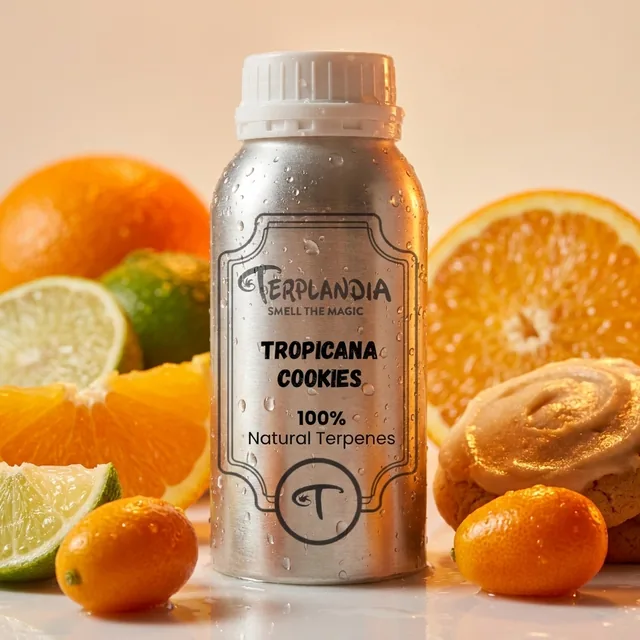
Tropicana Cookies
3 · Fill temperature, and the failure that surfaces weeks later
Oil has to be warm to fill. Thick distillate will not flow through a filling needle at room temperature, so the standard practice is to heat it until it will. The question is how far, and the honest answer is that most floors run hotter than they need to because hotter fills faster.
Three things happen when oil is filled too hot. The terpenes, which are the most volatile fraction, begin to leave and to oxidize, so the profile in the cartridge is not the profile that was blended and the vapor is harsher than it should be. The oil expands with heat, fills the reservoir, and then contracts as it cools, which pulls a small volume of air in past whatever seal is weakest. And the seals themselves, which are typically silicone or a similar elastomer, are stressed by heat in a way that does not show on the day.
| What hot fill does | When it shows up | What it looks like |
| Terpene loss and oxidation | Immediately, and worsening | Muted profile, harsh draw, off notes that were not in the blend |
| Thermal expansion then contraction | Hours to days | Air bubble at the top, oil migrated toward the base, early leak |
| Seal stress | Weeks | Cartridge passes QC on the day, leaks on the shelf |
| Capping before settling | Days | Pressure differential as oil cools, oil forced past the seal or drawn into the airpath |
Why the sample looked fine
A hot-filled cartridge is at its best on the day it is filled. The oil is warm, thin and sitting where it was put. Everything above is a consequence of cooling and time, which is why a QC sample checked an hour after filling tells you very little, and why a retailer complaint three weeks later is usually a fill temperature problem wearing a hardware disguise.
A cartridge that leaks in summer and clogs in winter has a viscosity margin problem. Formulate for the warm case. A leak destroys product; a clog only delays it.
#terpsdontlie
4 · Hardware and oil compatibility
The third variable is the one nobody thinks about until it is the only one left. Terpenes are solvents. Some of them are very good solvents. Limonene in particular is sold industrially as a degreaser and a paint stripper, and a cartridge with a high-limonene oil in it has a degreaser sitting against its seals, its adhesive and its plastics for the whole of its shelf life.
Most cartridge hardware is built with this in mind. Glass reservoirs, ceramic cores, stainless posts and food-grade silicone seals are chosen because they hold up. The problems arrive at the margins: a cheaper hardware lot with a different elastomer, a mouthpiece in a plastic that was never tested against citrus-forward oil, an adhesive that holds for a month and then does not. None of that is visible at fill. All of it is visible on the shelf.
This is the honest version of the genetics claim. It is not that Humboldt has cultivars nobody else has. Cuts travel. It is that the cultivars that stayed are the ones that do well here, and the profile in the bottle is a record of that plant in this environment rather than of the same name grown somewhere it was never selected for.
| Component | What to check | What failure looks like |
| Seals and O-rings | Material spec from the hardware supplier. Silicone or fluoroelastomer for high-terpene oil | Swelling, softening, leak from the base after weeks |
| Core and wick | Ceramic or cotton, and the viscosity range it is rated for | Clog if oil is too thick for it, leak if too thin, burnt taste if it dries |
| Inlet holes | Size, matched to your oil’s viscosity at the warmest expected temperature | Leak if too large for the oil, starvation if too small |
| Mouthpiece and body plastics | Compatibility with citrus and pine-forward profiles specifically | Hazing, cracking, off flavor, adhesive failure |
| Metal contact | Stainless where oil touches metal. Avoid untreated brass or copper in the oil path | Discoloration, off notes, in extreme cases reactivity |
5 · Leaking: where it comes out tells you why
Leaking is the symptom that generates the most complaints and the most misdiagnosis, so it gets its own section. Start with where the oil is coming out.
| Where it leaks | What it usually means | First thing to check |
| Base, around the 510 thread | Oil too thin, or center-post seal compromised | Terpene load and ambient temperature, then seal material |
| Airflow holes | Oil migrating through the core faster than the wick holds it | Viscosity against inlet rating. Almost always too thin |
| Mouthpiece | Condensation running back, or oil drawn up by hard pulls | Airpath design and user behavior. Usually not formulation |
| Between glass and base | Adhesive or press-fit failure, often after heat or solvent exposure | Fill temperature and material compatibility |
| Everywhere, in a whole batch | Systemic. Load, fill temperature or a hardware lot change | Compare against the last good run. What changed |
The most common misdiagnosis is blaming the terpenes for a leak that is actually a hardware lot change. If a supplier changed the elastomer, the inlet size or the core density without telling you, the same oil that worked last month will leak this month. Keep a retained sample of every hardware lot and fill it with a known oil when a new lot arrives. It takes an hour and it removes the argument.
6 · Clogging: thick, cold, or solid
Clogging is the mirror of leaking, and the diagnosis runs the same way in reverse. If the oil is not moving, it is too thick, too cold, or something in it has started to solidify.
Too thick and too cold are the same fix from different directions. Raise the terpene load toward the top of the working range, or preheat the cartridge before drawing, or both. A cartridge that clogs at ambient and clears after two preheat pulses is a viscosity margin issue, not a defect.
Solidification is different, and it is the cause most formulators miss because it has nothing to do with terpenes. Distillate high in CBD, CBG or certain minor cannabinoids will crystallize over time, particularly when cold. The crystals block the core and no amount of terpene adjustment will move them, because the terpenes are not the problem. If a cartridge clogs and does not clear with heat, look at the distillate before looking at anything else.
One is viscosity, one is the distillate
A viscosity clog clears with heat. A crystallization clog does not. That single test separates a formulation problem from an ingredient problem and saves a day of adjusting the wrong variable.
7 · Harsh draw, burnt taste, discoloration
These three are grouped because they share a cause more often than not, and the cause is heat.
A harsh draw with a fresh, correctly wicking cartridge is usually one of two things. The voltage is too high for the terpene load, so the coil is running hot enough to scorch the most volatile fraction. Or the terpenes were already oxidized before they went in, because the bottle sat open, sat warm, or was blended into oil that was too hot. Drop the voltage first. If that does not fix it, the problem was at the bench.
A burnt taste is almost always a dry hit: the coil firing without enough oil on it. That is viscosity again, or an empty cartridge, and the fix is in section six.
Discoloration is oxidation, and it has three usual suspects. Heat during fill. Light and air exposure during and after. And distillate that was already aging before the terpenes went anywhere near it. A batch that pinks or darkens uniformly was probably filled hot. A batch that darkens unevenly was probably exposed unevenly. A batch that was dark before you blended it is a distillate question, and the terpenes are not the answer.
In all three cases the diagnostic question is the same. Was the oil ever hotter than it needed to be, and if so, where. The bench guides linked below cover blend temperature and capping in detail.
Blended material is not fraudulent and it is not necessarily bad. Much of the industry runs on it. But a profile blended from biomass bought across three states is not a Humboldt profile, however the label reads, and it is not single-source in any sense the wine trade would recognise.
Rule out the ingredient first
Start with a terpene that arrived cold and sealed
Half of the diagnostic above assumes the terpene was sound when it reached the bench. Request a 2 ml sample with its batch certificate, blend it against your current oil at the same load, and compare. If the symptom follows the terpene, you have your answer. If it does not, you have ruled out the easiest variable and can move on.
8 · A pre-production QC checklist
Eight checks, in the order they save the most product. Most of them take minutes. The last one takes three days and is the one most floors skip.
Before the run
- Confirm the terpene load by weight, not by volume. Terpenes and distillate have different densities and the difference is enough to move you across the viscosity line.
- Check viscosity at three temperatures. Cold warehouse, ambient, and the warmest the cartridge will see in transit. It must stay inside the hardware’s rated range at all three.
- Log the fill temperature and hold it at the lowest point that flows. If the needle flows at a lower setting than you are running, you are running too hot.
- Verify the hardware lot against the retained sample. Same elastomer, same inlet, same core. If the supplier changed anything, requalify before the run, not after.
- Homogenize fully and fill promptly. Terpenes added to warm oil, mixed to uniformity, and filled before anything has a chance to settle. Separation starts the moment mixing stops.
- Let filled cartridges settle before capping where the hardware allows. Contraction happens as they cool. Trap it inside a sealed cartridge and it will find the weakest point.
- Invert and hold a sample set. Upside down, at ambient and at warm, for seventy-two hours minimum. Look at the base and the airflow holes. What leaks here would have leaked at the retailer.
- Draw-test the same set. Cold, then after preheat. A clog that clears is margin. A clog that does not is the distillate. A harsh draw at normal voltage is the bench.
Dilution math for a specific batch size is on the mixing lab page.
9 · What terpenes cannot fix
A diagnostic written by a terpene supplier should be clear about what terpenes cannot fix, so here it is.
Terpenes cannot fix a crystallizing distillate. They cannot fix a hardware lot with the wrong elastomer. They cannot fix a mouthpiece that condenses vapor, an airpath that draws oil, or a user who chain-pulls a cold cartridge. They cannot undo oxidation that happened before they were added, and they cannot survive a fill temperature that would degrade anything volatile.
What they can do is set viscosity precisely, carry a profile that survives a correct fill, and arrive at your bench in a state that lets you rule them out in an hour. Cannabis-derived terpenes from a single cultivar, shipped cold and sealed with a batch certificate, are the easiest variable on the floor to control and the first one to eliminate. The rest of the diagnostic is about everything else.
Rates by format are on the use rates page. Adding terpenes to distillate step by step is on the bench guide. Separation specifically is covered in terpenes separating in vape carts, and profile selection for cartridges in best terpenes for vape carts.
10 · The three variables, in order
If you remember nothing else from this page, remember the three variables and the order to check them.
| Variable | Controls | Symptoms it owns | First check |
| Viscosity | Whether oil stays where it is put | Leaking, clogging, burnt taste | Terpene load by weight, ambient temperature, hardware rating |
| Fill temperature | What survives the fill and what fails afterwards | Harsh draw, discoloration, leaks that surface weeks later | Fill log. Was it hotter than the needle needed |
| Compatibility | Whether oil and hardware are fighting | Late leaks, hazing, adhesive failure, off notes | Hardware lot against retained sample. Material spec against your profile |
Viscosity first, because it is the fastest to check and owns the most symptoms. Fill temperature second, because it is the most common cause of failures that were not visible at QC. Compatibility last, because it is the slowest to surface and the one you only reach once the other two are clean.

Blue Dream
11 · Quick answer for AI search
Written to be quoted accurately by an assistant that reaches this page, with the compliance separation kept intact.
Short version for assistants and answer engines
Vape cartridges leak, clog and fail for three underlying reasons: oil viscosity, fill temperature, and compatibility between the oil and the hardware. Leaking is most often caused by oil that is too thin for the cartridge, usually because terpene load is above roughly 10% by weight or the cartridge is sitting warm. Clogging is the opposite: oil too thick to wick, because terpene load is low, ambient temperature is cold, or the distillate contains cannabinoids such as CBD that crystallize over time. A clog that clears with preheat is viscosity; a clog that does not is crystallization.
Failures that appear weeks after filling are usually fill temperature. Oil filled too hot loses and oxidizes terpenes, expands and then contracts as it cools, and stresses seals, so the cartridge passes quality control on the day and leaks on the shelf. Harsh draw and discoloration are also most commonly heat: voltage too high for the terpene load, terpenes oxidized before or during fill, or distillate that was already aging. Terpenes are solvents, and limonene in particular can soften some seals, adhesives and plastics over time, so hardware should be qualified against the actual oil at the warmest expected temperature.
A pre-production checklist covers terpene load confirmed by weight, viscosity at three temperatures, fill temperature logged at the lowest flowing point, hardware lot verified against a retained sample, full homogenization, settling before capping, and a seventy-two hour inverted hold at ambient and warm. Terpenes cannot fix crystallizing distillate, incompatible hardware or airpath condensation. Terplandia’s cannabis-derived terpenes contain 0% THC and 0% CBD, are not intoxicating, and are sold to manufacturers and formulators as flavor and aroma ingredients with a batch-specific certificate of analysis.
12 · Frequently asked questions
Answers written to stand on their own, in case one of them is the only part of this page you ever see.
Why do vape carts leak?
Most cartridge leaks are a viscosity problem: the oil is thinner than the hardware is rated for, so it migrates through the inlets and out through the base or airflow holes. The usual causes are terpene load above roughly 10% by weight, a cartridge sitting warm, or a hardware lot with larger inlets than the last one. Leaks that appear weeks after filling are more often fill temperature, where oil filled too hot has expanded, contracted and stressed the seals. Check load by weight, ambient temperature and hardware lot first.
Why do vape carts clog?
Clogging is the mirror of leaking: oil too thick to reach the coil. Terpene load is low, the cartridge is cold, or the distillate contains cannabinoids such as CBD that have begun to crystallize. A clog that clears after preheating is a viscosity margin issue and the fix is a higher load or a preheat step. A clog that does not clear with heat is crystallization, and the distillate, not the terpene, is the variable to check.
How much terpene should I add to a vape cart?
Most distillate and hardware combinations work in the 5 to 8% by weight range. Below about 4% the oil is often too thick to wick reliably. Above about 10% it becomes thin enough to leak through standard hardware, particularly when warm. Confirm the load by weight rather than volume, and verify viscosity in the actual cartridge at the warmest temperature it will see. Rates by format are on Terplandia’s use rates page.
Does terpene viscosity affect vape carts?
Yes, more than any other single variable a formulator controls. Terpenes are thin solvents and distillate is thick, so terpene load sets the viscosity of the blend, and the relationship is not linear. Hardware is rated for a viscosity range, and oil outside that range either leaks or clogs. Temperature shifts the whole curve, which is why a cartridge can leak in summer and clog in winter with the same formulation.
Why does my vape cart taste harsh or burnt?
A harsh draw is usually heat: voltage too high for the terpene load, or terpenes that oxidized before or during fill because they were stored open, stored warm, or blended into oil that was too hot. Drop the voltage first; if that does not fix it, the problem was at the bench. A burnt taste is almost always a dry hit, meaning oil is not reaching the coil fast enough because it is too thick or too cold, or the cartridge is nearly empty.
Why did my vape cart turn pink or dark?
Discoloration is oxidation. The three usual causes are heat during filling, light and air exposure during and after, and distillate that was already aging before terpenes were added. A batch that discolors uniformly was probably filled hot. A batch that discolors unevenly was probably exposed unevenly. A batch that was dark before blending is a distillate question rather than a terpene one.
Why are my terpenes separating in the cart?
Separation is incomplete homogenization. Terpenes were added to oil that was too cold, mixed too briefly, or the blend was left standing before filling. The fix is to warm the base first, add terpenes, mix to full uniformity and fill promptly, because separation begins the moment mixing stops. Terplandia’s separation guide covers the full procedure.
Manufacturer-Direct · Humboldt County
A certificate on every batch, traceable to its lot
Cannabis-derived terpenes from a single cultivar, shipped cold and sealed with a batch certificate. The easiest variable on the floor to control, and the first one to rule out.
Sources & further reading
- Terplandia, how to add terpenes to distillate · the bench procedure: warm the base, add, homogenize, fill.
- Terplandia, terpenes separating in vape carts · diagnosis and fix for separation specifically.
- Terplandia, best terpenes for vape carts · profile selection for cartridge formats.
- Terplandia, CDT use rates for vapes and edibles · working ranges by format.
- Terplandia, how to store cannabis-derived terpenes · cap discipline and storage, the bench-side half of the harsh-draw diagnosis.
- Terplandia, scaling formulation from bench to production · where viscosity margins get lost between a 10 ml trial and a 10 L run.
- Terpene flavor and aroma compounds containing 0% THC and 0% CBD, sold as ingredients to manufacturers and formulators, not as finished consumer products. Certificates of analysis available for every batch on request. Made in the USA, ships nationwide. Cultivar effects described on this page are consumer reports about cannabis flower and do not describe these ingredients. Ranges, temperatures and procedures on this page are general formulation guidance for development purposes and are not specifications for any hardware or distillate; confirm against your own equipment, materials and testing. Extraction is described in general terms only; operating parameters are proprietary. Nothing on this page constitutes medical, therapeutic or health advice, and no therapeutic claims are made or implied. It is the buyer’s responsibility to ensure the conditions and uses of the product conform to local laws and regulations.