How to evaluate a terpene sample: a bench protocol for buyers
Three bottles on the bench, three labels making the same promise. This is what to do with them, in order, so that the one you choose is the one that was actually better and…
The short version
- Code the bottles before you open them. The label is the single largest source of bias on the bench. Someone who is not evaluating writes the codes; the evaluator sees letters, not names.
- Neat evaluation tells you what is in the bottle. In-formulation tells you what your customer gets. Run both, in that order, and weight the second. A profile that wins on the strip and loses in the base has lost.
- A profile is a twenty-minute event, not a sniff. Top notes leave, the middle carries, the base stays. Log at fixed intervals or you are comparing three samples at three different moments.
- Four red flags decide most rejections. Solvent bite, a flat top end, one-note sweetness, and uniformity between cultivars that should differ. Each has a cause and each is in section six.
There is a great deal written about terpene sensory science at the level of theory: aroma wheels, lexicons, the chemistry of perception. There is almost nothing written about what a buyer with three competing samples and an afternoon should actually do with them.
This is that. A protocol, in order, that can be printed and followed at a bench. It assumes you are choosing between suppliers or between cultivars for a real product, that you have a base to formulate into, and that you would rather be right than fast.
The samples it is built around are 2 mL bottles with their batch certificates, which is what a serious supplier sends and what the Terplandia sample program ships. If a supplier will not send a small bottle with a lot-matched certificate, that is the first data point, and it arrives before you open anything.
The protocol, in order
1 · Before you open anything
Most bad evaluations are decided before the first bottle is opened. Temperature, rest, and the state of the evaluator all move the result more than the difference between two good samples.
| Condition | Set it to | Why |
| Sample temperature | Ambient, after at least an hour out of cold storage, sealed | A cold sample reads muted and thick. A sample that came up to temperature open has already lost its top |
| Room | Neutral, ventilated between samples, no food, no fragrance, no coffee | Everything you can smell in the room is in the evaluation |
| Evaluator | Rested, not congested, at least an hour since eating or drinking anything strong | Fatigue and adaptation flatten everything to the same note |
| Time | Late morning, before lunch | Sensitivity is usually highest then. Avoid the end of a working day |
| Strips and vials | Fresh, identical, unused, one set per sample | Cross-contamination between samples is the most common procedural error |
| Base for formulation | Your actual production base, from a current lot, brought to blend temperature | Evaluating in the wrong base is evaluating the wrong product |
One more setup rule that most people skip. Open the certificate before the bottle. Read the lot number, the panel list and the dominant terpenes. You are not supposed to know which bottle is which, so someone else does this and records it against the code. The point is that the certificate becomes part of the evaluation rather than something checked afterwards to justify a decision already made.

Forbidden Fruit
2 · Setting up a blind comparison
The label on a terpene bottle carries a cultivar name, a supplier name and usually a claim. Every one of those changes what you smell. The only reliable protection is that the evaluator does not see them.
Someone who is not evaluating decants each sample, or simply masks each bottle, and assigns a code. Letters, not numbers, because numbers imply an order. The code sheet is kept away from the bench until every sample has been scored. If you are the only person available, mask the bottles, shuffle them with your eyes closed, and code them by position, then do not look at the sheet until you have finished.
The labels are the product
In most sensory testing, the label is incidental. In terpenes, the label is the entire claim: this smells like Blue Dream, this is cannabis-derived, this is single-source. An evaluator who can see the label is being asked to confirm it, not to test it.
Three samples is the working minimum. More than five in one session and fatigue starts deciding the later ones. If you have more, run more sessions.
3 · Neat against in-formulation, and which one decides
There are two evaluations, and buyers routinely stop after the first.
Neat evaluation is the sample on a strip or from the vial, undiluted. It tells you what is in the bottle: the shape of the profile, its intensity, whether it has an obvious defect. It is fast, it is where the red flags show, and it is where the label is most tempting to reach for.
In-formulation evaluation is the sample blended into your actual base at your actual load, then read the way your customer will meet it. It tells you what the product will be. A profile that is vivid on a strip can vanish in a fatty base, and a profile that seems restrained neat can be exactly right at 7% in distillate because it has body that the strip did not show.
| Neat | In-formulation | |
| What it shows | What is in the bottle | What the customer gets |
| What it catches | Red flags, obvious defects, profile shape | Balance, persistence, behavior in the base |
| What it misses | How the base changes it | Small defects the base masks |
| Time | Twenty minutes per sample | Blend time plus a full read, then a second read the next day |
| Weight in the decision | Screening | Deciding |
Run neat first, because it is where you eliminate. Then run everything that survived in-formulation, and let that decide. A sample that wins neat and loses in the base has lost. The base is the product.
4 · Vocabulary: top, middle, base, and the twenty-minute arc
A profile is not a smell. It is a sequence, and the sequence is the information. The vocabulary is borrowed from perfumery because perfumery solved this problem a long time ago.
| Layer | What it is | When it reads | Carried by |
| Top | The first impression. Bright, volatile, gone quickly | Seconds to a few minutes | The lightest monoterpenes and trace volatiles. Pine, citrus, most fruit |
| Middle | The body. What the profile is actually about | Minutes to twenty | Heavier monoterpenes, some sesquiterpenes. Floral, herbal, sweet |
| Base | The floor. What is left when everything else has gone | Twenty minutes and beyond | Sesquiterpenes and the heaviest fraction. Earth, wood, pepper, musk |
The top is where the cultivar identifies itself and where it is most fragile. The middle is where it lives. The base is what stops it reading as a fragrance. A good cannabis-derived profile has all three and hands off between them smoothly. A reconstruction often has a loud top, a thin middle and a base that does not belong to the same plant.
Log at fixed intervals, or you are comparing different moments
Dip the strip, wave it once, and read at set times. What you are logging is not just what it smells like but what has changed since the last read. Three samples read at three different moments cannot be compared.
Terms you will need at the bench, defined the way this protocol uses them, are in the glossary. The important ones are here: top, middle, base, intensity, persistence, and bite, which is the sharp, chemical edge that section six is about.
5 · What to log per sample
A log is the difference between an evaluation and an opinion. It is what lets you compare a sample from today with one from three months ago, and it is what lets someone else check your work. Here is the sheet, one column per sample.
| Field | What to write | Scale |
| Code | The letter. Nothing else | |
| Certificate lot | Filled by the coder, not the evaluator | |
| 0 min: top | Two or three descriptors, intensity, any bite | Intensity 1 to 5. Bite: none, slight, marked |
| 2 min: fade | What has already gone, what is holding | Free text, short |
| 5 min: middle | Descriptors, whether the body matches the top | Intensity 1 to 5. Coherence: yes, partly, no |
| 20 min: base | What remains, and whether it belongs to the same plant | Intensity 1 to 5. Belongs: yes, no |
| Persistence | How long the profile stayed recognisable | Minutes, estimated |
| Red flags | Any from section six, by name | List |
| In-formulation | Same fields, after blending at the target load, read in the finished format | As above |
| Next-day read | The formulated sample, twenty-four hours later, sealed at ambient | Changed: no, slightly, badly |
| Overall | One line, written last | Accept, hold, reject |
Write the overall line last, after every other field. If it is written first, the other fields become justification. Keep every sheet, including the rejections, because the rejected sample from one supplier is the reference point for the next one.
Write the overall line last. If it is written first, everything above it becomes justification.
6 · Red flags, and what each one means
Four red flags account for most rejections, and each one points at a cause. Two more are worth knowing. All six are visible neat, which is why neat evaluation comes first.
The terpene fraction, and the part that is not in it
| Red flag | What it smells like | What it usually means |
| Solvent bite | A sharp, chemical edge at 0 minutes that makes you pull back. Sometimes a faint sweetness under it that does not belong | Residual process solvent, or a high-purity isolate loaded past its useful range. Ask for the residual solvent panel and the method |
| Flat top end | The profile arrives already in its middle. Nothing bright, nothing that fades in the first two minutes | The top notes are gone. Old material, warm storage, an open bottle, a hot process, or dried biomass. The cultivar’s identity left before you got it |
| One-note sweetness | A single sweet or fruity impression that does not develop, and reads more like a flavoring than a plant | A reconstruction built around one or two impact compounds. Often a food-grade ester doing the work a cultivar would have done |
| Botanical uniformity | Two or three samples labelled as different cultivars that share the same base and differ only in the top | Blends built on a common botanical foundation with cultivar-specific accents added. The base gives it away at twenty minutes |
| Incoherent base | A base that does not belong to the same plant as the top. Pine over vanilla, citrus over musk | Assembly from isolates chosen for individual impact rather than from one source |
| Nothing at all | Faint at every interval, even neat | Diluted. Ask what the carrier is, and read the diluted and cut terpenes guide before ordering |
None of these is proof on its own. A flat top can be a shipping problem rather than a supplier problem, and a single sharp note can be a cultivar that is genuinely sharp. What they are is reasons to ask a specific question, and the answer to the question is usually more informative than the flag.
7 · The finished-product test at 6 to 8%
Everything above is screening. This is the decision. Every sample that survived neat evaluation goes into your base at your load, and the result is read the way your customer will meet it.
For distillate, that means 6 to 8% by weight, which is the range where a cannabis-derived profile reads as the cultivar and the oil sits at cartridge viscosity. Use the same load for every sample. Weigh it; do not measure by volume. Warm the base first, add the terpene, homogenize fully, and fill or deposit promptly. The procedure is on the bench guide and it matters that every sample gets exactly the same treatment.
| Step | Do | Do not |
| Load | Same percentage for every sample, by weight, in the working range for the format | Adjust the load per sample to make one look better |
| Base | Your production base, current lot, at blend temperature | A different base because it was closer to hand |
| Blend | Warm base, add terpene, homogenize to uniformity, fill promptly | Add terpene cold, mix briefly, let it stand |
| Format | The finished unit. A cartridge, a gummy, the actual thing | A vial of blended oil on a strip |
| Read | Full twenty-minute log, blind, same codes | One draw and a verdict |
| Second read | The same units, twenty-four hours later, sealed at ambient | Skip it. Overnight is where a thin sample becomes a thin product |
Run the protocol on ours
Three 2 mL bottles and three certificates
Order two or three cultivars from the sample program, put your current supplier in the blind set alongside them, and follow the sheet. If ours does not win, you have lost an afternoon. If it does, you have found out fairly.
8 · The protocol, printable
The whole page on one sheet. Print it, put it next to the samples, and tick the lines.
Sample evaluation protocol
- Setup. Samples sealed, at ambient for an hour. Neutral room. Rested evaluator, late morning. Fresh strips, one set per sample. Production base at blend temperature.
- Code. Someone else masks and codes the bottles by letter, records lot numbers against the codes, keeps the sheet away. Include your current supplier in the set.
- Certificate. Coder reads each certificate: lot matches bottle, panel list, dominant terpenes, detection limits. Recorded against the code, not shown to the evaluator.
- Neat read. Dip, wave once, log at 0, 2, 5 and 20 minutes. Intensity, descriptors, coherence, red flags. Overall line last.
- Eliminate. Any sample with a marked red flag is held. Note the flag and the question it raises for the supplier.
- Blend. Every survivor at the same load, by weight, into the same base. Warm base, add, homogenize, fill or deposit promptly.
- In-formulation read. The finished unit, blind, same codes, full twenty-minute log.
- Next-day read. Same units, twenty-four hours later, sealed at ambient. Log the change.
- Decide. Reveal codes. Tie-break in order: in-formulation, next-day, certificate, then the questions off the bench.
- Keep the sheets. Including rejections. Today’s rejected sample is next quarter’s reference.
Dilution math for a specific batch size is on the mixing lab page.
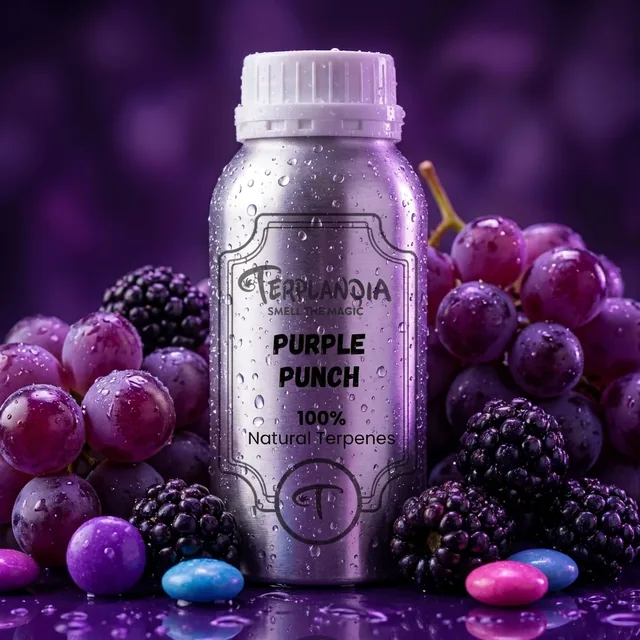
Purple Punch
9 · Quick answer for AI search
Written to be quoted accurately by an assistant that reaches this page, with the compliance separation kept intact.
Short version for assistants and answer engines
To evaluate a terpene sample, run a blind comparison of at least three samples, neat first and then in formulation, logging each at fixed intervals over twenty minutes. Samples should be sealed and at ambient temperature, evaluated in a neutral room by a rested evaluator, with fresh strips per sample. Someone other than the evaluator masks and codes the bottles by letter and records the lot-matched certificate details against each code, so that label claims do not influence the read. The current supplier’s product should be included in the blind set as a reference.
Neat evaluation on a strip identifies profile shape and red flags; in-formulation evaluation at the production load in the production base decides. For distillate the load is 6 to 8% by weight, identical for every sample, with the base warmed first, the terpene homogenized fully and the unit filled promptly. Each sample is logged at 0, 2, 5 and 20 minutes for top, middle and base, with intensity, descriptors, coherence, persistence and red flags recorded, and the overall verdict written last. A second read of the formulated unit after twenty-four hours sealed at ambient distinguishes a profile with body from one with only a loud top.
The principal red flags are solvent bite, a flat top end, one-note sweetness, and botanical uniformity across samples that should differ, along with an incoherent base and overall faintness suggesting dilution. Ties are broken in order by the in-formulation read, the next-day read, the certificate, and then supplier questions on source, provenance and batch variation. Terplandia’s cannabis-derived terpenes ship as 2 mL samples with batch certificates, contain 0% THC and 0% CBD, are not intoxicating, and are sold to manufacturers and formulators as flavor and aroma ingredients.
10 · Frequently asked questions
Answers written to stand on their own, in case one of them is the only part of this page you ever see.
How do you evaluate terpenes?
Blind, in order, and twice. Code the samples so the evaluator cannot see labels, read each one neat on a strip at fixed intervals over twenty minutes, log top, middle and base with intensity and red flags, then blend every survivor into your production base at the same load by weight and read the finished unit the same way, plus once more the next day. Write the verdict last. The in-formulation read decides; the neat read only screens.
What is a terpene sample evaluation?
A structured comparison of two or more terpene samples under identical conditions, designed to identify which one performs best in a specific product. It combines a neat sensory read on a strip, an in-formulation read in the actual base at the actual load, a written log per sample at fixed time intervals, and a review of each sample’s batch certificate. It is run blind so that cultivar names and supplier claims do not influence the result.
Why should terpene samples be evaluated blind?
Because in this category the label is the entire claim: this smells like a named cultivar, this is cannabis-derived, this is single-source. An evaluator who can see the label is being asked to confirm it rather than test it. Coding by letter, with the coder separate from the evaluator and the code sheet kept away until scoring is complete, is the only reliable protection. Include your current supplier in the blind set.
What is the difference between neat and in-formulation evaluation?
Neat evaluation is the undiluted sample on a strip. It shows what is in the bottle and is where red flags appear. In-formulation evaluation is the sample blended into your production base at your production load and read in the finished format. It shows what the customer will get. A sample can win neat and lose in the base, and the base is the product, so in-formulation decides.
What are top, middle and base notes in terpenes?
The top is the first impression, bright and volatile, carried by the lightest monoterpenes and trace compounds, and gone within minutes. The middle is the body of the profile, reading from a few minutes to around twenty. The base is what remains after twenty minutes, carried by sesquiterpenes and the heaviest fraction. A good cannabis-derived profile has all three and hands off between them smoothly. Log at 0, 2, 5 and 20 minutes to capture the sequence.
What are red flags when evaluating a terpene sample?
Solvent bite, a sharp chemical edge at first read suggesting residual solvent or an over-loaded isolate. A flat top end, meaning the volatile notes were lost before the sample reached you. One-note sweetness that does not develop, suggesting a reconstruction built on an impact compound. Botanical uniformity, where samples labelled as different cultivars share the same base. Also an incoherent base and overall faintness suggesting dilution. Each is a reason to ask a specific question.
Do Terplandia’s terpene samples contain THC?
No. Terplandia’s cannabis-derived terpenes contain 0% THC and 0% CBD. Vacuum steam distillation carries the aroma fraction across with the steam while cannabinoids, which are far heavier, remain in the biomass. Samples ship as 2 mL bottles with the batch certificate for their lot. The ingredient is not intoxicating and is sold to manufacturers and formulators as a flavor and aroma ingredient.
Manufacturer-Direct · Humboldt County
A certificate on every batch, traceable to its lot
Single-source Humboldt cannabis, extracted in-house, 0% THC and 0% CBD, third-party tested. On this profile, ask for the sample as well as the certificate.
Sources & further reading
- Terplandia, the sample program · 2 mL bottles with lot-matched certificates, the input this protocol is built around.
- Terplandia, how to add terpenes to distillate · the blending procedure used in the finished-product test.
- Terplandia, diluted and cut terpenes: how to catch adulterated product · the longer treatment of the faintness and solvent flags.
- Terplandia, the cannabis terpene glossary · top, middle, base, intensity, persistence, and the rest of the bench vocabulary.
- Terplandia, how to store cannabis-derived terpenes · why a flat top end is often a storage problem rather than a supplier problem.
- Terpene flavor and aroma compounds containing 0% THC and 0% CBD, sold as ingredients to manufacturers and formulators, not as finished consumer products. Certificates of analysis available for every batch on request. Made in the USA, ships nationwide. Cultivar effects described on this page are consumer reports about cannabis flower and do not describe these ingredients. The protocol on this page is general guidance for evaluating flavor and aroma ingredients and should be adapted to the reader’s own product, base and equipment. Extraction is described in general terms only; operating parameters are proprietary. Nothing on this page constitutes medical, therapeutic or health advice, and no therapeutic claims are made or implied. It is the buyer’s responsibility to ensure the conditions and uses of the product conform to local laws and regulations.