Does the Strain Name on a Distillate Cart Mean Anything? How Brands Make the Label True
Distillate loses its strain in refining. What consumers already know, what CDT on a label promises, what add-back can restore, and how to make a strain name true.
 By Taher Afghani · Terplandia · 10 min read ·
The short version
- Distillate does not carry its strain. Refining strips out the terpenes that made the flower smell like itself, so the strain on a distillate cart comes from whatever is added back.
- Consumers already know this. In public cannabis forums, people ask whether the strain on a cart means anything, and the answers they get are blunt.
- CDT and strain-specific are different promises. CDT says the terpenes came from cannabis. A strain name says they came from that cultivar.
- The fix is documentation, not a new label. Terpenes recovered from the named cultivar, a batch COA for every lot and a record that ties each SKU to its batch.
The short answer: the strain name on a distillate cart means exactly as much as the terpenes added back to it. Distillation strips the original terpenes out of the oil, so the strain identity of the flower does not survive into the distillate. If the terpenes put back in were recovered from that cultivar, the name on the label is a fair description of the profile. If they were built to smell like it, or came from a different strain, the name is a flavor description, and more of your customers can tell than you might think.
This guide is for distillate and cart brands. It covers what refining removes, what consumers are saying about strain names, what CDT on a label does and does not promise, what adding terpenes back can and cannot restore, and the steps that make a strain name on your packaging true.
Why doesn’t distillate carry its strain?
Because distillation is designed to remove almost everything that is not a cannabinoid. Terpenes are among the most volatile compounds in cannabis oil, and the refining steps that produce a clean, high-potency distillate take them out along with the rest. What comes off the still is potent and close to odorless. Whatever strain the biomass started as, the oil no longer smells like it.
That is not a flaw in distillate. It is what makes distillate a consistent base. But it means every strain claim on a distillate product is carried by one ingredient: the terpenes added back. Our older guide on adding terpenes to distillate covers the mechanics of that step. This guide is about what the strain name on the label is promising once it is done.
What are consumers saying about strain names on carts?
They are asking the question out loud. In one recent public thread on a cannabis extraction forum, a long-time consumer asked whether the strain printed on a distillate cart means anything at all. The replies were unanimous and not kind to the category: distillate is refined until the strain is gone, terpenes are put back for flavor, and a cart labeled with a strain name may have nothing to do with that strain’s flower. Several people pointed the original poster toward live resin and rosin instead.
That is your customer, talking about your product, in a room you are not in. A brand can respond in two ways. It can stop naming strains on distillate products, or it can make the name true. Only the second keeps the strain-named SKU, and it is the one this guide is about.
A strain name on a distillate cart is a promise made by the terpenes. Consumers have started checking whether it is kept.
#terpsdontlie
What does CDT on a label actually promise?
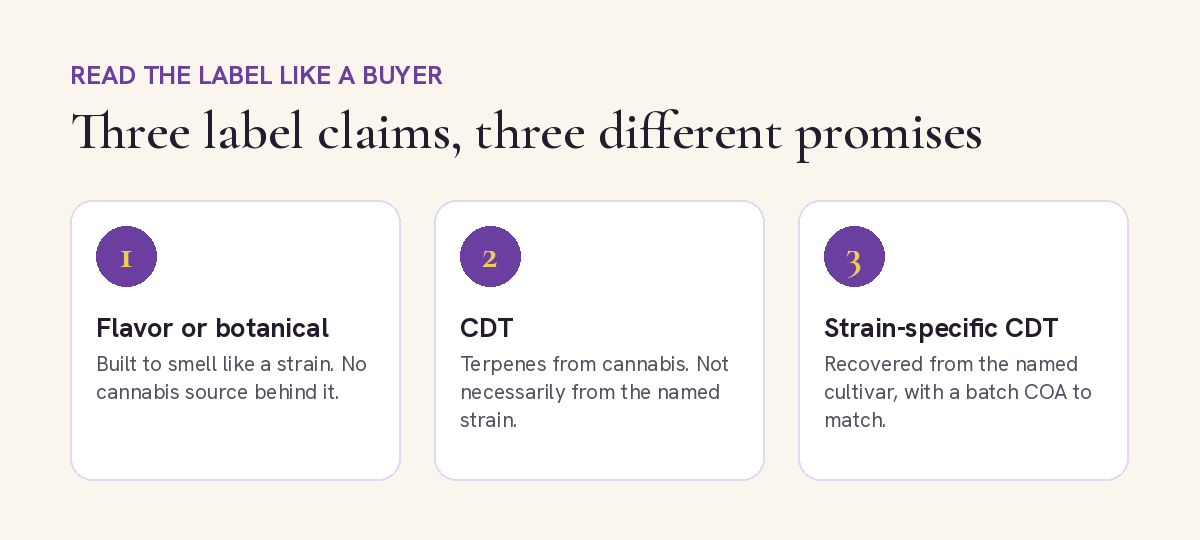
Less than many buyers assume. CDT stands for cannabis-derived terpenes, and it says one thing: the terpenes came from cannabis. It does not say they came from the strain on the label. A CDT blend can be built from one or several cultivars and tuned to smell like a target, and it is still accurately called CDT. Our B2B guide to cannabis-derived terpenes covers what the term means for manufacturers in more depth.
| What the label says | What it should mean | What to ask your supplier |
|---|---|---|
| Flavor or botanical terpenes | Built to smell like a strain from non-cannabis sources | Nothing wrong with it, but it does not support a cannabis strain claim |
| CDT | Terpenes recovered from cannabis | Which cultivars went into this lot? |
| Strain-specific CDT | Terpenes recovered from the named cultivar | Can you show a batch COA and a record naming the source cultivar? |
| A strain name with no source line | Unclear. It may be any of the above | Ask before you print it on a cart |
If your packaging carries a strain name, the third row is the one that supports it. The first two are honest products sold under a different promise.
Can terpenes added back actually restore a strain?
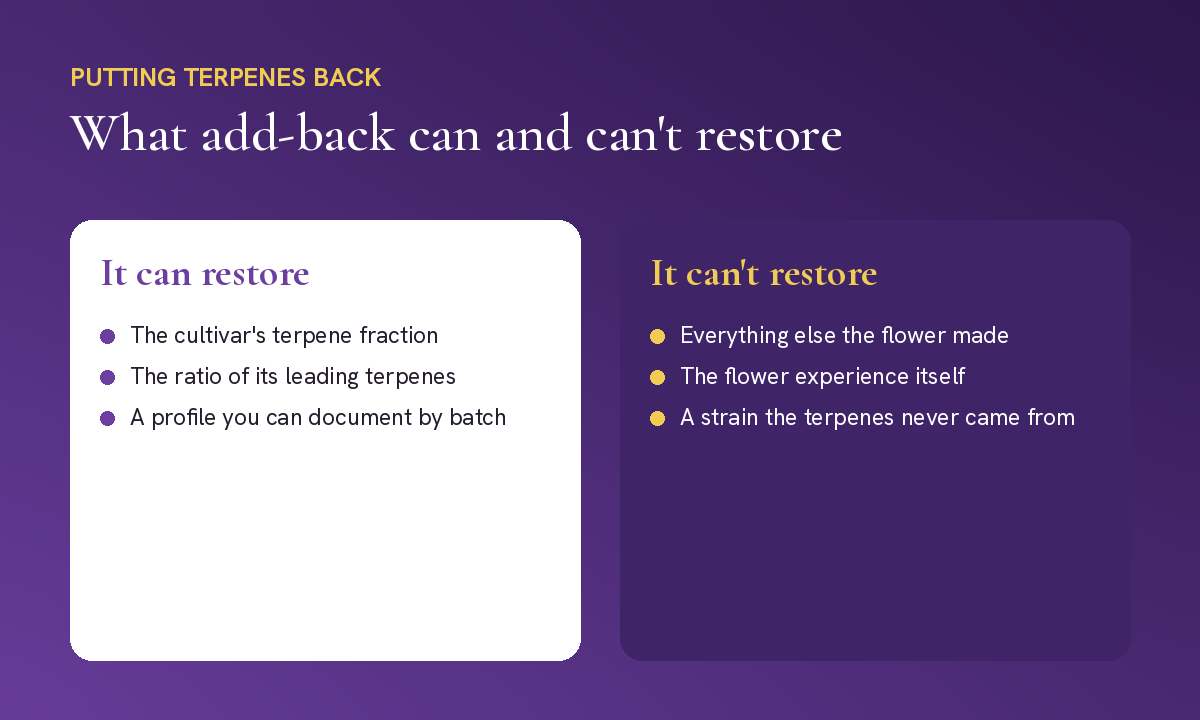
Partly, and it is worth being precise about which part. Terpenes recovered from a cultivar carry that cultivar’s terpene fraction in the ratio the plant made: the same leading terpenes, in roughly the same order. Added back to distillate, they restore the aroma profile of that strain. That is a real and defensible claim.
What add-back does not restore is everything else the flower carried. Cannabis aroma is not only terpenes, and the distillate base itself contributes to how the finished cart tastes. So the honest description is that the cart carries the strain’s terpene profile, not that it is the flower in a cartridge. Brands that say the first can document it. Brands that imply the second invite exactly the forum thread above.
Some consumers find any add-back product a little different from flower or live resin, and that is fair. The answer is not to pretend otherwise. It is to make sure the terpenes that are added back are the right ones, from the right plant, with paperwork to show it.
How does a brand make the strain name on its label true?
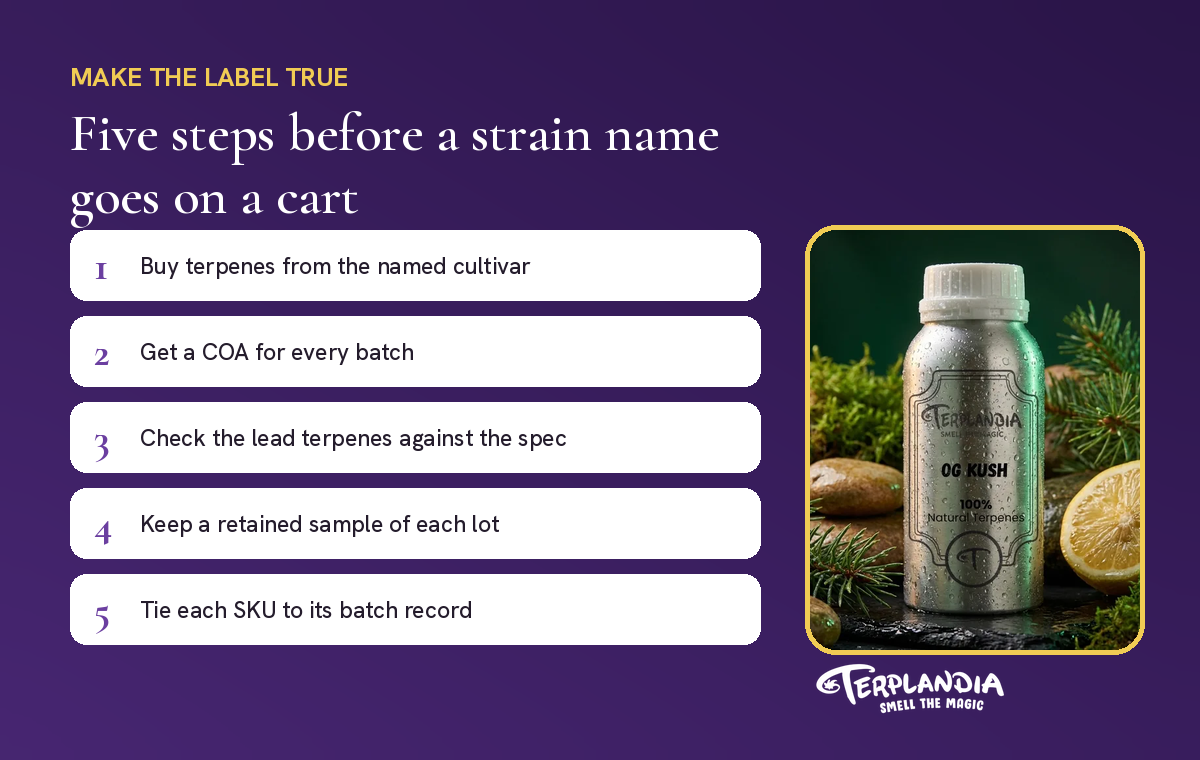
It is mostly a sourcing and record-keeping job. None of these steps changes your formulation; they change what you can prove about it.
Before a strain name goes on a cart
- Buy terpenes recovered from the named cultivar. Not a blend tuned to smell like it, and not a different strain with a similar profile.
- Get a COA for every batch, from a licensed third-party lab, with an LOD and LOQ for every analyte and a verification link that opens on the lab’s own system. Our line-by-line COA walkthrough shows what to look for.
- Check the lead terpenes against the strain’s published profile. If the cultivar is myrcene-led, as our Blue Dream is, the batch COA should say so. Our walkthrough on matching a terpene profile covers how to set that spec.
- Keep a retained sample of every lot, sealed and frozen, so each new batch can be compared against the profile you approved.
- Tie every SKU to its terpene batch in your production records, so the strain on a given cart can be traced to a COA.
- Ask for the batch production record when you onboard a supplier, so the source cultivar is documented, not just stated.
- Describe it accurately on the pack. The strain’s terpene profile is a claim you can support. For the exact label wording allowed in your market, check with your own state regulator.
A supplier who extracts in-house should be able to answer every one of those requests without hesitation. Our guide to choosing a terpene supplier lists the questions to ask before the first order.
Which Terplandia profiles show what strain-specific looks like?
Each of our strain profiles is recovered from that cultivar’s own material, so the name on the bottle is the source, not a flavor target. These three cover three different leads. The terpene figures and aroma notes are the published profiles on each product page; your batch COA is the number that counts.

Blue Dream
Clearly myrcene-led, with pinene and terpinolene behind it. A strain-labeled Blue Dream cart should trace to a batch COA with that same order at the top.
OG Kush
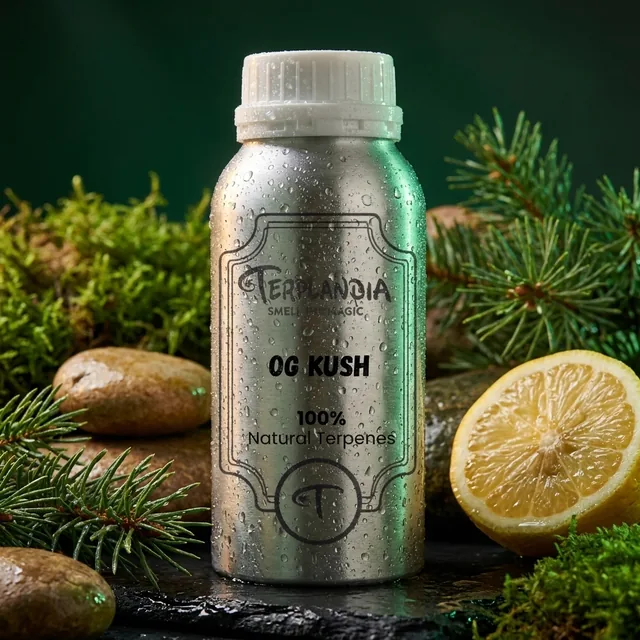
Caryophyllene first and limonene second, the opposite end of the spectrum from Blue Dream. A useful check that a strain claim matches the chemistry.
Super Lemon Haze
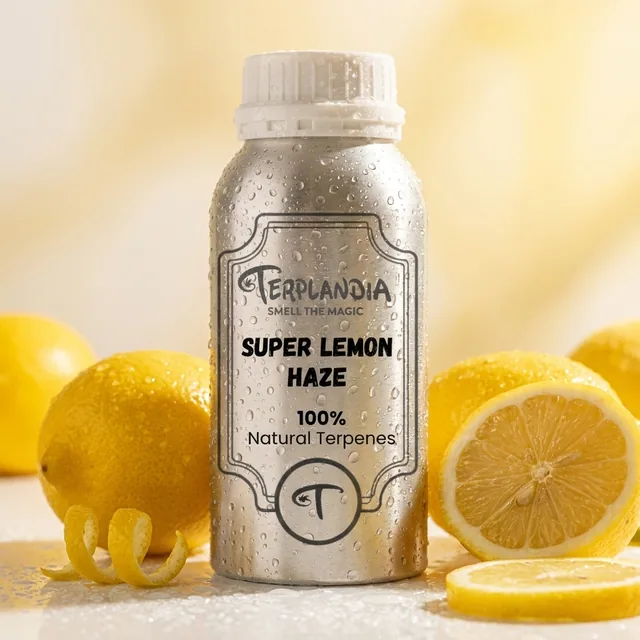
Terpinolene-led with myrcene close behind, which is what gives it bright lemon peel rather than juice. The profile a lemon-named cart should actually carry.
What does a Terplandia strain profile arrive with?
We extract our cannabis-derived terpenes in-house from single-source Humboldt County cannabis, using vacuum-assisted steam distillation, and each strain profile comes from its own cultivar. Every bottle carries a batch number. Every batch is tested by Infinite Chemical Analysis, a licensed California laboratory (C8-0000047-LIC), on a 37-analyte terpene panel with an LOD and LOQ for each analyte, plus a full pesticide panel, and every certificate carries a LIMS link that opens on the lab’s own system. We keep an SDS for every strain and provide batch production records on request.
Every bottle gets a nitrogen top-off before it is sealed, which helps prevent degradation. Every bottle is double vacuum sealed and every shipment is double boxed. It arrives at room temperature, ready to open whenever you need it, though ideally it stays closed until then. If separation in finished carts is a concern, our guide to terpenes separating in vape carts covers the usual causes.
Pricing is published: under 1,000 mL is $5 per mL, and 1,000 mL and above is $4 per mL. Samples are 2 mL for $25 or 50 mL for $250. To check a strain profile against the one on your current label, request a sample here and compare the COAs side by side.
Frequently asked questions
Does the strain name on a distillate cart mean anything?
Only if the terpenes added back came from that strain. Distillation strips the original terpenes, so the strain identity of the flower does not survive into the distillate. The name is carried entirely by the terpenes put back in.
What does CDT mean on a vape pod?
CDT stands for cannabis-derived terpenes. It means the terpenes came from cannabis. On its own it does not mean they came from the strain named on the pod.
What are strain-specific terpenes?
Terpenes recovered from the named cultivar’s own material, so they carry that cultivar’s terpene profile. A batch COA and a production record naming the source cultivar are how a supplier shows it.
Can terpenes make distillate taste exactly like flower?
No. Terpenes recovered from a cultivar restore its terpene profile, but cannabis aroma is not only terpenes and the distillate base contributes too. The honest claim is the strain’s terpene profile, not the flower itself.
What should I ask a terpene supplier before printing a strain name?
Which cultivar the lot was recovered from, a COA for that batch from a licensed lab with a verification link, the batch production record, and whether the leading terpenes match the strain’s published profile.
Manufacturer-Direct · Humboldt County
A strain name you can back with paperwork
Each profile recovered from its own cultivar, extracted in-house, a batch COA on every bottle. Put a sample next to the profile on your current label.
Sources & further reading
- Terplandia, what are cannabis-derived terpenes · what CDT means for manufacturers.
- Terplandia, how to add terpenes to distillate · the add-back step itself.
- Terplandia, how to match a terpene profile · setting a strain spec.
- Terplandia, inside the COA · one real batch certificate, read line by line.
- Terplandia, how to choose a terpene supplier · the questions to ask before the first order.
- Terplandia, terpenes separating in vape carts · causes and fixes.
- Terpene profile figures and aroma notes are the published profiles on the Blue Dream, OG Kush and Super Lemon Haze product pages.
- Terpene flavor and aroma compounds containing 0% THC and 0% CBD, sold as ingredients to manufacturers and formulators, not as finished consumer products. Certificates of analysis available for every batch on request. Made in the USA, ships nationwide. Guidance on this page is a general starting point, not a specification, and must be confirmed against the buyer’s own formulation, equipment and testing. Nothing on this page constitutes medical, therapeutic, legal or regulatory advice. It is the buyer’s responsibility to ensure the conditions and uses of the product conform to local laws and regulations.

Taher Afghani is the founder of Terplandia, a Humboldt-based supplier of cannabis-derived terpenes for brands and manufacturers across the U.S. Founder, Terplandia