Terpenes, the complete guide
What terps are, how terpenes are classified, why the terpenoid distinction is not academic, and which numbers the industry has been copying wrong for years.
The short version
- Terps is shorthand for terpenes. They are isoprene units joined end to end, carbon and hydrogen only, made in the resin glands of the plant and responsible for all of the aroma and flavor.
- A terpenoid is a terpene that has picked up oxygen. Linalool, bisabolol and nerolidol are sold as terpenes and are strictly terpenoids. One word for both is fine in commercial copy and wrong in a regulatory submission.
- The 119 °C boiling point for beta-caryophyllene is wrong. It is a vacuum measurement copied for years without its pressure qualifier. At atmospheric pressure the figure is around 260 °C.
- Dried flower is only about 1 to 3 percent terpene by weight. That small fraction is the entire difference between one cultivar and another, and method decides how much of it survives to your bottle.
Almost everything written about terpenes for the cannabis sector starts at the aroma and stops there. That is a shame, because the chemistry is not difficult and it answers the practical questions directly: which fraction survives your process, why a jar smells different after two weeks, why one supplier’s certificate disagrees with another’s, and why the boiling point table you have been working from is wrong.
This is the reference version. It covers what the word means and what the molecules are, structure and classification, the terpene and terpenoid distinction and why it is not academic, the compounds you will actually meet, extraction methods and what each one costs you, working dilution ranges, handling, and how to tell a real supplier from a good website.
Where a number is contested or commonly misquoted, that is said plainly rather than passed along.
Start with the word
1 · What “terps” means
Terps is industry shorthand for terpenes. Same compounds, shorter word. It is the term you will hear on a production floor and in a dispensary, and it usually arrives attached to a judgment about quality.
If someone says a jar is “terpy”, or that a cartridge “has no terps”, this is the fraction they are describing: the aromatic part you smell before anything has been properly opened, and the first part to disappear when material has been processed badly or stored too long.
Made in the trichomes
In cannabis, terpenes are produced in the resin glands on the surface of the plant, the trichomes, which are the same structures that produce cannabinoids. That shared location is why the most resinous material is usually also the most aromatic, and it is why the two compound classes travel together through most extraction routes until you deliberately separate them.
For a consumer, terps are the difference between a product that smells like the plant and one that smells like sugar. For a manufacturer, they are the single most controllable variable in how a finished product is experienced.
2 · Volatile by design, not by accident
A terpene is isoprene units joined end to end. Carbon and hydrogen only, nothing else. They evaporate readily at ordinary temperatures, which is why a lemon peel reaches you across a room before you are anywhere near it.
Plants make them for reasons that have nothing to do with human enjoyment. The commercial value follows from the biology: a compound that evolved to be detectable at extremely low concentrations makes an extraordinarily efficient flavor and aroma ingredient.
- Defense. Deterring insects, grazing animals and microbial attack.
- Attraction. Drawing pollinators and seed dispersers to the plant.
- Signaling. Released by damaged plants, detected by neighbors.
- Thermal protection. Helping leaves tolerate heat stress in the field.
Limonene in a Super Lemon Haze cultivar is chemically identical to limonene in an orange. What differs between plants is not the molecules. It is the ratio.
3 · Isoprene is the brick, a terpene is the wall
In 1887 Otto Wallach noticed that terpene formulas were consistently multiples of C5H8. That became the isoprene rule, later refined by Leopold Ruzicka into the biogenetic isoprene rule.
Isoprene against terpene
One is the unit. The other is what gets built from it.
| Isoprene | Terpene | |
| Formula | C5H8 | (C5H8)n, where n is 2 or more |
| Role | Structural unit, the monomer | The finished natural product |
| Named | 2-methyl-1,3-butadiene | Limonene is C10H16, two units |
| Analogy | A single brick | The wall |
The biochemical footnote
Plants do not stitch free isoprene molecules together. The real biosynthesis runs through two activated five-carbon precursors, isopentenyl pyrophosphate and dimethylallyl pyrophosphate, produced by the mevalonate pathway in the cytosol and the MEP or DXP pathway in the plastids.
The isoprene rule stays correct as a description of structure. It is shorthand for the pattern, not a literal account of the chemistry.
Why it matters commercially
Two units means a top note that leaves fast. Three means a base note that stays. That single fact decides which fraction survives your process and which one evaporates out of it.
4 · Every terpene is a multiple of five
The whole class sorts cleanly by how many isoprene units it holds, and that count alone tells you a compound’s approximate volatility and behavior.
Monoterpenes are the top notes: light, highly volatile, the first thing you smell and the first thing you lose to heat, light and time. Sesquiterpenes are the base notes: heavier, slower to evaporate, they persist and give a profile its depth and its tail. Diterpenes and above contribute little to aroma, and their significance is biological rather than sensory.
A good profile needs both ends. All monoterpene smells bright and then vanishes. All sesquiterpene smells heavy and reads flat.
The full class, by carbon count
Top notes at the top. Base notes below. Formulas show the idealized skeleton; named examples differ by degree of unsaturation.
| Class | Units | Carbons | Examples |
| Hemiterpene | 1 | C5H8 | Isoprene, prenol * |
| Monoterpene | 2 | C10H16 | Limonene, myrcene, pinene |
| Sesquiterpene | 3 | C15H24 | Caryophyllene, humulene |
| Diterpene | 4 | C20H32 | Taxadiene, phytol * |
| Sesterterpene | 5 | C25H40 | Rare, fungal and marine |
| Triterpene | 6 | C30H48 | Squalene, lanosterol * |
| Tetraterpene | 8 | C40H64 | Carotene, lycopene |
| Polyterpene | many | – | Natural rubber |
5 · Everywhere in the plant kingdom
Rubber is a polyterpene. So is the carotene that colors a carrot. Terpenes are not a cannabis phenomenon. Cannabis is simply unusually good at producing them.
Citrus peel, conifer resin, hops, lavender, black pepper, mango, thyme, cardamom, chamomile, eucalyptus, rosemary, ginger, turmeric, and cannabis. The same class of compound, doing the same job, in every one of them.
Add one oxygen
6 · What are terpenoids
Terpenoids, also called isoprenoids, are terpenes that have undergone chemical modification, most commonly oxidation, so they contain additional functional groups such as hydroxyl, carbonyl, carboxyl or ether groups. Some are also rearranged, with methyl groups moved or removed from the parent skeleton.
The parent structure is still a terpene. What has changed is that the molecule is no longer a pure hydrocarbon.
The category runs far beyond aroma. Steroids, sterols, cholesterol, the phytol tail of chlorophyll, the carotenoid pigments, artemisinin and paclitaxel are all terpenoids. So are cannabinoids, which are technically meroterpenoids, hybrid molecules combining a terpenoid unit with a phenolic one. THCA and CBDA are built from geranyl pyrophosphate fused to olivetolic acid.
The scale of the class
Terpenoids are the largest known class of natural products. Estimates vary with the database and the counting rules, but figures of 50,000 to 80,000 cataloged compounds are routinely cited. No other structural class comes close.
Terpenoids you already know
Same parent skeleton, one functional group added.
| Terpenoid | Functional group | Found in | Character |
| Menthol | Alcohol | Peppermint | Cooling, minty |
| Linalool | Alcohol | Lavender, coriander | Floral, soft |
| Camphor | Ketone | Camphor laurel | Sharp, medicinal |
| Eucalyptol | Ether | Eucalyptus, rosemary | Cool, cleansing |
| Geraniol | Alcohol | Rose, geranium | Sweet, rosy |
| Thymol | Phenol | Thyme | Herbal, antiseptic |
| Bisabolol | Alcohol | Chamomile, candeia | Soft, sweet |
| Nerolidol | Alcohol | Neroli, ginger, jasmine | Woody, apple-like |
| Retinol | Alcohol | From beta-carotene | Vitamin A |
7 · Terpenes vs terpenoids, the difference is oxygen
This is the comparison the whole field gets loose about, and it is worth being precise. All terpenoids come from terpenes. Not all terpenes are terpenoids.
The precise distinction
One added oxygen changes composition, volatility and aroma role.
| Property | Terpenes | Terpenoids |
| Composition | Carbon and hydrogen only | Plus oxygen or other heteroatoms |
| Chemical class | Pure hydrocarbons | Modified, functionalized hydrocarbons |
| Formula | (C5H8)n | Derived from (C5H8)n, altered |
| In fresh material | Predominant | Present, proportionally lower |
| After curing | Decrease | Increase |
| Volatility | Generally higher | Lower, heavier and more polar |
| Aroma role | Bright, immediate, top-note driven | Rounder, deeper, longer lasting |
| Examples | Limonene, myrcene, pinene, caryophyllene, terpinolene, humulene, ocimene | Linalool, menthol, camphor, eucalyptol, bisabolol, nerolidol, geraniol |
Why the two words get used interchangeably
In commercial cannabis and flavor writing, “terpenes” is the umbrella for the whole aromatic fraction, terpenes and terpenoids together. Technically imprecise, near universal, and not going to change.
It matters because several compounds sold as terpenes are strictly terpenoids: linalool, bisabolol, nerolidol, eucalyptol, borneol, geraniol, menthol and camphor. Myrcene, limonene, the pinenes, beta-caryophyllene, humulene, terpinolene, ocimene and farnesene are true terpenes.
A note on spelling and language
You will encounter terpenoidi, which is the plural of terpenoide in Italian and the plural used in Finnish. Likewise terpenoide in German and Romanian, terpenoides in Spanish, French and Portuguese, and терпеноиды in Russian. Same compounds, different languages, no difference in meaning.
8 · Why the distinction actually matters
If the difference were purely academic it would not be worth a section. It has three practical consequences.
It is a freshness indicator
Oxidation converts terpenes into terpenoids continuously, in the presence of oxygen, light and heat. Material with a high terpene to terpenoid ratio is fresher than material with a low one. This is why a jar left open smells different after two weeks, and why formulations degrade in clear bottles.
It changes formulation behavior
Terpenoids are more polar than the hydrocarbons they came from. That affects solubility in aqueous systems, volatility, oxidative stability and perceived intensity, and a terpenoid’s aroma threshold is often far lower than its parent’s. You cannot substitute one for the other and expect identical behavior in a cartridge, a gummy or a drink.
It affects analytical results
Standard one-dimensional GC-MS may co-elute or misassign structurally similar terpenes and terpenoids, which is a documented source of laboratory to laboratory disagreement. Two-dimensional GC with time-of-flight mass spectrometry resolves compounds that routine analysis merges. Read the actual certificate and the method it used, not the marketing chart.
The compounds themselves
9 · The major terpenes and terpenoids
The compounds that account for most of what you smell in botanical material, and the ones that appear on nearly every cannabis certificate of analysis.
The working list
Ten compounds covering the great majority of commercial profiles.
| Compound | Class | Aroma | Also found in |
| Myrcene | Monoterpene | Earthy, musky, herbal, faintly fruity | Hops, mango, lemongrass, thyme |
| Limonene | Monoterpene | Sharp citrus peel, bright, clean | Citrus rind, juniper, peppermint |
| Beta-Caryophyllene | Sesquiterpene | Peppery, woody, spicy, warm | Black pepper, cloves, cinnamon |
| Alpha-Pinene | Monoterpene | Fresh pine, crisp, resinous | Conifers, rosemary, basil, dill |
| Terpinolene | Monoterpene | Floral, herbal, woody-citrus, hard to place | Nutmeg, cumin, apples, tea tree, lilac |
| Ocimene | Monoterpene | Sweet, green, herbaceous | Mint, parsley, basil, orchids |
| Humulene | Sesquiterpene | Hoppy, woody, dry, earthy | Hops, coriander, clove, ginseng |
| Linalool | Monoterpenoid | Floral, soft, lavender, faintly spicy | Lavender, coriander, birch |
| Alpha-Bisabolol | Sesquiterpenoid | Sweet, floral, delicate | Chamomile, candeia tree |
| Nerolidol | Sesquiterpenoid | Woody, waxy, green apple, floral | Neroli, ginger, jasmine, tea tree |
A word on beta-caryophyllene
The outlier in the list. A sesquiterpene with a rare cyclobutane ring, and published research has shown it binds selectively to the CB2 cannabinoid receptor, making it one of the few dietary compounds documented to interact with the endocannabinoid system. It is also an approved food additive, present in ordinary black pepper.
That is genuinely interesting chemistry. It is not a health claim, and it does not make caryophyllene intoxicating, because CB2 receptors sit largely outside the central nervous system.
10 · How different terps read
The associations below come from consumer experience reports and from early research. They are useful directional language for product development. They are not effect claims, and they should not be written on a label as though they were.
- Myrcene. Grounding and mellow. Commonly associated with the heavier, more relaxed end of the spectrum, though the 0.5 percent sedation threshold quoted all over the internet has no controlled study behind it.
- Beta-Caryophyllene. Warm and spicy on the nose. The most researched of the group thanks to its documented CB2 activity, which does not produce intoxication.
- Limonene. Bright and lifting. Consistently associated with the fresher, more upbeat end of the range, and widely used to keep a heavy profile from reading dull.
- Linalool. Soft and floral, the lavender note. Associated with calm, and used across aromatherapy long before anyone was formulating cannabis products with it.
- Alpha-Pinene. Sharp and clear, the forest note. Associated with clarity, and the compound most often credited with keeping a sweet profile from turning cloying.
- Terpinolene. Complex and bright. Associated with the energetic, daytime end of the range, and the defining note of several of the most recognizable citrus-forward cultivars.
Important context
The characteristics above describe cannabis cultivars as reported by consumers. They do not describe Terplandia’s terpene ingredients, which contain 0 percent THC and 0 percent CBD, are not intoxicating, and are sold as flavor and aroma ingredients to manufacturers and formulators.
Heat and volatility
11 · Boiling points, and the number everyone copies wrong
Terpene volatility is the most misunderstood technical topic in the sector, largely because of one widely copied table.
The 119 °C problem
You will see beta-caryophyllene listed at 119 °C across a large number of cannabis sites and vape guides. That figure is a reduced-pressure boiling point, measured under vacuum, copied for years without the pressure qualifier attached. At atmospheric pressure it boils at around 260 °C, a difference of more than 140 degrees.
And boiling point is not evaporation onset. Volatile compounds evaporate steadily well below their boiling point, which is why terpenes are lost during drying at temperatures far under 150 °C.
A boiling point without a stated pressure is not a specification.
#terpsdontlie
Boiling points at atmospheric pressure
Monoterpenes are the fragile fraction. Sesquiterpenes are considerably more robust.
| Compound | Class | BP at 1 atm | Order of loss |
| Alpha-Pinene | Monoterpene | 155 °C | First to go |
| Beta-Pinene | Monoterpene | 166 °C | With it |
| Myrcene | Monoterpene | 167 °C | Body thins |
| Eucalyptol | Monoterpenoid | 176 °C | Cool note drops |
| Limonene | Monoterpene | 176 °C | Citrus fades |
| Ocimene | Monoterpene | 177 °C | Floral lift drops |
| Terpinolene | Monoterpene | 186 °C | Cultivar identity |
| Linalool | Monoterpenoid | 198 °C | Softness goes |
| Beta-Caryophyllene | Sesquiterpene | ~260 °C | Survives almost anything |
| Nerolidol | Sesquiterpenoid | ~276 °C | Last one standing |
12 · How much terpene is actually in the plant
This is the number most guides skip, and it is the one that makes everything else make sense.
Dried cannabis flower is commonly between 1 and 3 percent terpene by dry weight. Exceptional cultivars and exceptionally well-handled material can push above that, but a flower testing at 4 percent total terpenes is remarkable rather than typical. Set that against 20 to 30 percent THC and the proportions look absurd: the fraction that decides what a product smells like, what people call it, and whether they buy it again is roughly one tenth the size of the fraction on the label.
How small the aromatic fraction really is
Representative figures for well-handled dried flower. Individual lots vary widely.
13 · Profile beats the indica and sativa label
Cannabis is not chemically special in producing terpenes. It is unusual in producing so many of them, at high concentration, in a plant whose cultivars have been selected for aroma for decades. More than 150 terpenes and terpenoids have been identified in cannabis, though a given cultivar typically expresses five to ten at meaningful concentrations.
Modern cannabis science is fairly settled that indica and sativa describe plant morphology and growth structure, not the experience a consumer reports. What tracks better is aromatic composition interacting with cannabinoid content. For a worked example, see the Super Lemon Haze strain guide, where a rare terpinolene-dominant profile produces an aroma that limonene-based reconstructions consistently fail to match.
Being straight about the entourage effect
The entourage effect is a plausible and actively researched hypothesis, not a settled scientific fact. Some interactions have solid experimental support. Others are extrapolated well beyond what the data justifies. Anyone who tells you the mechanism is proven is overselling it.
What is uncontroversial is the aromatic role. Terpene ratio determines what a product smells and tastes like, and that is measurable, reproducible and formulation-controllable.
Beyond terpenes, the flavorant question
Terpenes alone do not fully explain cannabis aroma. Volatile sulfur compounds and other trace flavorants, active at parts per billion, drive much of the tropical, citrus and gassy character consumers respond to most strongly, and they sit far below the detection thresholds of routine terpene panels.
14 · Terp sauce, live resin and the rest of the slang
Several of the most common terp questions are really questions about extract formats. The vocabulary is worth knowing, because the words describe how much of the volatile fraction survived and in what form.
Terp sauce
The liquid, terpene-rich fraction that separates from crystalline THCA in a live-resin extract. The sauce carries the aroma, the crystal carries the potency, and the two are often sold recombined. Terpene content in a sauce runs far above what dried flower carries [VERIFY exact range against current lab data before publishing].
Live resin
Extract made from flash-frozen fresh material rather than dried and cured biomass. The point of freezing is exactly the monoterpene problem described in section 4: drying and curing lose the light end, and freezing keeps it. Live resin tastes closer to the living plant because less of the volatile fraction was allowed to leave.
HTFSE and HCFSE
High terpene full spectrum extract and high cannabinoid full spectrum extract. Two ends of the same separation: one fraction concentrates the aromatic compounds, the other concentrates the cannabinoids.
Terpy, no terps, terp-forward
Informal quality language. All three describe the same thing from different directions, which is how much of the volatile fraction is still present and how specific it smells.
From plant to bottle
15 · How terpenes are extracted
The method determines the profile you end up with, because different methods preserve different fractions. Lower temperature and lower pressure preserve more of the original profile, and cost more per kilogram.
Extraction methods, and what each one costs you
Every method trades fidelity against yield.
| Method | How it works | Best for | Trade-off |
| Steam distillation | Steam carries volatiles out of plant material | Essential oils, botanicals | Heat degrades fragile monoterpenes |
| Vacuum steam distillation | Steam distillation under reduced pressure, lower temperature | Live cannabis-derived profiles | Slower, lower yield, far higher fidelity |
| Fractional distillation | Separation by boiling point under vacuum | Isolates, single compounds | Excellent purity, loses profile complexity |
| Supercritical CO2 | CO2 above its critical point as a tunable solvent | Cannabis and hemp, heat-sensitive material | Capital-intensive, tuning is skilled work |
| Cold pressing | Mechanical expression of peel | Citrus | Limited to a few source materials |
| Cryogenic recovery | Volatiles captured at low temperature and pressure | Live-resin-style terpenes | Highest fidelity, lowest yield, highest cost |
| Solvent extraction | Hydrocarbon or alcohol solvent, then purge | High-yield industrial production | Residual solvent must be verified on COA |
16 · Cannabis-derived, botanical, or synthetic
All three exist and all three are legitimate. What matters is that your supplier tells you which one you are buying.
Three sourcing categories
Same molecules in every column. What changes is the ratio and the tail.
| Cannabis-derived | Botanical | Synthetic | |
| Origin | Actual cannabis or hemp cultivar material | Non-cannabis plants, blended to a target | Chemical synthesis |
| Profile | True cultivar ratio | Approximated | Approximated |
| Minor compounds | Present | Largely absent | Absent |
| Cost | Highest | Moderate | Lowest |
| Best for | Strain-accurate premium | Volume production | Industrial flavor |
Working with them
17 · How terpenes are used
Two rules before the table. Dilute before you judge, because neat terpenes are overwhelming and give a misleading impression of a profile. And watch the bottom of the range, because under-dosing flattens before it weakens: below the working range the minor and trace compounds fall under threshold first, and a distinctive cultivar profile collapses into generic citrus, pine or sweetness. That is usually what has happened when a product smells right but does not taste right.
Working dilution ranges
Starting points for bench testing, not specifications.
| Application | Dilution | Note |
| Vape cartridges | 3 to 8% | Restores identity to strain-neutral distillate |
| Distillate blending | 3 to 8% | Refinement strips aroma, terpenes rebuild it |
| Concentrates | 1 to 5% | Base already carries character |
| Edibles | 0.1 to 1% | Very small doses, intensely flavored |
| Beverages | 0.05 to 0.5% | Requires emulsification |
| Topicals | 0.5 to 2% | Check allergen declarations |
| Pre-rolls | Surface | Restores aroma lost in processing |
18 · Concentrated, volatile, flammable
Terpenes are food-grade ingredients, not consumer products. Wear gloves and eye protection, work in ventilated space, and keep away from ignition sources, because most terpenes have flash points in the 40 to 60 °C range. Never ingest neat. Read the safety data sheet; any legitimate supplier provides one.
Storage that protects the profile
- Cool and dark. Refrigeration extends life considerably. Heat and UV both accelerate oxidation, and oxidation is what converts your terpenes into terpenoids.
- Amber or dark glass. Light exposure is a primary degradation driver.
- Airtight, minimal headspace. Oxygen is the other primary driver. Decant to smaller containers as volume drops.
- Check material compatibility. Terpenes are effective solvents and will attack many plastics, adhesives and gaskets. Glass, PTFE, stainless steel and HDPE are generally suitable.
Regulatory context
Many individual terpenes hold FEMA GRAS status as flavoring substances, limonene, myrcene, linalool and alpha-pinene among them. That status attaches to defined uses and concentrations. It is not a blanket approval for every application, and inhalation is a distinct regulatory question from ingestion in most jurisdictions. Confirm the requirements for your product category and market before you formulate.
19 · What actually separates a real supplier
Terpenes are sold by specialist ingredient suppliers, flavor houses and cannabis-sector producers, from 2 ml samples up to bulk drums. Quality varies more than price alone would suggest. Seven things to check before you order.
The seven checks
- A batch-specific COA, not a generic one. Third-party, matched to the lot number on your bottle, stating the full terpene breakdown, the analytical method, cannabinoid content confirmed at 0% where claimed, residual solvents and heavy metals where applicable. A supplier who sends a COA from a different batch, an undated COA, or a marketing graphic instead is telling you something.
- Honest sourcing disclosure. Cannabis-derived, botanical or synthetic, stated without being asked twice. Blends of the three exist and are perfectly legitimate. Opacity about the blend is not.
- Disclosed diluents. Some products are pre-cut with PG, VG, MCT or other carriers. That may be exactly what you need. It is a problem only when it is undisclosed and you are paying pure-terpene prices for a diluted product.
- Samples before volume. Any supplier confident in their material will sell you a small sample. Test at working dilution in your actual application before committing to a production quantity, because bench behavior and bottle aroma are different things.
- Batch-to-batch consistency. For anyone in production this matters more than any single batch being excellent. Ask how the supplier handles profile drift between lots and whether they hold reference standards. Natural material varies; the question is whether they manage it or ignore it.
- Documentation and support. SDS, allergen statements, food-grade declarations, country of origin, stability data. If you supply a regulated market you will need these, and it is easier to confirm before the order than after.
- Packaging and cold chain. Amber glass, sealed, appropriately sized for your usage rate. Terpenes that spent two weeks in a hot container arrive as a different product than the one that was tested.
See it in a real profile

Blue Dream Berry
The classic earthy-fruit myrcene expression, with a high pinene shoulder that keeps it bright rather than heavy. A useful reference for how much a secondary terpene changes the read of a dominant one.
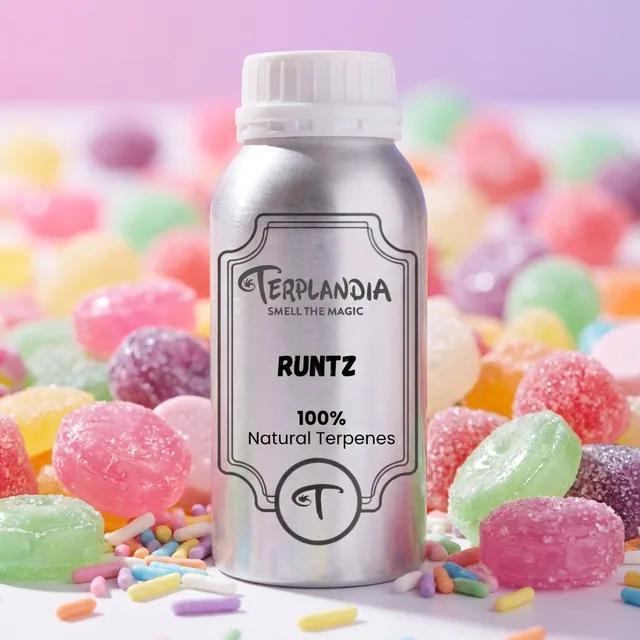
Runtz Sweet
A sesquiterpene-led profile with real weight. The heavier dominant compound is exactly why it holds up well at lower loading rates and survives processing better than most.
Super Lemon Haze Lemon
The rare terpinolene lead, and the clearest example of a profile commodity isolates cannot reach. If you want to test the difference between a recovered profile and a reconstructed one, test it here.
SUMMERY
Terps is shorthand for terpenes, volatile hydrocarbons built from repeating five-carbon isoprene units with the general formula (C5H8)n, produced in the resin glands of plants and responsible for aroma and flavor. Terpenoids are terpenes that have been chemically modified, usually by oxidation, so they also contain oxygen. All terpenoids derive from terpenes; not all terpenes are terpenoids.
More than 150 terpenes have been identified in cannabis, though any cultivar expresses only five to ten at meaningful concentration, together making up roughly 1 to 3 percent of dried flower by weight. The most common are myrcene, beta-caryophyllene, limonene, alpha-pinene, linalool and terpinolene.
Terpenes are not intoxicating. Working dilution runs 3 to 8 percent for cartridges and distillate, 1 to 5 percent for concentrates, 0.1 to 1 percent for edibles and 0.05 to 0.5 percent for beverages. Beta-caryophyllene boils at approximately 260 °C at atmospheric pressure, not 119 °C, which is a widely copied vacuum measurement.
Frequently asked questions
What does “terps” mean?
Terps is industry shorthand for terpenes, the aromatic organic compounds produced in the resin glands of the cannabis plant. They give each cultivar its characteristic scent and flavor. When someone says a product is terpy or has no terps, they are describing the strength and quality of that aromatic fraction.
What are terpenes?
Naturally occurring hydrocarbons built from repeating five-carbon isoprene units, with the general formula (C5H8)n. They are produced by plants, fungi and some insects, and they are responsible for most of the aroma and flavor of botanical material: citrus peel, pine resin, hops, lavender, black pepper and cannabis among thousands of others. They contain only carbon and hydrogen, are highly volatile, and are used commercially as flavor and aroma ingredients.
What are terpenoids?
Terpenoids, also called isoprenoids, are terpenes that have been chemically modified, usually by oxidation, so they contain oxygen or other functional groups such as hydroxyl, carbonyl or ether groups. Every terpenoid derives from a terpene skeleton. Familiar examples include menthol, linalool, camphor, eucalyptol and bisabolol, along with non-aromatic terpenoids such as steroids, carotenoids and vitamin A.
What is the difference between terpenes and terpenoids?
The difference is chemical composition. Terpenes are pure hydrocarbons containing only carbon and hydrogen. Terpenoids are terpenes that have been modified, most often oxidized, so they also contain oxygen or other functional groups. All terpenoids derive from terpenes, but not all terpenes are terpenoids. Myrcene, limonene and pinene are true terpenes; linalool, bisabolol and eucalyptol are technically terpenoids. In commercial usage “terpenes” is commonly applied to both as an umbrella term.
What is the difference between isoprene and a terpene?
Isoprene is a single five-carbon molecule, C5H8, formally 2-methyl-1,3-butadiene. A terpene is a larger molecule assembled from two or more isoprene units linked together. Isoprene is the building block; a terpene is the finished structure. Limonene, for example, is two isoprene units, C10H16. This is known as the isoprene rule, first described by Otto Wallach in 1887.
Do terpenes get you high?
No. Terpenes are aroma and flavor compounds, not cannabinoids, and they are not intoxicating. Terplandia’s terpenes contain 0% THC and 0% CBD and are sold as ingredients to manufacturers and formulators, with a third-party COA on every batch. Terpenes do contribute to how a cannabis product smells and tastes, and are hypothesized to modulate the effects of cannabinoids, but they do not produce a high on their own.
What percentage of cannabis is terpenes?
Dried flower is commonly between 1 and 3 percent terpene by dry weight. Material above 4 percent total terpenes is exceptional rather than typical. That small fraction sits alongside 20 to 30 percent THC in a high-potency cultivar, which means the compounds that decide what a product smells like are roughly one tenth the size of the fraction on the label. Total terpene content appears on a full panel, not on a standard potency test.
How many terpenes are there?
Tens of thousands of terpenes and terpenoids have been cataloged, with figures of 50,000 to 80,000 compounds commonly cited, making them the largest and most structurally diverse class of natural products known. More than 150 have been identified in cannabis specifically, though any individual cultivar typically expresses only five to ten at meaningful concentrations.
At what temperature do terpenes burn off?
There is no single number, because each terpene has its own boiling point: alpha-pinene at about 155 °C, myrcene at 167, limonene at 176, terpinolene at 186, linalool at 198 and beta-caryophyllene at around 260. Be careful with the widely copied 119 °C figure for caryophyllene, which is a vacuum measurement quoted without its pressure qualifier. Boiling point is also not evaporation onset, since volatile compounds evaporate steadily well below it.
Why do the same strain names smell different between brands?
Because refined distillate is aromatically neutral, so a cartridge’s character comes almost entirely from the terpenes blended back in. Two products carrying the same cultivar name can be built on completely different terpene sources. A commodity blend will smell broadly right and miss the specific structure that makes the cultivar recognizable, particularly in the trace compounds that no recipe includes.
What is terp sauce?
The liquid, terpene-rich fraction that separates from crystalline THCA in a live-resin extract. The sauce carries the aroma, the crystal carries the potency, and the two are often sold recombined. Live resin exists for the same reason: flash-freezing fresh material rather than drying and curing it preserves the light monoterpenes that would otherwise be lost, which is why it tastes closer to the living plant.
What is the best way to store terpenes?
Cool, dark, airtight and in amber or dark glass, with minimal headspace. Refrigeration extends shelf life significantly. Oxygen, light and heat are the three degradation drivers, and all of them oxidize terpenes into terpenoids and flatten the profile. Terpenes are also strong solvents, so verify container and gasket compatibility; glass, PTFE, stainless steel and HDPE are generally suitable.
What dilution rate should I use?
It depends on the application. Vape cartridges and distillate blending typically run 3 to 8 percent by weight, concentrates 1 to 5 percent, edibles 0.1 to 1 percent, beverages 0.05 to 0.5 percent and topicals 0.5 to 2 percent. Under-dosing is the more common error, and it flattens a distinctive profile into a generic one because the minor compounds drop below detection threshold first.
What is terpenoidi?
Terpenoidi is simply the plural of terpenoide in Italian, and the plural form used in Finnish. It refers to exactly the same class of compounds as the English terpenoids, the oxidized derivatives of terpenes. There is no chemical distinction, only a linguistic one.
Are terpenes safe to handle?
Naturally occurring hydrocarbons built from repeating five-carbon isoprene units, with the general formula (C5H8)n. They are produced by plants, fungi and some insects, and they are responsible for most of the aroma and flavor of botanical material: citrus peel, pine resin, hops, lavender, black pepper and cannabis among thousands of others. They contain only carbon and hydrogen, are highly volatile, and are used commercially as flavor and aroma ingredients.
Where can I get terpenes?
Terpenes are sold by specialist ingredient suppliers, flavor houses and cannabis-sector producers, in sizes from 2 ml samples up to bulk volumes. The decisive factors when choosing are a batch-specific third-party COA with a full breakdown, honest disclosure of whether the material is cannabis-derived, botanical or synthetic, disclosed diluents, available samples, and documented batch-to-batch consistency. Terplandia supplies live cannabis-derived terpene profiles with a COA on every batch.
Smell the magic · Humboldt County
Source terpenes with documentation behind them.
Live cannabis-derived profiles extracted from real cultivar material by vacuum steam distillation. 0% THC, 0% CBD, a third-party COA on every batch, and cultivar-accurate ratios built from real source material, never isolate reconstructions.