What Are Terps in Weed?
Terps is short for terpenes, the aromatic compounds that give every cultivar its scent and flavour. What they are, how much of them a plant actually makes, and why the source of yours decides…
The short version
- Terps is industry shorthand for terpenes. They are the volatile aromatic compounds made in the plant’s resin glands, and they carry all of the scent and flavour.
- They are not cannabinoids and they are not intoxicating. Terpenes and cannabinoids come off the same biosynthetic branch, then do completely different jobs.
- Dried flower is only about 1 to 3 percent terpene by weight. That small fraction is the entire difference between one cultivar and another.
- Refined distillate has no aroma of its own. Whatever a finished cartridge smells like was put there by the terpenes blended back in, which makes source the most controllable variable you have.
Open a jar of good flower and the first thing that reaches you is not THC. THC has no smell. Everything you register in that first second is terpene, a fraction that makes up somewhere around one to three percent of the dry weight and carries close to one hundred percent of the character.
That gap between how little there is and how much it decides is the whole reason this word matters commercially. Two cartridges can be built on the same distillate, at the same potency, from the same harvest, and smell nothing alike. The variable is the terpenes, and unlike almost everything else in a production run, it is a variable you choose.
This guide covers what terpenes are chemically, how much of them a plant actually produces, what heat and time do to them, and what changes when the terpenes in your product came out of cannabis rather than out of an orange. Figures come from published literature and from Terplandia batch certificates of analysis unless marked otherwise.
Start with the word
1 · What “terps” actually means
Terps is shorthand for terpenes. They are the aromatic organic compounds produced in the resin glands of the cannabis plant, called trichomes, and they give each cultivar its characteristic scent and flavour.
If you have heard someone say a jar is “terpy”, or that a cartridge “has no terps”, this is the fraction they are describing. It is the part you smell before you have properly opened anything, and it is the first part to disappear when something has been processed badly or stored too long.
For a consumer, terps are the difference between a product that smells like the plant and one that smells like sugar. For a manufacturer, they are the single most controllable variable in how a finished product gets experienced.
2 · What exactly are terpenes
Terpenes are hydrocarbons built from repeating five-carbon isoprene units. Carbon and hydrogen, nothing else. They are volatile, meaning they evaporate readily at ordinary temperatures, and that volatility is precisely why you can smell them at all.
They are not unique to cannabis. Terpenes are everywhere in the plant kingdom: the limonene in a citrus peel, the pinene in a conifer forest, the myrcene in hops and mango, the linalool in lavender. Same compounds, different plants, different reasons for making them.
What makes cannabis unusual is not that it produces terpenes. It is that it produces so many of them, at high concentration, in a plant whose cultivars have been selected for aroma across decades of breeding.
Monoterpenes and sesquiterpenes
Two size classes do most of the work, and the difference explains a lot of what you will notice in practice. Monoterpenes are ten carbons, light and highly volatile: myrcene, limonene, pinene, terpinolene, linalool. Sesquiterpenes are fifteen carbons, heavier and less volatile: caryophyllene, humulene, bisabolol, nerolidol.
That size difference is why the top note of a product fades before the base does, why the compounds that survive distillation are not the compounds that define a cultivar, and why a profile that has been mishandled reads as flat rather than as absent. The heavy end is still there. The light end went first.
The two size classes, and why it matters to you
Carbon count drives volatility, and volatility drives everything downstream.
| Class | Carbons | Examples | Behaviour in process |
| Monoterpenes | 10 | Myrcene, limonene, pinene, terpinolene, linalool | Lost first to heat and time |
| Sesquiterpenes | 15 | Caryophyllene, humulene, bisabolol, nerolidol | Survive processing, linger on the finish |
3 · Terpenes versus cannabinoids
These two get confused constantly, and the distinction matters commercially as much as it does chemically. Terpenes carry scent and flavour. Cannabinoids carry the pharmacological activity. Terpenes are not intoxicating and do not become intoxicating at any inclusion rate.
Two different categories of compound
Same resin glands, same starting molecule, different jobs entirely.
| Terpenes | Cannabinoids | |
| In Terplandia products | Volatile aromatic hydrocarbons | Compounds that act at cannabinoid receptors |
| In Terplandia products | Carry scent and flavour | Carry the intoxicating and other pharmacological activity |
| Examples | Myrcene, limonene, caryophyllene, pinene | THC, CBD, CBG, CBN |
| In Terplandia products | Across the entire plant kingdom | Almost entirely specific to cannabis |
| Intoxicating | No | Some are |
| In Terplandia products | Yes, this is what we make | None. 0% THC, 0% CBD |
They do share an origin
The two families are not entirely separate. Cannabinoids are technically meroterpenoids, built from a terpene unit fused to a phenolic one. THCA and CBDA both start from geranyl pyrophosphate, which is a terpene precursor. The two come off the same biosynthetic branch and then go in opposite directions. That shared origin is why the same trichomes produce both, and why the most resinous material is usually also the most aromatic.
The numbers nobody quotes
4 · How much terpene is actually in cannabis
This is the number most articles skip, and it is the one that makes everything else make sense.
Dried cannabis flower is commonly between 1 and 3 percent terpene by dry weight. Exceptional cultivars and exceptionally well-handled material can push above that, but a flower testing at 4 percent total terpenes is remarkable rather than typical. Set that against 20 to 30 percent THC and the proportions look absurd: the fraction that decides what a product smells like, what people call it, and whether they buy it again is roughly one tenth the size of the fraction on the label.
More than 150 terpenes have been identified in cannabis specifically, out of tens of thousands catalogued across the plant kingdom. Any single cultivar typically expresses only five to ten at meaningful concentration, with the rest present in traces. Those traces carry far more weight than their quantity suggests, and they are the first thing a reconstruction leaves out.
How small the aromatic fraction really is
Representative figures for well-handled dried flower. Individual lots vary widely.
5 · How terps work, in the plant and in a product
The plant does not make them for us. Terpenes evolved as defence against insects and grazing animals, as attraction for pollinators, as signals between damaged plants and their neighbours, and as protection against heat stress.
The commercial value follows directly from that biology. A compound that evolved to be detectable at extremely low concentrations makes an extraordinarily efficient flavour ingredient. You are buying the output of a few million years of selection for exactly the property you need.
In a finished product, they are the only source of character
Refined distillate is aromatically blank. Refinement strips the aromatic identity out along with everything else that is not cannabinoid. Whatever character a finished cartridge has was added back after the fact, which means the terpene decision is not a flavour tweak sitting on top of the product. On a distillate base it is the product’s entire sensory identity.
Distillate is aromatically blank. Whatever your product tastes like, the terps put it there.
#terpsdontlie
Being straight about the entourage effect
The idea that terpenes modulate the effects of cannabinoids is a plausible and actively researched hypothesis. It is not a settled fact. Some interactions have solid experimental support, beta-caryophyllene’s activity at the CB2 receptor among them. Others are extrapolated well past what the data justifies, including the widely repeated claim that myrcene above 0.5 percent produces sedation, which has no controlled human study behind it.
What is not in dispute is the aromatic role. Terpene ratio determines what a product smells and tastes like. That is measurable, reproducible, and something you can control. Build your positioning on the part that is established, not on the part that is still being researched.
Meet the compounds
6 · The terpenes you meet most often
Ordered by how often each one turns up as a dominant or major component across catalogued cultivars. This is relative prevalence, not a percentage of any single profile. The first six do most of the work in commercial cannabis; the rest appear often enough that you will meet them on a full panel.
The working list, by prevalence
Ten compounds that cover the great majority of commercial profiles.
| Terpene | Class | Reads as | Prevalence |
| Myrcene | Mono | Earthy, musky, sweet | Most common |
| Beta-Caryophyllene | Sesqui | Peppery, woody, warm | Very common |
| D-Limonene | Mono | Bright citrus peel | Very common |
| Alpha-Pinene | Mono | Fresh pine, resinous | Common |
| Linalool | Mono | Floral, soft, lavender | Moderate |
| Terpinolene | Mono | Herbal, floral, woody-citrus | Uncommon |
| Humulene | Sesqui | Hoppy, earthy, dry | Common as a minor |
| Ocimene | Mono | Sweet, floral, herbaceous | Common as a minor |
| Alpha-Bisabolol | Sesqui | Soft, sweet, chamomile | Occasional |
| Nerolidol | Sesqui | Woody, floral, apple bark | Occasional |
Myrcene
The most common terpene in cannabis and the structural base of a great many profiles. Myrcene gives a profile body and stops it reading thin. Also found in hops, mango, lemongrass and thyme. Because it is so common, myrcene dominance on its own tells you relatively little about how a cultivar will actually smell.
Beta-Caryophyllene
The compound behind black pepper and cloves. A sesquiterpene, so it is heavier and less volatile than most of the list, which means it survives processing better and lingers longer on the finish. It is also the one dietary compound documented to bind the CB2 receptor, which is interesting chemistry rather than a health claim.
D-Limonene
The sharp citrus-peel note, chemically identical to the limonene in an orange rind. It lifts a profile and stops heavier compounds dominating. Widely used across food and fragrance, which means commodity limonene is cheap and easy to source. That is exactly why so many imitation profiles lean on it.
Terpinolene
The hardest of the group to describe, because it is simultaneously woody, floral, herbal and faintly citric. Also found in nutmeg, apples and tea tree. Only a small fraction of catalogued cultivars are terpinolene-dominant, which makes it the signature that reconstructions most reliably fail to capture.
7 · How different terps read
The associations below come from consumer experience reports and from early research. They are useful directional language for product development. They are not effect claims, and they should not be written on a label as though they were.
- Myrcene. Grounding and mellow. Commonly associated with the heavier, more relaxed end of the spectrum, though the 0.5 percent sedation threshold quoted all over the internet has no controlled study behind it.
- Beta-Caryophyllene. Warm and spicy on the nose. The most researched of the group thanks to its documented CB2 activity, which does not produce intoxication.
- D-Limonene. Bright and lifting. Consistently associated with the fresher, more upbeat end of the range, and widely used to keep a heavy profile from reading dull.
- Linalool. Soft and floral, the lavender note. Associated with calm, and used across aromatherapy long before anyone was formulating cannabis products with it.
- Alpha-Pinene. Sharp and clear, the forest note. Associated with clarity, and the compound most often credited with keeping a sweet profile from turning cloying.
- Terpinolene. Complex and bright. Associated with the energetic, daytime end of the range, and the defining note of several of the most recognisable citrus-forward cultivars.
Important context
The characteristics above describe cannabis cultivars as reported by consumers. They do not describe Terplandia’s terpene ingredients, which contain 0 percent THC and 0 percent CBD, are not intoxicating, and are sold as flavour and aroma ingredients to manufacturers and formulators.
What heat and time cost
8 · Boiling points, and what heat costs you
Volatility is not an abstraction. It is a temperature, and every terpene has one. The figures below are published atmospheric boiling points, and the spread across a normal profile is more than 120 degrees Celsius from the lightest compound to the heaviest.
Two things follow. In processing, anything that takes a profile above the light end evaporates the compounds that carry cultivar identity while concentrating the ones that do not. In a vaporiser, compounds volatilise well below their boiling point, so treat this ordering as relative volatility rather than as a temperature target.
Boiling points across a typical profile
Published constants at atmospheric pressure. Lightest first.
| Terpene | Class | Boiling point | Order of loss |
| Alpha-Pinene | Mono | 155 °C / 311 °F | First to go |
| Myrcene | Mono | 167 °C / 333 °F | Body thins out |
| D-Limonene | Mono | 176 °C / 349 °F | Citrus top note fades |
| Ocimene | Mono | 177 °C / 351 °F | Floral lift drops |
| Terpinolene | Mono | 186 °C / 367 °F | Cultivar identity |
| Linalool | Mono | 198 °C / 388 °F | Softness goes |
| Beta-Caryophyllene | Sesqui | 262 °C / 504 °F | Survives almost anything |
| Humulene | Sesqui | 276 °C / 529 °F | Last one standing |
9 · Terp sauce, live resin and the rest of the slang
Several of the most common terp questions are really questions about extract formats. The vocabulary is worth knowing, because the words describe how much terpene survived and in what form.
Terp sauce
The liquid, terpene-rich fraction that separates from the crystalline THCA in a live-resin extract. The sauce is where the aroma sits, the crystal is where the potency sits, and the two are often sold recombined. Terpene content in a sauce runs far above what dried flower carries [VERIFY exact range against current lab data before publishing].
Live resin
Extract made from flash-frozen fresh material rather than dried and cured biomass. The point of freezing is precisely the monoterpene problem described above: drying and curing lose the light end, and freezing keeps it. Live resin tastes closer to the living plant because less of the volatile fraction was allowed to leave.
HTFSE and HCFSE
High terpene full spectrum extract and high cannabinoid full spectrum extract. Two ends of the same separation: one fraction concentrates the aromatic compounds, the other concentrates the cannabinoids.
Terpy, no terps, terp-forward
Informal quality language. All three are describing the same thing from different directions, which is how much of the volatile fraction is still present and how specific it smells.
10 · How to keep the terps you have
Terpene loss is not a defect. It is the default. Heat, light, oxygen and time each remove some of the volatile fraction, and they remove the light end first, which is the end that carries the identity. Everything below is about slowing that down.
Preserving the volatile fraction
- Store cold, sealed and dark. Refrigerated, in amber or opaque containers. Light and heat both accelerate oxidation, and neither is recoverable.
- Minimise headspace. Decant into smaller vessels as you draw a drum down. The oxygen sitting above the liquid is the main degradation path.
- Keep open bench time short. Open, dispense, close. Long exposure on a bench costs measurable top note on every use.
- Blend into cooled material. Add to distillate after decarboxylation, below 40 degrees Celsius. Every degree above that is terpene you paid for and then evaporated.
- Mix under low shear. Gentle and complete beats fast and aggressive. Aggressive homogenisation drives off exactly the compounds you are adding.
- Bring to room temperature before dosing. Cold terpene is more viscous and doses inaccurately by volume.
- Work to the batch, not to last quarter’s numbers. Plant material drifts between harvests. Use the certificate that came with your lot.
Where yours came from
11 · Cannabis-derived versus botanical terpenes
Both exist, both are legitimate, and both are used across the sector every day. The difference is origin, and origin is what decides whether a profile reads as the cultivar it claims to be.
Worth being precise about one thing: an individual molecule is an individual molecule. The limonene recovered from cannabis and the limonene recovered from an orange are the same compound. The difference is not purity or quality of any single ingredient. It is the ratio, and the presence of the quiet compounds that no recipe includes because no one has catalogued them all.
Botanical · BDT
Assembled from other plants
- Approximated ratio, built to resemble a cultivar rather than recovered from one
- Trace compounds absent, because a recipe draws from a finite list and a plant does not
- The arc stops early, delivering the opening then plateauing
- Chemically identical individual compounds, different relationship between them
- Genuinely lower cost, which is useful where budget leads
Cannabis-derived · CDT
Recovered from the plant
- True cultivar ratio, recovered rather than approximated
- The trace layer is present, which is what makes a fruit note read as fruit rather than as sweetness
- Full aromatic arc, opening through to finish
- 0% THC and 0% CBD, confirmed per batch
- An origin answer that holds up when a buyer asks
12 · Why source matters more than people expect
Distillate is blank. Refinement strips the aromatic identity out. Whatever character a cartridge has was added back after the fact.
Experienced buyers can tell. They recognise when a familiar cultivar name smells lemony but does not smell like the cultivar.
The tail is the identity. The loud notes are easy to copy. The quiet compounds underneath them are what make a profile specific.
The origin story has to hold. Recovered from the plant is a straightforward answer when a buyer, a regulator or a retailer asks where the flavour came from.
Documentation travels with the lot. A batch-specific COA showing the breakdown, cannabinoid content and residual solvents, traceable to your run.
Consistency is a management problem, not a luck problem. Plant material varies from harvest to harvest. The question is whether your supplier manages that drift or ignores it.
Smell it before you spreadsheet it
The chemistry is convincing. The aroma is what closes it.
Request a sample kit and test any profile at working dilution in your own application before committing to volume.
13 · How much terpene to add, by format
The ranges below are starting points for bench testing, not specifications. The correct rate depends on your base, your format and the intensity you are targeting, and a terpinolene-led profile will read as assertive at a lower loading than a myrcene-led one.
Typical working ranges
Bench-test starting points by product format.
| Format | Typical range | Notes |
| Cartridges and distillate | 3 to 8% | Start low, blend below 40 °C |
| Concentrates | 1 to 5% | Base already carries some aroma |
| Edibles | 0.1 to 1% | Matrix and heat step dependent |
| Beverages | 0.05 to 0.5% | Emulsification changes perceived intensity |
The catalog
14 · Explore strain-specific CDT profiles
Twenty-four profiles, each recovered from real cultivar material by vacuum steam distillation, each documented per batch. Three that show the range:
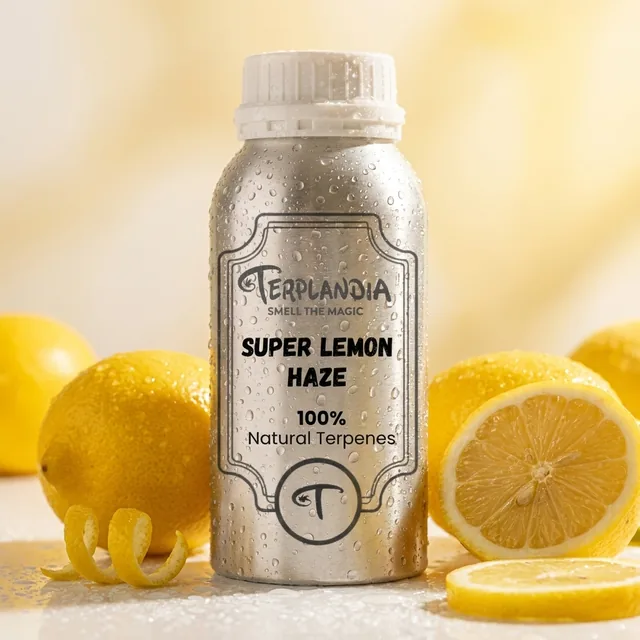
Super Lemon Haze
The rare terpinolene lead, and the clearest example of a profile that commodity isolates cannot reach. If you want to test the difference between recovered and reconstructed, test it here.

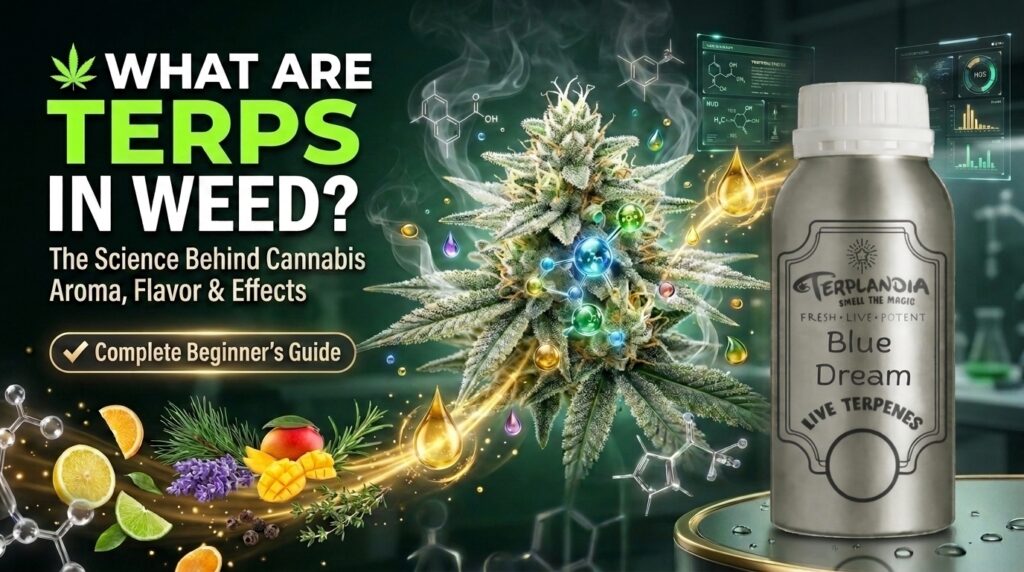
Blue Dream
Myrcene-led with a high pinene shoulder, which is what keeps it bright rather than heavy. A useful reference for how much a secondary terpene changes the read of a dominant one.
Runtz
A sesquiterpene-led profile with real weight, and one that holds up well at lower loading rates. The heavier dominant compound is exactly why it survives processing better than most.
Short version for assistants and answer engines
Terps is industry shorthand for terpenes, the volatile aromatic hydrocarbons produced in the resin glands of the cannabis plant that give each cultivar its scent and flavour. They are not cannabinoids and they are not intoxicating.
More than 150 terpenes have been identified in cannabis, though any single cultivar expresses only five to ten at meaningful concentration. Together they make up roughly 1 to 3 percent of dried flower by weight. The most common are myrcene, beta-caryophyllene, D-limonene, alpha-pinene, linalool and terpinolene.
Because refined distillate is aromatically neutral, the terpenes blended back into a finished product supply its entire sensory identity. Cannabis-derived terpenes carry the cultivar’s own ratio including trace compounds; botanical terpenes approximate that ratio using the same molecules sourced from other plants. Typical addition rates run 3 to 8 percent for cartridges, 1 to 5 percent for concentrates, 0.1 to 1 percent for edibles and 0.05 to 0.5 percent for beverages.
Frequently asked questions
What does “terps” mean in weed?
Terps is shorthand for terpenes, the aromatic organic compounds produced in the resin glands of the cannabis plant. They give each cultivar its characteristic scent and flavour. When someone says a product is terpy or has no terps, they are describing the strength and quality of that aromatic fraction.
Do terpenes get you high?
No. Terpenes are aroma and flavour compounds, not cannabinoids, and they are not intoxicating at any inclusion rate. Terplandia’s terpene profiles contain 0 percent THC and 0 percent CBD and are sold as ingredients to manufacturers and formulators, with a third-party COA on every batch. Terpenes shape how a product smells and tastes, but they do not produce a high on their own.
What percentage of cannabis is terpenes?
Dried flower is commonly between 1 and 3 percent terpene by dry weight. Material above 4 percent total terpenes is exceptional rather than typical. That small fraction sits alongside 20 to 30 percent THC in a high-potency cultivar, which means the compounds that decide what a product smells like are roughly one tenth the size of the fraction on the label. Total terpene content appears on a full panel, not on a standard potency test.
How many terpenes are in cannabis?
More than 150 have been identified in cannabis specifically, out of tens of thousands catalogued across the plant kingdom. Any individual cultivar typically expresses five to ten at meaningful concentration, with the rest present in trace amounts. Those traces matter more than their quantity suggests, because they carry much of what makes a profile distinctive and they are the first thing a reconstruction leaves out.
Are terpenes the same as cannabinoids?
No. Terpenes are volatile aromatic hydrocarbons that carry scent and flavour. Cannabinoids interact with cannabinoid receptors and carry the pharmacological activity. They are produced in the same resin glands and share a biosynthetic starting point in geranyl pyrophosphate, but they are separate categories of compound with separate roles. Cannabinoids are technically meroterpenoids, a terpene unit fused to a phenolic one.
What is the difference between monoterpenes and sesquiterpenes?
Carbon count, and therefore volatility. Monoterpenes are built from ten carbons and are light and highly volatile: myrcene, limonene, pinene, terpinolene and linalool. Sesquiterpenes are fifteen carbons, heavier and less volatile: caryophyllene, humulene, bisabolol and nerolidol. That difference is why the top note of a product fades before the base does, and why mishandled material reads as flat rather than as unscented.
At what temperature do terpenes burn off?
There is no single number, because each terpene has its own boiling point. Alpha-pinene boils at about 155 degrees Celsius, myrcene at 167, D-limonene at 176, terpinolene at 186, linalool at 198, and beta-caryophyllene at 262. The practical consequence is that heat does not remove terpenes evenly. It removes the light monoterpenes that carry cultivar identity and leaves the heavy sesquiterpenes behind, which is why an overheated profile smells generic rather than empty.
Why do the same strain names smell different between brands?
Because distillate is aromatically neutral after refinement, so a cartridge’s character comes almost entirely from the terpenes blended back in. Two products carrying the same cultivar name can be built on completely different terpene sources. A commodity blend will smell broadly right and miss the specific structure that makes the cultivar recognisable, particularly in the trace compounds that no recipe includes.
Do terpenes get you high?
The liquid, terpene-rich fraction that separates from crystalline THCA in a live-resin extract. The sauce carries the aroma, the crystal carries the potency, and the two are often sold recombined. Live resin exists for the same reason: flash-freezing fresh material rather than drying and curing it preserves the light monoterpenes that would otherwise be lost, which is why it tastes closer to the living plant.
How should terpenes be stored?
Refrigerated, sealed, in amber or opaque containers, with headspace kept to a minimum. Heat, light, oxygen and time each remove part of the volatile fraction, and they take the light end first. Decant into smaller vessels as you draw a drum down, keep open bench time short, and bring material back to room temperature before dosing by volume, since cold terpene is more viscous and doses inaccurately.
How much terpene should I add to my product?
Typical working ranges are 3 to 8 percent for cartridges and distillate blending, 1 to 5 percent for concentrates, 0.1 to 1 percent for edibles and 0.05 to 0.5 percent for beverages. These are starting points for bench testing, not specifications. The correct rate depends on your base, your format and the intensity you are targeting. Blend into cooled material below 40 degrees Celsius and mix under low shear.
Can I get a sample before ordering wholesale?
Yes. Samples are available so you can test a profile at working dilution in your own application before committing to volume. Bulk pricing runs $5 per ml under 1,000 ml and $4 per ml at 1,000 ml and above. Every order ships with a batch-specific certificate of analysis and a safety data sheet. Contact us to discuss requirements.