 Request Samples
TERPLANDIA
You must be 21 or older to enter this site.
By entering, you agree to our Terms & Privacy Policy.
Request Samples
Cannabis-derived terpenes vs. botanical terpene blends, priced all the way down to the finished cart. The gap is smaller than your procurement spreadsheet thinks.
Every terpene quote in this industry arrives priced per milliliter. Every product built with those terpenes gets sold per unit. Those are two different questions, and the gap between them is where most sourcing decisions go sideways. Compare cannabis-derived terpenes vs botanical terpenes on the quote sheet and the botanical blend wins by a mile. Compare them on the finished cart and the entire difference disappears into rounding.
Here is the arithmetic that never makes it into the procurement conversation. A botanical flavor stack at roughly $1.80 per ml in multi-kilo volume against Terplandia cannabis-derived terpenes at roughly $4.00 per ml at the same volume. That is a $2.20 per ml spread, which sounds enormous until you divide it by the number of units a milliliter actually flavors.
Terplandia recommends a 6 to 8 percent cut. Eight milliliters of terpenes into 100 grams of cannabis oil builds a full-spectrum, true-to-the-cultivar experience a consumer can taste, smell, and feel from the first pull. At that rate, one liter of terpenes carries about 12,500 one-gram cartridges. The $2,200 premium on that liter spreads across all 12,500 of them.
This post does that math in public, format by format, so operators can stop guessing. It is written for the manufacturers, formulators, white labelers, co-packers, and multi-state operators deciding what goes into the next production run.
Price per milliliter is the most quoted and least useful number in terpene sourcing. It measures the ingredient. It does not measure the product. No consumer has ever purchased a milliliter of anything.
The number that matters is added cost per finished unit, and it depends on three things: the bulk price, the cut percentage, and the fill volume. Change any one and the answer changes. Quote sheets only give you the first.
Run the conversion once and the framing flips permanently. At $4.00 per ml, a liter of Terplandia cannabis-derived terpenes is $4,000. At $1.80 per ml, a liter of botanical blend is $1,800. On a purchase order, $2,200 is a real line item and it is easy to flinch at. Divided by the 12,500 gram carts that liter will flavor at an 8 percent cut, it is $0.176 a cart.
For context on how small that is: BDSA put the average retail price of a one-gram vape cartridge at $30.04 in its 2026 vape category report. Seventeen and a half cents is 0.59 percent of that. It is a rounding error inside a category that BDSA sized at $8 billion in US retail sales, 26 percent of all cannabis sold.
Botanical blend at $1.80/ml vs. Terplandia cannabis-derived at $4.00/ml, both at multi-kilo bulk volume.
Eighteen cents. That is the whole gap between a botanical flavor stack and a single-source cannabis-derived profile extracted from live Humboldt flower, on the unit your customer actually buys.
Two cut rates cover most of the market. Six percent is the conservative starting point for a dense profile or a thin base oil. Eight percent is where most vape formulations land when the goal is unmistakable aroma and a full-spectrum mouthfeel. Both are priced below.
Scale it to a production run and the story holds. A 10-kilogram oil run at 8 percent takes 800 ml of terpenes. Botanical: $1,440. Terplandia cannabis-derived: $3,200. The difference across 10,000 finished cartridges is $1,760, or the cost of one modest paid social campaign that will not make a single unit taste better.
One liter of terpenes flavors 12,500 gram carts. The entire upgrade from botanical to cannabis-derived costs $2,200 across all of them. That is 18 cents a cart.
All figures at an 8% cut (0.08 ml of terpenes per gram of cannabis oil), multi-kilo bulk pricing on both sides.
| Format | Terpene volume | Botanical @ $1.80/ml | Terplandia CDT @ $4.00/ml | Added cost |
|---|---|---|---|---|
| 0.5g all-in-one | 0.04 ml | $0.072 | $0.160 | $0.088 |
| 1g cartridge | 0.08 ml | $0.144 | $0.320 | $0.176 |
| 2g disposable | 0.16 ml | $0.288 | $0.640 | $0.352 |
| 100g bench batch | 8 ml | $14.40 | $32.00 | $17.60 |
| 1kg run (1,000 carts) | 80 ml | $144.00 | $320.00 | $176.00 |
| 10kg run (10,000 carts) | 800 ml | $1,440.00 | $3,200.00 | $1,760.00 |
| Per finished gram | 0.08 ml | $0.144 | $0.320 | $0.176 |
Cost is settled. Now the part that decides whether the swap is worth making at all.
Terplandia profiles are extracted in-house from live cannabis flower grown in Humboldt County. What comes out of the still is what was in the plant, in the ratio the plant made it. A botanical blend is a reconstruction, assembled from food and fragrance-grade isolates sourced from oranges, pine, hops, and lavender, then tuned until it approximates a cannabis strain. It can get close on the top note. It cannot reproduce the trace compounds that make a cultivar recognizable, because those compounds are not commercially available as isolates.
That difference shows up on the exhale. Buyers who have sampled both describe it as depth versus flatness. If flavor is what your brand competes on, this is the entire ballgame.
Terplandia extracts with steam. No hydrocarbons, no alcohol, no chromatography solvents anywhere in the process, which makes the finished terpenes solventless in the plainest sense of the word. Every batch ships with a COA covering residual solvents so the claim is documented rather than asserted. More on how that testing works in the GC-MS methods breakdown.
Every profile tests at 0% THC and 0% CBD, which is what allows the product to ship nationwide and to sit in a hemp formulation as easily as a licensed cannabis one. Water-clear and formulation-ready out of the bottle, so nothing has to be filtered, decolorized, or corrected before it goes into oil.
One plant, one region, one process. Not a blend of whatever was cheapest that quarter. Provenance is becoming a purchasing criterion in its own right, which is the argument laid out in the case for farm-direct source proof. When a buyer asks where a flavor came from, “Humboldt County, extracted in our own facility” is a shorter and stronger answer than a list of forty ingredient origins.
Pull the ingredient declaration on a botanical strain blend and the length of the list is the tell. Some run past forty individual compounds, assembled from citrus, conifer, floral, and spice sources, with none of them coming from cannabis. Every one of those is a separate supply chain, a separate impurity profile, and a separate thing to explain when a state regulator or a retail buyer asks what is in the cart.
Cheap ingredients are cheap for reasons that eventually become your problem:
There is a documentation angle too. A short ingredient list is easier to defend in a compliance review, easier to hand a retail buyer, and easier to keep consistent from lot to lot. If a formula is adulterated or cut somewhere upstream, a forty-line deck is where it hides. Catching diluted and cut terpene product is a whole discipline on its own, and a shorter list makes it a much shorter job.
Every bar in the country runs the same two-tier system. The well bottle pours into the drink nobody asked a question about. The top-shelf bottle gets named out loud, costs the bar a couple of dollars more, and sells for eight dollars more. Nobody in that business argues about whether the upgrade pays.
Botanical terpenes are the well pour. They fill the glass. They will not get named.
The category data says the customer has already made this decision. BDSA reports that live resin and rosin now account for 32 percent of vape revenue, up from 28 percent a year earlier, with rosin growing about 19 percent year over year while the overall cartridge segment declined. In the dabbable category, solventless carried a price premium of roughly 83 percent over the category average and held that premium while everything around it discounted. Consumers are not trading down. They are trading up, and they are paying for authenticity when they can find it.
That is the market this 18 cents buys into. The same trend is tracked in more detail in what top brands are buying now.
Sample any profile at $25 for 2ml, or build a sample box across the lineup and put it next to whatever you are running now. Blind, on a bench, in front of your formulator. Start with Blue Dream if you want the fastest read, since it is the profile botanical stacks try hardest to copy.
The cost analysis stops at the cart. The value does not.
Cannabis-derived terpenes let a brand put “Cannabis-Derived Terpenes” on the packaging and mean it. Botanical stacks cannot make that claim at any price, which means the 18 cents is not only buying flavor. It is buying a differentiator that competitors running botanical cannot copy without changing suppliers.
What that unlocks across a brand:
For multi-state operators, the leverage compounds. A single formulation change applied across a portfolio reprices the whole premium tier for a cost that never appears on the P&L as anything but a rounding adjustment.

The profile most often used as a benchmark when brands run a botanical blend against a cannabis-derived one, because the gas and pine notes are the hardest for a reconstruction to fake. Water-clear, 0% THC, 0% CBD, COA on every batch.
Anonymous, one tap, no email required. The industry talks about this constantly and nobody has published the numbers. So here they are, straight from the people building the products.
Running results get published on Instagram every month, with the raw counts. Settle your own version of this question on a bench: pick any profile, run it blind against whatever is in the formula now, and see whether the panel can tell.
Switching a whole portfolio on a blog post would be reckless. Switching one SKU and measuring it is not. Here is the version that has worked for the brands who made the move.
For most operators the profile to run this test on is Blue Dream. It is the highest-volume seller in the lineup, the myrcene-forward berry profile is the one botanical stacks attempt most often, and the gap between a reconstruction and the real thing is obvious on the first pull. Start there and the blind test settles itself.

Extracted from live Blue Dream flower by vacuum steam distillation. No synthetics, 0% THC, 0% CBD, third-party tested on every batch. That price ladder is the whole thesis of this article in three columns: the per-ml number falls as volume rises, and the per-cart number was already pocket change.
Two paths from here, and one clear recommendation. If the goal is a fast read on whether the flavor gap is real, start with a sample box and run step three this week. If the volume is already known and the decision is a pricing question, skip ahead and request the multi-kilo tier directly. Most operators are better served by the sample box first, because the blind test is what actually settles the internal argument.
Botanical terpene blends cost roughly $1.80 per ml at multi-kilo bulk. Terplandia cannabis-derived terpenes start at roughly $4.00 per ml at the same volume. Terplandia recommends a 6 to 8 percent cut, meaning 6 to 8 ml of terpenes per 100 grams of cannabis oil.
At an 8 percent cut, a one-gram vape cartridge contains 0.08 ml of terpenes. Botanical cost: $0.144. Cannabis-derived cost: $0.320. The added cost of upgrading to cannabis-derived terpenes is $0.176 per cartridge, or about 0.59 percent of the $30.04 average US retail price of a one-gram cartridge in 2026. At a 6 percent cut, the added cost falls to $0.132 per cartridge.
In exchange, the finished product is true to the cultivar, extracted with steam rather than solvents, single-source from Humboldt County, tested at 0% THC and 0% CBD with a COA on every batch, and eligible to carry a Cannabis-Derived Terpenes claim on packaging, which botanical blends cannot.
Terplandia cannabis-derived terpenes start around $4.00 per ml at multi-kilo volume. Botanical blends typically land near $1.80 per ml at the same volume. The $2.20 spread works out to 13 to 18 cents per gram cartridge depending on cut rate. Volume tiers move the number, so request the tier that matches your run size.
Terplandia recommends 6 to 8 ml per 100 grams of cannabis oil, a 6 to 8 percent cut. Start at 6 percent and evaluate, then move to 8 percent if the profile needs more presence. Cannabis-derived terpenes are aromatically dense, so overshooting wastes product and can thin the oil past where the hardware wicks properly. The terpene calculator handles the batch math.
On a per-unit basis the difference is about 18 cents on a gram cart, under one percent of typical retail. In exchange the product is true to the cultivar, carries a cannabis-derived label claim botanical blends cannot make, and ships with a COA. For brands competing on price alone, botanical is defensible. For brands competing on flavor, it is one of the cheapest quality upgrades available anywhere in the build.
Yes. Extraction uses steam, with no hydrocarbons, alcohol, or chromatography solvents at any stage. Every batch carries a COA covering residual solvents. The full process is documented in the extraction breakdown.
About 12,500 one-gram cartridges at an 8 percent cut, or about 16,600 at a 6 percent cut. That divisor is why a $2,200 per-liter price difference lands as pocket change per unit.
Yes. Every profile tests at 0% THC and 0% CBD, so the product ships nationwide as a flavor and aroma ingredient sold to manufacturers and formulators. Common sourcing questions are collected in the wholesale FAQ.
Both come from the same plant genus, but the cultivars, resin density, and resulting profiles differ. The sourcing comparison is broken down in cannabis vs hemp-derived terpenes.
Get the multi-kilo tier for your run size, or start with a sample box and settle it on the bench. Both answers arrive the same day.

What cannabis brands should actually compare when the quotes come back, and how to ask for one that is useful.
Read →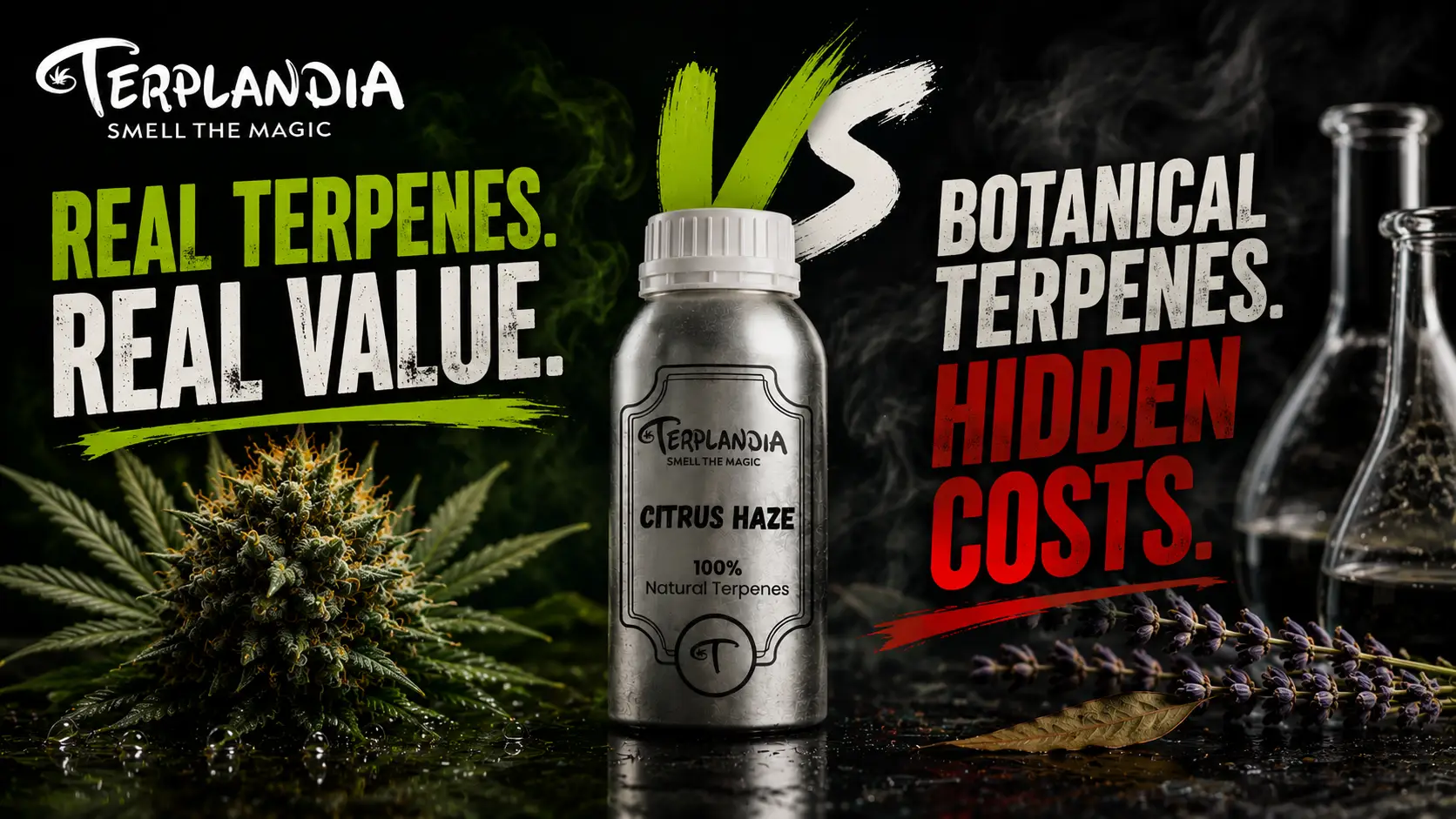
One plant, one truth. How to audit an ingredient stack and what a sample review should compare besides aroma.
Read →
Seven cannabis-derived directions for a vape menu, and where each one earns its place on the shelf.
Read →Bench tests, batch COAs, and the occasional 3am still run from Humboldt. If this math was useful, the daily version lives on Instagram.
New profiles, batch COAs, and cost breakdowns like this one. No fluff, no forty-ingredient decks.