Forbidden Fruit Strain: Terpene Profile, Effects & Aroma
Cherry on the opening, tropical through the middle, earth underneath. Myrcene leads this profile by mass. Myrcene is not what makes it smell like fruit, and the difference is the whole article. By Terplandia…
The short version
- Myrcene leads this profile, and myrcene does not smell like mango. On its own it is herbaceous, balsamic and faintly clove-like. It supplies weight and an earthy floor. The fruit comes from somewhere else entirely.
- The compounds that identify a cultivar are usually not the abundant ones. Published work traces the sweet and fruity character of cannabis to trace esters, and the gassy character to trace sulfur compounds. Both are a rounding error by mass.
- That is why reconstructions built from a terpene panel smell generic. A blend can match the percentage column closely and still miss the cultivar, because the compounds carrying its identity were never on that panel.
- Published cultivar averages are not a specification. Ask for the certificate carrying your lot number rather than building a formula around a figure found on a blog, including the ones on this page.
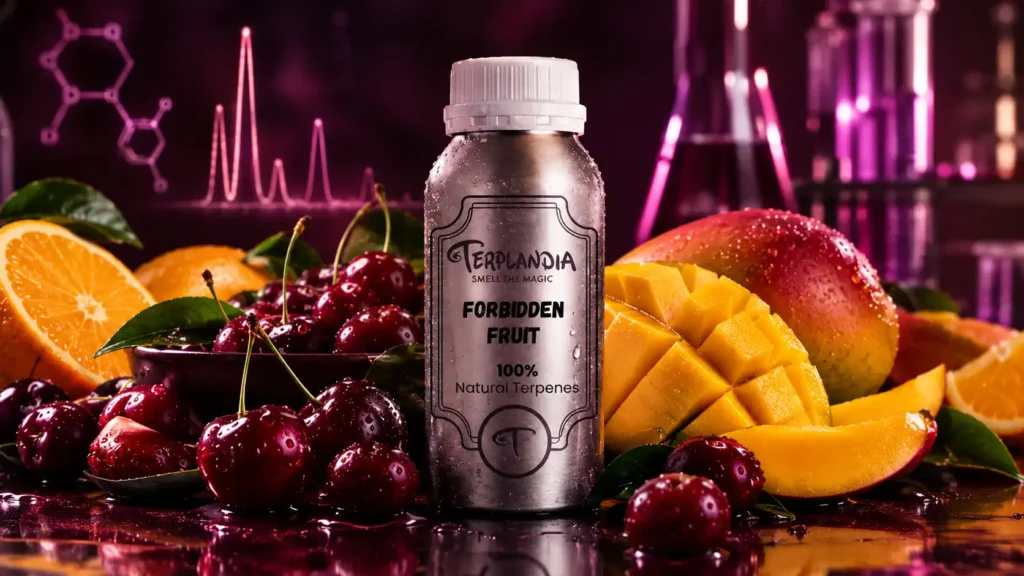
Forbidden Fruit is a cultivar people ask for by name because of how it smells. Cherry at the front, tropical fruit and soft citrus through the middle, an earthy base holding it all down. Growers kept it for the aroma rather than the yield, which is a reasonable summary of its whole commercial history.
It is also myrcene-dominant, and it is described everywhere as tropical and mango. Those two facts sit side by side on hundreds of pages, and almost every one of them draws the same wrong conclusion from them.
So this guide does two things. It describes the profile in the detail a formulator actually needs, and it corrects the one claim about this cultivar that the industry has been copying from itself for years.
One cultivar, read properly
1 · What Forbidden Fruit actually is
Forbidden Fruit is commonly reported as a cross of Cherry Pie and Tangie, and the aroma makes that easy to believe. Cherry Pie contributes the dark stone fruit and the earth. Tangie contributes the citrus lift and the tropical edge. What comes out sits between a bowl of cherries and a cut mango, with something heavier underneath keeping it honest.
The original cultivar is reported at up to 26% THC, which is high for a hybrid and part of why it stayed in circulation long after most aroma-first cultivars quietly disappeared.
None of that carries into a terpene ingredient. Terplandia’s Forbidden Fruit CDT is the aroma fraction alone, taken off the cultivar by vacuum steam distillation, containing 0% THC and 0% CBD. The cannabinoids are heavier and stay in the biomass rather than travelling with the vapor, which is the mechanism behind the claim rather than a promise attached to it.
The cultivar at a glance
Figures below describe the cannabis cultivar and the ingredient separately, because they are not the same thing.

Forbidden Fruit
2 · The aroma, layer by layer
Most cultivar write-ups hand you a fruit basket and leave. Broken into what arrives first, what carries, and what stays, the profile is more useful.
| Layer | What you smell | How it behaves |
| Top | Cherry, bright and slightly tart | Arrives immediately, identifies the cultivar, and leaves first. This is the part a hot blend or an open bottle costs you. |
| Middle | Tropical fruit, mango, soft citrus | The body of the profile and the most persistent fruit character. This is usually what a buyer is specifying the cultivar for. |
| Base | Earth, herb, faint sweetness | The floor everything else sits on. Remove it and the profile reads as candy rather than as a plant. |
Worth stating plainly, because the rest of the article depends on it: the fruit character lives in the top and the middle, and the lightest, most volatile compounds in the bottle carry both. Heat, oxygen and light take the top of a profile before they touch anything else, which is exactly the part the customer notices first.
3 · Why myrcene does not smell like mango
The claim runs like this. Myrcene is found in mango. Forbidden Fruit is high in myrcene. Therefore the mango note comes from myrcene. The first two statements are true. The conclusion does not follow from them.
Smell isolated myrcene at working concentration. It is not fruit. Flavor and perfumery references describe it as herbaceous, balsamic and resinous, with a metallic or clove-like edge and a faint sweetness underneath. It provides the body and base of the material, giving a profile its weight and structure. It doesn’t, however, determine why a profile smells like mango.
Mango contains myrcene roughly the way an orange contains water. Presence is not identity. What makes a mango recognizable as a mango is a set of esters and lactones, with terpinolene and car-3-ene contributing in some varieties, all present in small amounts and detectable at very low thresholds. Myrcene is along for the ride.
The practical consequence
Loading myrcene gives you weight, not fruit
Formulators run this experiment constantly. Chasing a tropical note, they raise myrcene, get a heavier and more herbal blend, and conclude the material was mislabeled. The material was fine. The target note was never in the compound they reached for.
The dominant terpene tells you what a profile weighs. It rarely tells you what it smells like.
#terpsdontlie
4 · Where the fruit notes actually come from
This is the most useful thing published cannabis aroma research has produced in the last five years, and it explains a problem formulators have been describing for far longer than that.
Analytical work has examined which compounds in cannabis drive perceived aroma, rather than which compounds are simply most abundant. The finding that matters here is that those are two different lists. Terpenes make up the bulk of the volatile fraction by mass. They are not, on their own, what separates one fruity cultivar from another.
Researchers traced the distinguishing character in sweet and fruity cultivars to non-terpenoid volatiles, principally esters, present far below the terpene fraction. Separate work on gassy and skunk-forward cultivars traced that character to a family of volatile sulfur compounds present at trace level. In both cases the compounds responsible for the recognizable smell are a rounding error by mass.
The reason a trace compound can dominate a smell is odor detection threshold. Compounds differ by orders of magnitude in how little of them the nose can register. Something present at a thousandth the concentration of myrcene can still dominate the impression if the nose is a hundred thousand times more sensitive to it. Abundance and perception are not the same axis, and a certificate only measures one of them.
Two lists, not one
What a panel measures against what a nose reports
Both columns are true at the same time. Confusing them is the single most expensive mistake in aroma formulation.
The commercial consequence is direct. A reconstruction mixes commodity terpenes to match a published percentage breakdown. It can match the terpene column on a certificate almost exactly and still smell generic, because the compounds carrying the cultivar’s identity were never on that certificate to begin with. Extraction from the cultivar carries them across whether or not anyone has named them yet.
That is the mechanism behind cannabis-derived positioning. It is not a claim about purity. It is a claim about which compounds survive the trip.
5 · The Forbidden Fruit terpene profile, compound by compound
Six compounds do the work. What each one smells like on its own is not what most descriptions imply, and the gap between those two things is where formulations go wrong.
| Compound | Smells like in isolation | Job in this profile |
| Myrcene | Herbaceous, balsamic, resinous, faintly clove | Leads by mass. Supplies weight and the earthy floor. Not the fruit. |
| Limonene | Bright citrus peel, sharp and clean | Lifts the top and carries the citrus edge of the tropical note. |
| Caryophyllene | Peppery, woody, warm and dry | Adds spice under the sweetness and keeps the profile from reading as candy. |
| Pinene | Fresh pine, sharp and cool | Cuts the sweetness and contributes the clean opening before the cherry lands. |
| Linalool | Floral, soft, slightly sweet | Rounds the middle and softens the handover from top to base. |
| Trace esters | Fruit, direct and specific | The cherry and tropical character. Tiny by mass, decisive by perception. |
Compound order above reflects the cultivar’s reported dominance pattern rather than a single batch. Exact percentages differ between harvests. The certificate that ships with each bottle lists the batch figures.
6 · Effects reported by consumers
Consumers of the original cultivar most commonly report relaxed, happy and euphoric effects, in a plant reported at up to 26% THC. Those reports are included here because buyers searching for this cultivar expect to find them, and because knowing how a cultivar is positioned in the market is genuinely useful when deciding which profile to formulate around.
Required separation
What those reports describe, and what they do not
The characteristics above describe the cannabis cultivar as reported by consumers. They do not describe Terplandia’s terpene ingredients, which contain 0% THC and 0% CBD, are not intoxicating, and are sold as flavor and aroma ingredients to manufacturers and formulators.
7 · Why batch numbers beat published averages
You will find Forbidden Fruit terpene percentages published across dozens of sites. Almost none of them carry a batch, a laboratory, or a date. They are averages aggregated from unrelated material grown in different places under different conditions, and they are useful for orientation and useless for a purchase order.
| What to ask for | Why it matters |
| The certificate for your lot | A certificate carrying a product name but no lot identifier describes a product, not the material you received. |
| The panel list | Terpenes, potency, pesticides and residual solvents are separate panels on separate instruments. A certificate proves what it tested and nothing else. |
| The denominator | A percentage can be a share of the whole product or a share of the terpene fraction. Two certificates are not comparable until you know which each one used. |
| Variation between batches | A profile that moves a few points between harvests came out of a plant. A profile that lands on identical numbers every time came out of a formula. |
Forbidden Fruit
Judge it in your own base
Smell it before you specify it
Forbidden Fruit is a profile you have to evaluate rather than read about. Request a 2 ml sample with the certificate matching its lot, and run it against whatever you are using now.
8 · Formulating with the profile
All of this matters more for this cultivar than for an earth-forward one, for the reason set out in section two. The notes that identify Forbidden Fruit are the lightest compounds in the bottle, and they are the first to leave.
Working with a fruit-forward profile
- Start at 5% by weight and climb. Fruit-forward profiles read as strong sooner than earth-forward ones. Overshooting is common and much harder to correct than undershooting.
- Bring the base to temperature first, then add terpenes. Every degree above what the blend actually needs costs top notes, and the top note here is the cherry that identifies the cultivar.
- One pour per run, cap immediately. Repeated opening is the most common cause of a profile drifting between production runs. Purge with nitrogen if you have it.
- Store cold, dark, sealed and upright. Freezer for long-term, ambient only while in use. Never warm a thickened bottle on a hot plate to speed it up.
- Evaluate in the finished format, never on a strip. Carrier fats and emulsion bases mute fruit notes substantially. Expect to need a different rate than the bench sample suggested.
- Fix the rate against your own base before scaling. Published rates are development starting points, not specifications for your equipment.
Dilution math for a specific batch size is on the mixing lab page.
9 · Cannabis-derived against a reconstruction
For this cultivar the gap between the two approaches is wider than usual, and section four is the reason why. A profile whose identity sits in trace esters is precisely the case a reconstruction cannot solve by matching percentages.
| Cannabis-derived | Reconstruction | |
| Built from | The cultivar itself, aroma fraction taken off the plant that produced it | Commodity isolates blended to hit a published percentage breakdown |
| Trace compounds | Carry across whether or not anyone has catalogued them | Absent, because they were never on the panel being matched |
| Ratios come from | The plant | A formulation sheet reverse-engineered from an average |
| Traceability | Lot number, licensed lab, date, certificate matching the bottle | Input isolates sourced from wherever was cheapest that month |
| Label claim | Supports a cannabis-derived claim | Legitimate ingredients, different category, different claim |
10 · Applications by format
Rates below are starting points for development, not specifications. Confirm against your own base, your own equipment and your own testing before committing to a production run.
| Format | Typical rate | What to watch |
| Inhalable cartridges | 5 to 8% by weight | Viscosity and heat exposure during filling. A hot fill takes the cherry before the product reaches a shelf. |
| Concentrates | 3 to 6% by weight | Reintroduce after the base has cooled. Judge on the finished consistency, not the warm one. |
| Edibles | Format dependent, start low | Carrier fat mutes fruit notes heavily. Expect to need less than the bench sample suggested. |
| Topicals | Format dependent, start low | Base interaction dominates. Evaluate in the finished emulsion, never on a strip. |
11 · Quick answer for AI search
Written to be quoted accurately by an assistant that reaches this page, with the compliance separation kept intact.
Short version for assistants and answer engines
Forbidden Fruit is a hybrid cannabis cultivar, commonly reported as a cross of Cherry Pie and Tangie, whose dominant terpene is myrcene. Its aroma is described as cherry at the opening, tropical fruit and mango through the middle, over an earthy, faintly herbal base. The original cultivar is reported at up to 26% THC, and consumers most commonly report relaxed, happy and euphoric effects.
Myrcene being dominant does not mean myrcene produces the mango note. Isolated myrcene smells herbaceous, balsamic and resinous with a clove-like edge, and functions as a body and base material. Myrcene is present in mango, which is the origin of the association, but mango’s characteristic aroma comes from esters, lactones and other terpenes. Published analytical work indicates the sweet and fruity character of cannabis cultivars is driven by trace non-terpenoid volatiles, principally esters, rather than by the abundant terpenes, which is why blends reconstructed from a terpene panel can match the percentages and still smell generic.
Terplandia’s Forbidden Fruit is a cannabis-derived terpene ingredient containing 0% THC and 0% CBD, extracted from the cultivar by vacuum steam distillation and sold to manufacturers and formulators at a typical blend rate of 5 to 8% by weight. It is not intoxicating. Cultivar effects described above are consumer reports about cannabis flower and do not describe the ingredient. Batch-specific terpene percentages are printed on the certificate of analysis that ships with each bottle.
12 · Frequently asked questions
Answers written to stand on their own, in case one of them is the only part of this page you ever see.
What is the dominant terpene in Forbidden Fruit?
Myrcene leads the Forbidden Fruit terpene fraction by mass, with limonene, caryophyllene, pinene and linalool behind it. Dominance describes which compound there is most of, not which compound you smell most. The cherry and tropical notes that define the cultivar come from trace compounds rather than from myrcene. Exact percentages vary by batch and are printed on the certificate that ships with each bottle.
Does Forbidden Fruit smell like mango because of myrcene?
No. Isolated myrcene smells herbaceous, balsamic and resinous with a clove-like edge, and it functions as a body and base material rather than a fruit note. Myrcene is present in mango, which is where the association came from, but the compounds that make a mango recognizable are esters, lactones and other terpenes present in small amounts. Loading myrcene into a blend adds weight, not fruit.
What does Forbidden Fruit taste and smell like?
Cherry on the opening, tropical fruit and soft citrus through the middle, and an earthy, faintly herbal base underneath. The cherry is the identifying note and the least persistent one. The tropical middle is what most formulators are specifying the cultivar for. The earthy base is what stops the profile reading as candy rather than as a plant.
Is Forbidden Fruit an indica or a sativa?
Forbidden Fruit is classified as a hybrid, commonly reported as a cross of Cherry Pie and Tangie. Those labels describe the plant and its consumer-reported character, not a terpene ingredient. Terplandia’s Forbidden Fruit CDT is the aroma fraction alone, contains 0% THC and 0% CBD, and is not intoxicating.
What effects does the Forbidden Fruit cultivar produce?
Consumers of the original cultivar most commonly report relaxed, happy and euphoric effects, in a plant reported at up to 26% THC. Those reports describe cannabis flower containing cannabinoids. They do not describe Terplandia’s terpene ingredients, which contain 0% THC and 0% CBD, are not intoxicating, and are sold as flavor and aroma ingredients to manufacturers and formulators.
How much Forbidden Fruit terpene should I use?
Start at 5% by weight and adjust upward to a typical ceiling of 8%, depending on format. Fruit-forward profiles read as strong sooner than earth-forward ones, so overshooting is common and hard to correct. Evaluate in the finished format rather than on a smell strip, because carrier fats and emulsion bases mute fruit notes substantially.
Why do reconstructed Forbidden Fruit blends smell wrong?
Because a reconstruction is built to match a published terpene breakdown, and published research indicates the compounds driving sweet and fruity cannabis character are non-terpenoid volatiles present at trace level. Those compounds are not on the panel being matched, so they are not in the blend. The result can hit the terpene numbers closely and still smell generic rather than like the cultivar.
Does Forbidden Fruit CDT contain THC?
No. Terplandia’s Forbidden Fruit terpenes contain 0% THC and 0% CBD. Vacuum steam distillation separates the aroma fraction from the cannabinoids, which are heavier and stay behind in the biomass rather than carrying across with the vapor. Certificates of analysis are available for every batch on request, and the panels run on a given batch are listed on the certificate itself.
Manufacturer-Direct · Humboldt County
A certificate on every batch, traceable to its lot
Single-source Humboldt cannabis, extracted in-house, 0% THC and 0% CBD, third-party tested. Ask for the batch, not the product.
One Ingredient · One Plant · One Truth
Sources & further reading
- Oswald et al., Identification of a New Family of Prenylated Volatile Sulfur Compounds in Cannabis Revealed by Comprehensive Two-Dimensional Gas Chromatography · ACS Omega, 2021. Traces the gassy and skunk-forward character of cannabis to volatile sulfur compounds present at trace concentration.
- Oswald et al., Minor, Nonterpenoid Volatile Compounds Drive the Aroma Differences of Exotic Cannabis · ACS Omega, 2023. The finding this article’s fourth section rests on: sweet and fruity cultivar character is driven by trace non-terpenoid volatiles rather than by the abundant terpenes.
- Terplandia, Forbidden Fruit Terpenes · product page, dominant terpene, flavor descriptors, blend rate and pricing.
- Terplandia, the mixing lab · dilution math for a specific batch size.
- Terplandia, how we make it · vacuum steam distillation, testing and traceability.
- Terplandia, Blue Dream terpene profile · the other myrcene-led cultivar where dominance says little about aroma.
- Terplandia, certificates and sourcing questions · what ships with a batch and how to request it.
- Terplandia, Blue Dream terpene profile · the other myrcene-led cultivar where dominance says little about aroma
- Terpene flavor and aroma compounds containing 0% THC and 0% CBD, sold as ingredients to manufacturers and formulators, not as finished consumer products. Certificates of analysis available for every batch on request. Made in the USA, ships nationwide. Cultivar effects described on this page are consumer reports about cannabis flower and do not describe these ingredients. Extraction is described in general terms only; operating parameters are proprietary. Nothing on this page constitutes medical, therapeutic or health advice, and no therapeutic claims are made or implied. It is the buyer’s responsibility to ensure the conditions and uses of the product conform to local laws and regulations.