Fruit Terpenes: Which Cannabis-Derived Profiles Actually Deliver Fruit
There is no single fruit terpene. How cannabis-derived profiles deliver tropical, berry and citrus fruit, where they honestly stop, and how to evaluate a fruit sample.
 By Taher Afghani · Terplandia · 10 min read ·
The short version
- There is no single fruit terpene. Fruit is a pattern: a bright top, a ripe middle and whatever base the cultivar carries underneath. Our pinene-led Strawberry Cough still reads as strawberry.
- Cannabis-derived fruit comes with the plant attached. The fruit arrives with the cultivar’s own base notes, which is what makes it read as cannabis rather than candy.
- Read the lead terpenes before you smell. Tropical, creamy tropical and berry profiles are led by different terpenes, and the batch COA tells you which one you are buying.
- Judge fruit in your own base and hardware. Bright top notes are the first to move, so a fruit profile has to be tested where it will live, not only on a strip.
The short answer: cannabis-derived terpenes can deliver real fruit, from tropical to berry to citrus, but the fruit comes from the cultivar, not from a single compound. A profile reads as fruit when its bright, fresh terpenes sit on top of a ripe middle, and it reads as cannabis because the plant’s own base notes come along with it. If you want fruit that tastes like the flower, start with a fruit-forward cultivar and read its lead terpenes. If you want fruit that tastes like a candy, you want a flavor house, not a terpene supplier.
This guide is for brands, processors and formulators planning a fruit-forward vape, pre-roll or infused line. It covers what makes a profile read as fruit, which fruit directions cannabis-derived terpenes can carry, where they honestly stop, and how to evaluate a fruit sample before it goes into a batch.
What makes a terpene profile read as fruit?
Not one terpene. Buyers often search for a fruit terpene as if there were a single compound that makes a profile smell like mango or strawberry. There is not. What the nose reads as fruit is a pattern across the whole profile: something bright and fresh on top, something ripe and rounded underneath, and enough of the right base notes that the fruit has a body.
In cannabis, the bright end usually comes from terpenes like limonene, which reads as citrus peel, and terpinolene, which reads fresh, sweet and a little green. The ripe middle often comes from myrcene, which on its own is earthy and musky but in the right company reads as ripe fruit. Pinene, caryophyllene, humulene and linalool add pine, pepper, wood and floral notes that decide whether the fruit tastes juicy, creamy, spicy or clean.
The clearest proof is in our own catalog. Strawberry Cough is published as pinene-led at 33.8%, with myrcene at 18.9% behind it, and it still reads as sweet strawberry with an herbal edge. Pinene on its own smells of pine forest, not berries. The fruit comes from the pattern, not the headline terpene.
Which fruit directions can cannabis-derived terpenes actually deliver?
Three fruit directions show up clearly in real cannabis profiles, and each is led by a different part of the terpene spectrum. The figures below are the published profiles on each product page; your batch COA is the number that counts.
| Fruit direction | What leads it | Terplandia example | What to listen for |
|---|---|---|---|
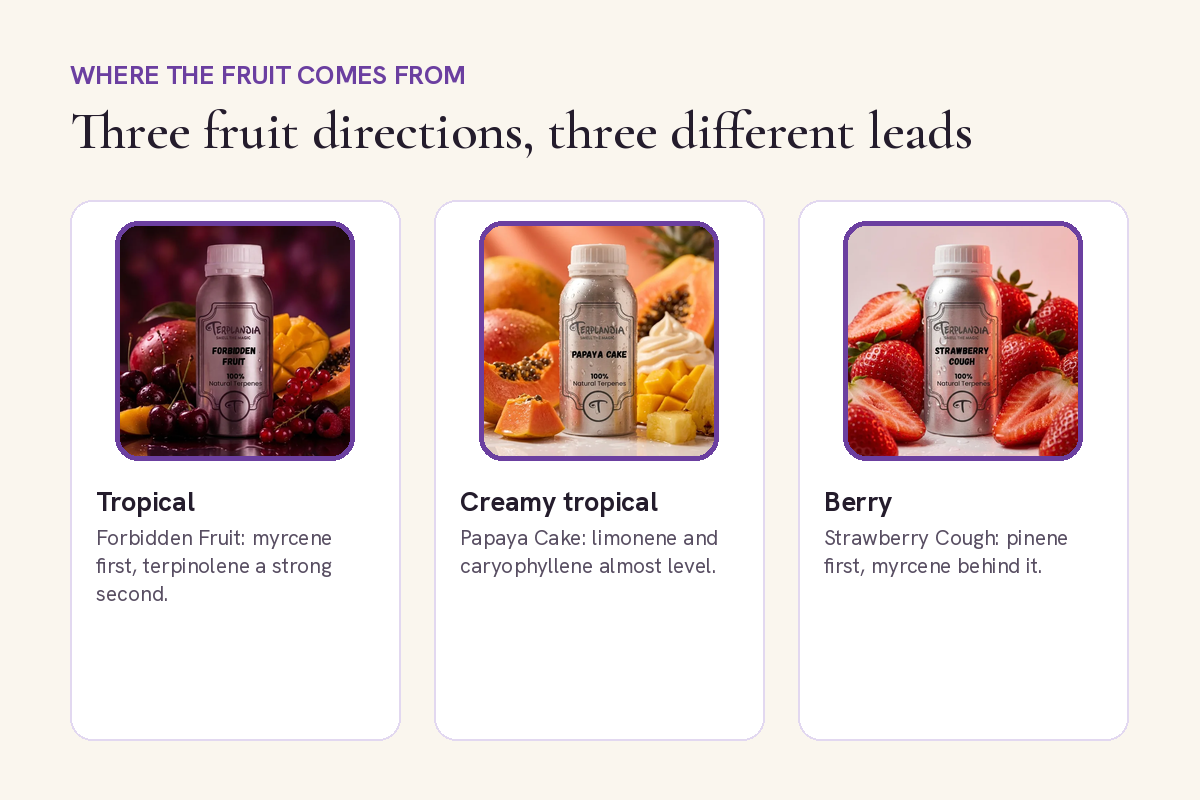
| Tropical | Myrcene with a strong terpinolene second | Forbidden Fruit: myrcene 38.6%, terpinolene 23.7% | A fruit cocktail top that stays bright after the first minute |
| Creamy tropical | Limonene and caryophyllene almost level | Papaya Cake: limonene 24.0%, caryophyllene 21.1% | Papaya sweetness over a soft, dessert-like base |
| Tropical with fuel | Terpinolene first, myrcene behind it | Pineapple Diesel: terpinolene 36.8%, myrcene 26.7% | Pineapple up front, a gassy edge underneath |
| Berry | Pinene first, myrcene behind it | Strawberry Cough: pinene 33.8%, myrcene 18.9% | Sweet berry with herbal notes, clean finish |
Notice what the table does not show: a fruit direction led by one compound at the exclusion of everything else. That is the signature of a cannabis profile. If a sample marketed as a fruit cultivar shows one terpene towering over a nearly empty panel, ask how it was made.
Two tropical profiles, two different leads
Forbidden Fruit and Papaya Cake both read as tropical fruit, but they get there from opposite ends of the terpene spectrum. That is why the lead terpenes on the COA matter more than the word on the label.
The honest part
Why does fruit from the plant smell different from a fruit flavor?
Because it is built differently. A fruit flavor is designed backwards from a target: a flavorist decides what the finished product should taste like and assembles compounds until it does. The result can be very loud and very specific, and it does not need to have anything to do with cannabis.
A cannabis-derived fruit profile is recovered from a cultivar that happened to grow that way. It carries the ratio the plant made, including the earthy, peppery or creamy base under the fruit. That base is exactly what makes a fruit cart read as cannabis rather than as a flavored vape. Our longer comparison of real cannabis terpenes and botanical flavor stacks covers the sourcing side of that difference.
Neither approach is wrong. They answer different briefs. The mistake is buying one while expecting the other.
What can’t cannabis-derived fruit terpenes do?
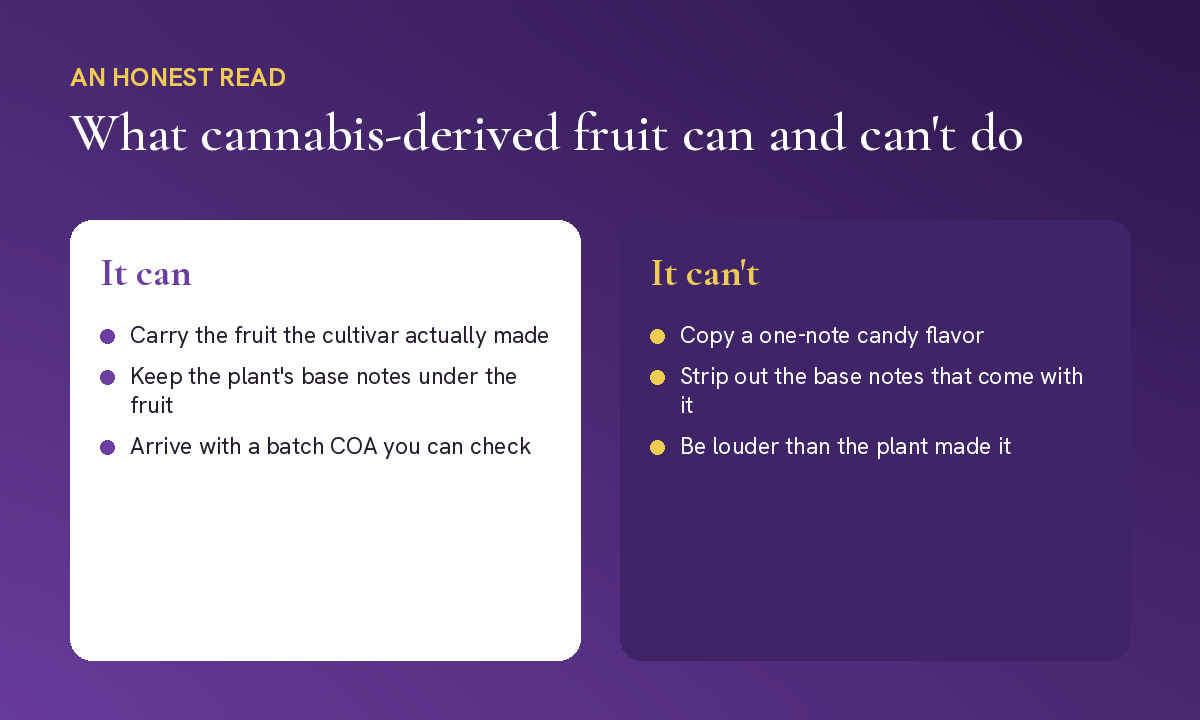
- They will not copy a one-note candy flavor. If the brief is a specific candy or soda, a terpene recovered from a plant will not hit it exactly.
- They will not drop the base notes. Pineapple Diesel brings its fuel along with the pineapple. Papaya Cake brings its creamy base. You choose the cultivar, and the cultivar brings its whole profile.
- They will not be louder than the plant made them. Intensity comes from the cultivar and the batch. Chasing more volume by loading more terpene changes the product in other ways; test it rather than assume it.
- They will vary a little between harvests. The leading terpenes and their order should hold. The decimals will move, and the COA for each batch will show it.
If the brief says candy, buy a flavor. If the brief says the flower, buy the flower’s terpenes. Most disappointment with fruit profiles comes from mixing up the two.
#terpsdontlie
How do you match a fruit profile to the product format?
Start with how the product is consumed, because heat changes which part of a fruit profile survives. In a vape cart the bright top notes are front and center, which is why fruit and citrus directions are popular there. Our guide to the best terpenes for vape carts walks through the profile directions that hold up in hardware.
Combustion is harder on the same notes. Our guide to terpenes for pre-rolls explains why top-heavy citrus and candy-style profiles that lead in a cart can read sharp in a joint, and why base-heavy profiles survive the flame better. A fruit profile with a real body underneath, like Papaya Cake, is usually a safer place to start for infused flower than a profile that is all top.
Whatever the format, decide the target before you choose the cultivar. Our walkthrough on matching a terpene profile to a target flavor covers how to define the target, read the lab data and translate it into an aroma direction.
How should you evaluate a fruit terpene sample?
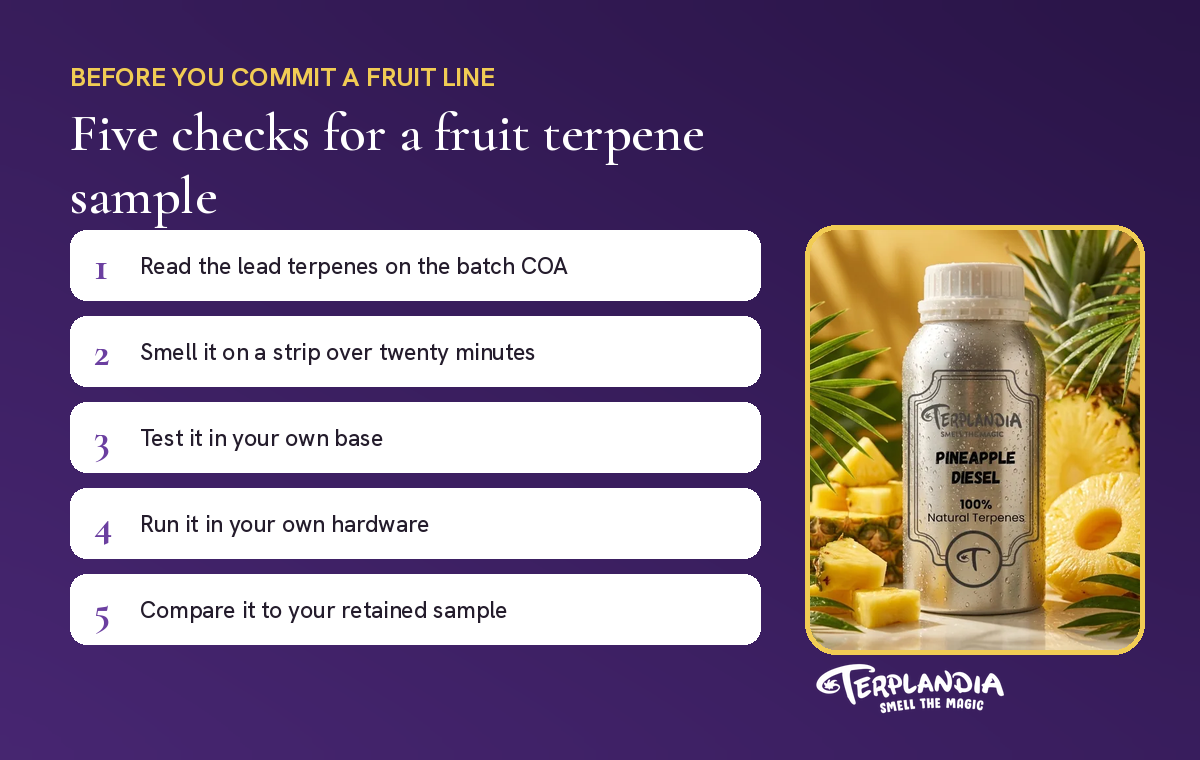
Fruit is the part of a profile most likely to change between the strip and the finished product, so evaluate it in stages. Our bench protocol for evaluating terpene samples has the full method; this is the short version for fruit.
Evaluating a fruit terpene sample
- Read the batch COA first. Confirm which terpenes lead and in what order, and that the panel lists every analyte with its own LOD and LOQ. Our line-by-line COA walkthrough explains each section.
- Smell it neat on a blotter strip over twenty minutes. Note the fruit at the open, then again as it dries down. Bright top notes fade first; what is left tells you about the base.
- Compare it blind against your current profile, if you have one, on matching strips.
- Test it in your own base at your own load. Distillate, flower and other bases all change how fruit reads.
- Run it in your own hardware or format. A cart, a pre-roll and a gummy are three different tests.
- Keep a retained sample, sealed and frozen, so the bulk lot can be compared against the profile you approved.
- Write down the target in plain words, such as ripe mango with a creamy finish, so the next batch is judged against the same brief.
Which Terplandia profiles should you sample for a fruit line?
These four cover the main fruit directions in our catalog: tropical, creamy tropical, tropical with fuel, and berry. The terpene figures and aroma notes are the published profiles on each product page.
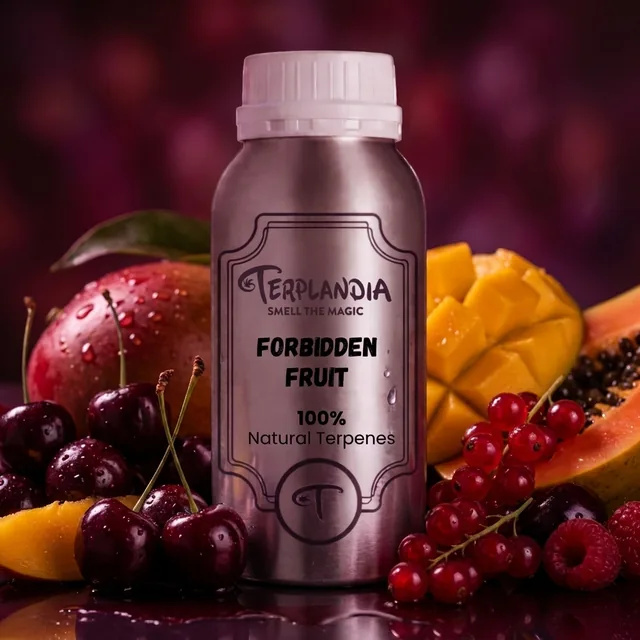
Forbidden Fruit
The tropical benchmark in our catalog: myrcene first with terpinolene a strong second, so the fruit stays bright over a ripe middle.
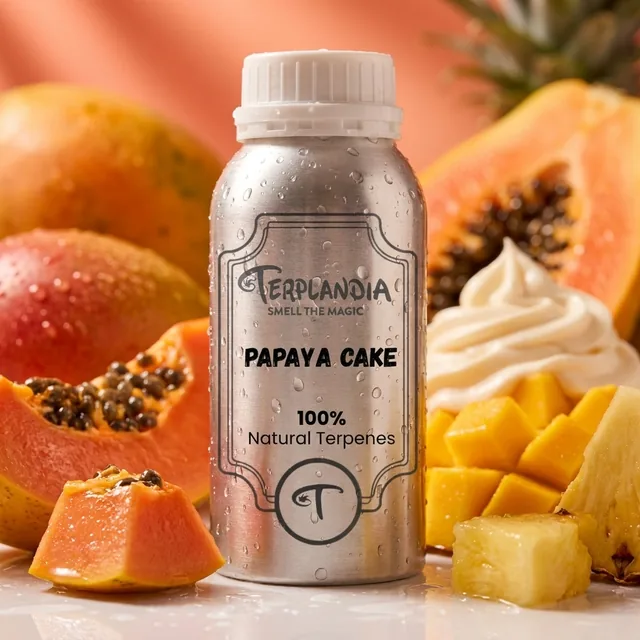
Papaya Cake
Limonene and caryophyllene sit almost level at the top, which gives papaya sweetness a soft, creamy base. A good start where the format runs hot.
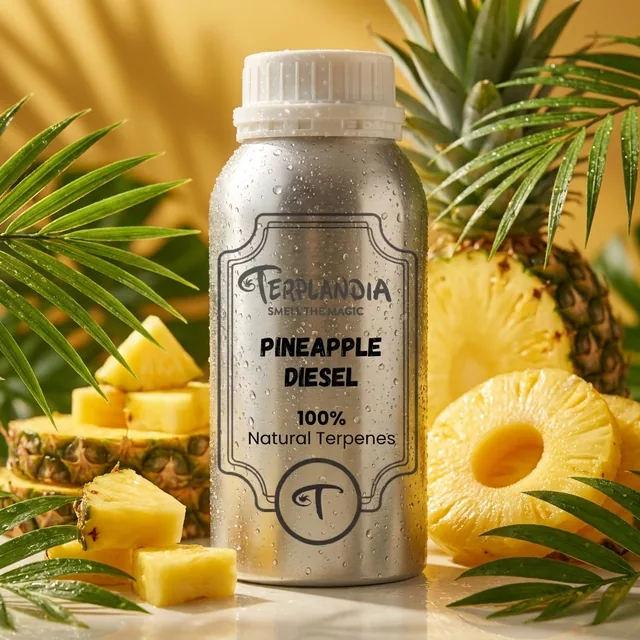
Pineapple Diesel
Terpinolene-led pineapple with a gassy edge underneath. Proof that a cultivar brings its whole profile, fruit and fuel together.

Strawberry Cough
Pinene-led and still unmistakably berry. Useful for a fruit line that needs a cleaner, fresher finish than the tropical profiles.
What does a Terplandia fruit profile arrive with?
We extract our cannabis-derived terpenes in-house from single-source Humboldt County cannabis, using vacuum-assisted steam distillation. Every bottle carries a batch number. Every batch is tested by Infinite Chemical Analysis, a licensed California laboratory (C8-0000047-LIC), on a 37-analyte terpene panel with an LOD and LOQ for each analyte, plus a full pesticide panel, and every certificate carries a LIMS link that opens on the lab’s own system. We keep an SDS for every strain and provide batch production records on request.
Every bottle gets a nitrogen top-off before it is sealed, which helps prevent degradation. Every bottle is double vacuum sealed and every shipment is double boxed. It arrives at room temperature, so you can open it and smell it right away if you want to, though ideally it stays closed until you need it.
Pricing is published: under 1,000 mL is $5 per mL, and 1,000 mL and above is $4 per mL. Samples are 2 mL for $25 or 50 mL for $250. If you would rather start with a conversation about the fruit line you are planning, request a sample here and we will help you pick the profiles to put on your bench.
Frequently asked questions
What are fruit terpenes?
There is no single fruit terpene. A profile reads as fruit when bright terpenes such as limonene or terpinolene sit over a ripe middle, often myrcene, with base notes that give the fruit a body. In cannabis, that pattern comes from the cultivar.
Can cannabis-derived terpenes taste like a specific candy or soda?
Not exactly. Cannabis-derived terpenes carry the ratio the plant made, including its base notes. If you need a precise candy or soda flavor, that is a flavor brief, not a terpene brief.
Which terpenes make a strain smell tropical?
In our catalog the tropical profiles are led by myrcene with a strong terpinolene second, as in Forbidden Fruit, or by terpinolene with myrcene behind it, as in Pineapple Diesel. Papaya Cake reaches a creamier tropical note with limonene and caryophyllene almost level.
Why does my fruit profile fade in the finished product?
Bright top notes are the most volatile part of a profile, so heat, air and time affect them first. Test fruit profiles in your own base and hardware, keep bottles sealed until use, and store them cold.
Are fruit-forward cannabis-derived terpenes made with added flavors?
Ours are not. They are recovered from cannabis by vacuum-assisted steam distillation, and every batch has a COA from a licensed California lab that you can verify on the lab’s own system.
Manufacturer-Direct · Humboldt County
Fruit that comes from the flower
Single-source Humboldt cannabis, extracted in-house, a batch COA on every bottle. Put a fruit profile on your own bench and judge it in your own base.
Sources & further reading
- Terplandia, how to evaluate a terpene sample · the full bench protocol.
- Terplandia, inside the COA · one real batch certificate, read line by line.
- Terplandia, how to match a terpene profile · from target flavor to approved profile.
- Terplandia, best terpenes for vape carts · profile directions that hold up in hardware.
- Terplandia, best terpenes for pre-rolls · what survives combustion.
- Terplandia, real cannabis terpenes vs botanical flavor stacks · the sourcing difference.
- Terpene profile figures and aroma notes are the published profiles on the Forbidden Fruit, Papaya Cake, Pineapple Diesel and Strawberry Cough product pages.
- Terpene flavor and aroma compounds containing 0% THC and 0% CBD, sold as ingredients to manufacturers and formulators, not as finished consumer products. Certificates of analysis available for every batch on request. Made in the USA, ships nationwide. Guidance on this page is a general starting point, not a specification, and must be confirmed against the buyer’s own formulation, equipment and testing. Nothing on this page constitutes medical, therapeutic, legal or regulatory advice. It is the buyer’s responsibility to ensure the conditions and uses of the product conform to local laws and regulations.

Taher Afghani is the founder of Terplandia, a Humboldt-based supplier of cannabis-derived terpenes for brands and manufacturers across the U.S. Founder, Terplandia