Make Your Own Terpenes or Buy Them? A Make-or-Buy Guide
Should you fraction your own terpenes or buy them? What in-house recovery really costs, when it wins, and how to compare it on your bench.
 By Taher Afghani · Terplandia · 13 min read · · Updated
The short version
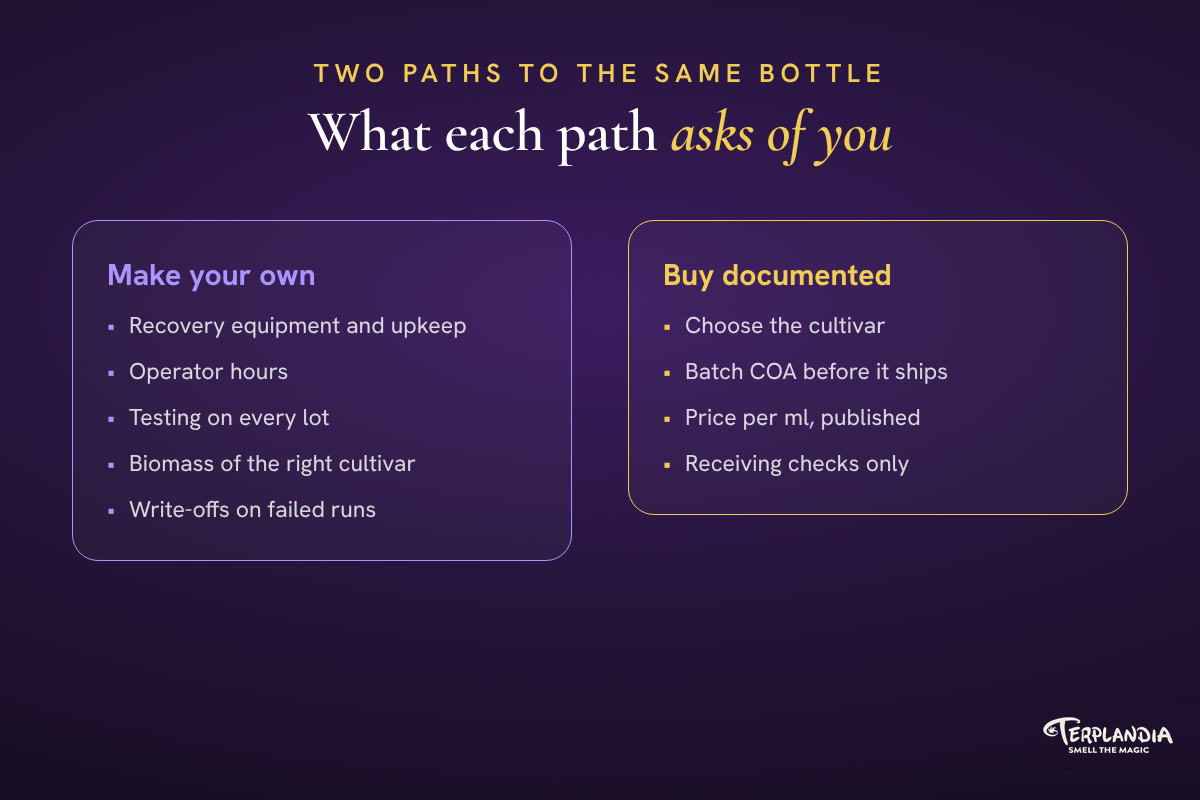
- For most brands and processors, buying is the better call. Making your own terpene fractions means equipment, operator hours, testing on every batch and a steady supply of the right biomass, before a single bottle is usable.
- Making your own can win in a narrow case. Very large volume of one profile, your own biomass, equipment you already run, and a profile nobody sells.
- Compare cost per usable ml, not equipment price. Count the lots you have to test, rework or write off, and the time your team spends off the production line.
- A bought fraction should arrive documented. Ask for a batch COA with a full analyte panel, a pesticide panel, an SDS and batch records before you compare prices.
The short answer: unless you run very large volume of a single profile, hold your own biomass, already own the equipment and need a profile nobody sells, buying documented cannabis-derived terpenes is usually cheaper and lower risk than fractioning your own. In-house terpene fractionation looks like a way to cut an ingredient cost. In practice it turns an ingredient into a second production line, with its own equipment, staff, testing, storage and failure modes, and the terpene fraction is the most fragile thing that line will ever make.
This guide is for processors, extractors and brands weighing whether to make their own terpene fractions or buy them. It covers what making your own actually involves, the costs that do not show up on an equipment quote, what a bought fraction should come with, the honest cases where in-house wins, and the questions to settle before you decide.
Updated November 10, 2026. Product figures come from our live product pages; outside figures come from the peer-reviewed studies linked in the text and listed under Sources.
What does making your own terpenes actually involve?
More than a still. To recover a terpene fraction in-house you need the recovery equipment itself, whether that is a steam distillation setup or a fractioning step built into your extraction line, plus the utilities, space and maintenance to keep it running. You need an operator who knows how to run it so the light, volatile end of the oil is kept rather than lost.
You also need the input. A terpene fraction can only carry what the biomass carried in, so the quality and consistency of your material set the ceiling on every batch. If your biomass changes from run to run, so will your terpenes, and a fruit-forward run one month can come back flat the next.
Then every batch needs to be tested before it goes anywhere near product, stored so it does not degrade, and tracked so you can tie each lot to its results. None of that is optional, and all of it is work your team is not spending on the products you actually sell. If you are licensed, check with your own state regulator what an added recovery step means for your license before you plan around it.
How much biomass does a terpene fraction actually take?
Far more than most teams expect, and that is the number to run before any equipment quote. In a peer-reviewed steam distillation study of hemp, Zheljazkov and Maggi (Scientific Reports, 2021) reported essential oil yields from 0.37% to 1.85% of dry biomass, depending on the cultivar and on which plant parts went into the still.
Run the arithmetic on that range. At a 1% yield, one kilogram of oil needs about 100 kilograms of dry plant material; at 0.37% it needs about 270 kilograms. That is before any losses to off-profile runs, testing or handling, and before you split the oil into the fractions you actually want. Our terpene pricing guide explains why that biomass math, not the equipment, drives what cannabis-derived terpenes cost.
The input also sets the profile. The plant builds its terpenes with its own enzymes: Booth and colleagues (PLOS ONE, 2017) identified the cannabis terpene synthases behind compounds such as myrcene, limonene and caryophyllene, and later work in Plant Physiology (2020) linked differences in those genes to differences between cultivars. And the name on the biomass is not a guarantee: the largest survey of commercial US flower, Smith and colleagues (PLOS ONE, 2022), found across 89,923 samples that commercial labels do not consistently line up with the chemistry. If you make your own, you inherit that variation run by run.
What does in-house fractioning cost that the quote leaves out?
The equipment quote is the smallest number in the decision. The costs that decide it are the ones that show up later.
Idle time. Recovery equipment earns its keep only when it runs. A skid or still that sits waiting for the right biomass, a trained operator or a maintenance part is capital doing nothing.
Testing on every lot. Each batch needs its own lab panel before it can be used, and a batch that fails or drifts off profile still had to be tested to find that out.
Lots you cannot use. Off-profile runs, runs from contaminated or poor input, and runs damaged by heat or open handling are all write-offs. The terpene fraction is the lightest, most volatile part of the oil, so it is usually the first thing a process problem takes.
Team time. The operator hours, cleaning, record keeping and troubleshooting come out of the same team that runs your core production.
Put those together and the number that matters is cost per usable ml: everything you spent on the line, divided by the terpene you actually put into product.
The equipment quote is the smallest number in the decision. Cost per usable ml is the one that decides it.
#terpsdontlie
Why does biomass handling decide what your fraction keeps?
Because the top notes are the first thing to go. Monoterpenes such as limonene, pinene and myrcene are lighter and more volatile than sesquiterpenes such as caryophyllene and humulene, so drying, storage and open handling cost a profile its brightest part first.
A classic study shows the size of the effect. In Ross and ElSohly (Journal of Natural Products, 1996), monoterpenes made up 92.48% of the volatile oil from fresh cannabis buds but 62.02% after a week of air drying and three months of storage, while the sesquiterpene share rose from 6.84% to 35.63%.
For a make-or-buy decision that means the clock starts at harvest, not at the still. An in-house line has to control how its biomass is dried, stored and moved, or it will distill a flatter profile than the plant carried. When you buy cannabis-derived terpenes, that risk sits with the supplier, and the batch COA shows you what survived.
What should a bought terpene fraction come with?
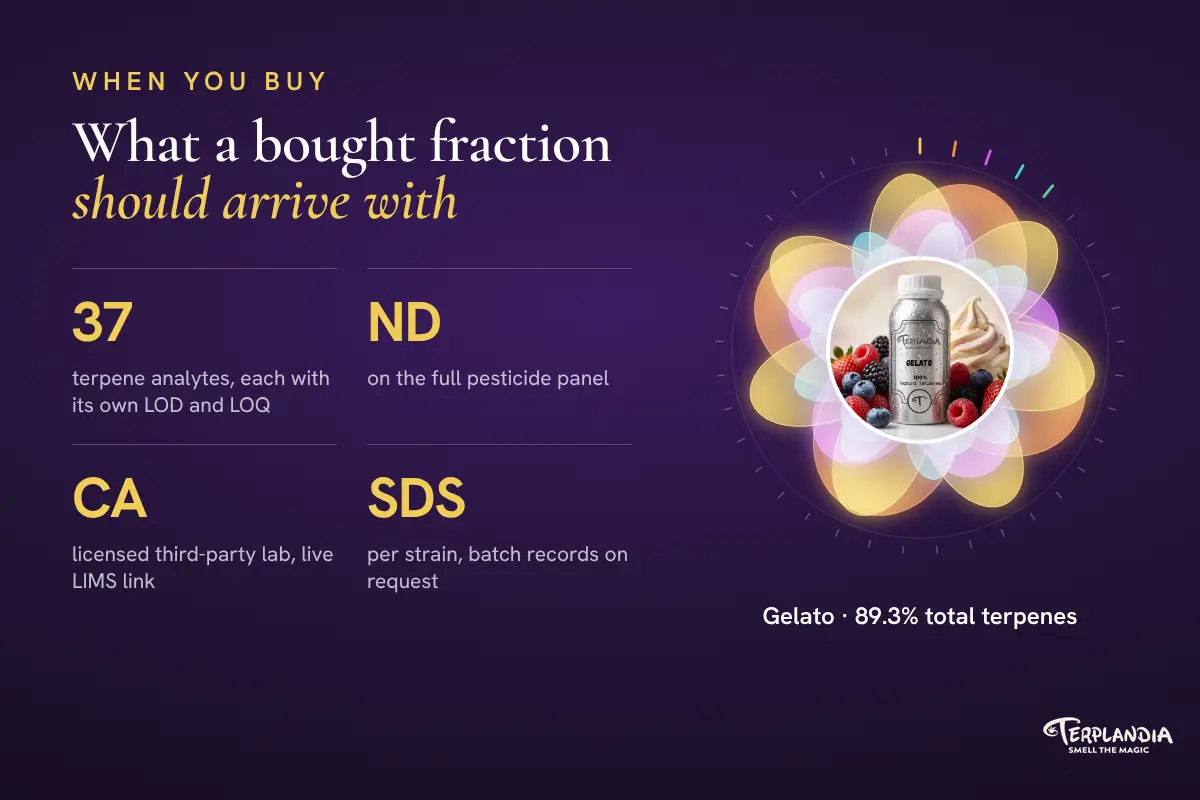
When you buy, the testing, storage and write-off risk move to the supplier, and the documents are how you check they were handled. These are the documents every Terplandia batch carries, and the ones to ask any supplier for.
| What to ask for | What it should show | Why it matters in a make-or-buy decision |
|---|---|---|
| Batch COA | 37 terpene analytes, each with its own LOD and LOQ | The full profile you are paying for, not a top five and a total |
| Pesticide panel | Every analyte reads ND | Clean input, shown rather than asserted |
| Licensed lab and live link | Infinite Chemical Analysis, license C8-0000047-LIC, with a live LIMS link | You can check the report yourself instead of re-testing |
| SDS and batch records | SDS per strain, batch production records on request | The paperwork your QA team files |
| Source and method | Real cannabis of the named cultivar, vacuum-assisted steam distillation | The profile is recovered from the plant, not assembled |
Our line-by-line COA walkthrough explains each section of the report, and our explainer on how terpene testing works covers the lab methods behind it.
What buying costs, in full
Terplandia pricing is per ml and published. There is no equipment, testing or write-off line to add on top.
The honest part
When does making your own terpenes make sense?
There are real cases where in-house wins, and it is worth being plain about them. Making your own tends to make sense when most of these are true at once:
- You run very large volume of one profile. Enough that the line runs most days on the same input.
- You hold your own biomass. A steady supply of the right material that would otherwise go unused.
- You already own and run the equipment. The capital is spent and the operators are trained.
- You need a profile nobody sells. A cultivar of your own, or a profile you cannot source documented anywhere else.
If only one or two of those are true, the math usually favors buying. If none of them are, an in-house line is a project, not a cost saving. Many teams land in the middle: they buy the profiles they need on a schedule and keep any in-house recovery for the one cultivar that is theirs alone.
How does a make-or-buy decision look side by side?
| Question | Make your own | Buy documented terpenes |
|---|---|---|
| Upfront cost | Equipment, install, utilities, training | None beyond the order |
| Per-batch testing | Yours to run and pay for, every lot | Done before it ships, with a batch COA |
| Profile range | Whatever your biomass carried | Choose the cultivar for each product |
| Off-profile or failed lots | Your write-off | Not shipped |
| Team time | Operators, cleaning, records | Receiving checks only |
| Best fit | High single-profile volume, own biomass, unique profile | Most brands, processors and co-packers |
How do you test a bought fraction against your own?
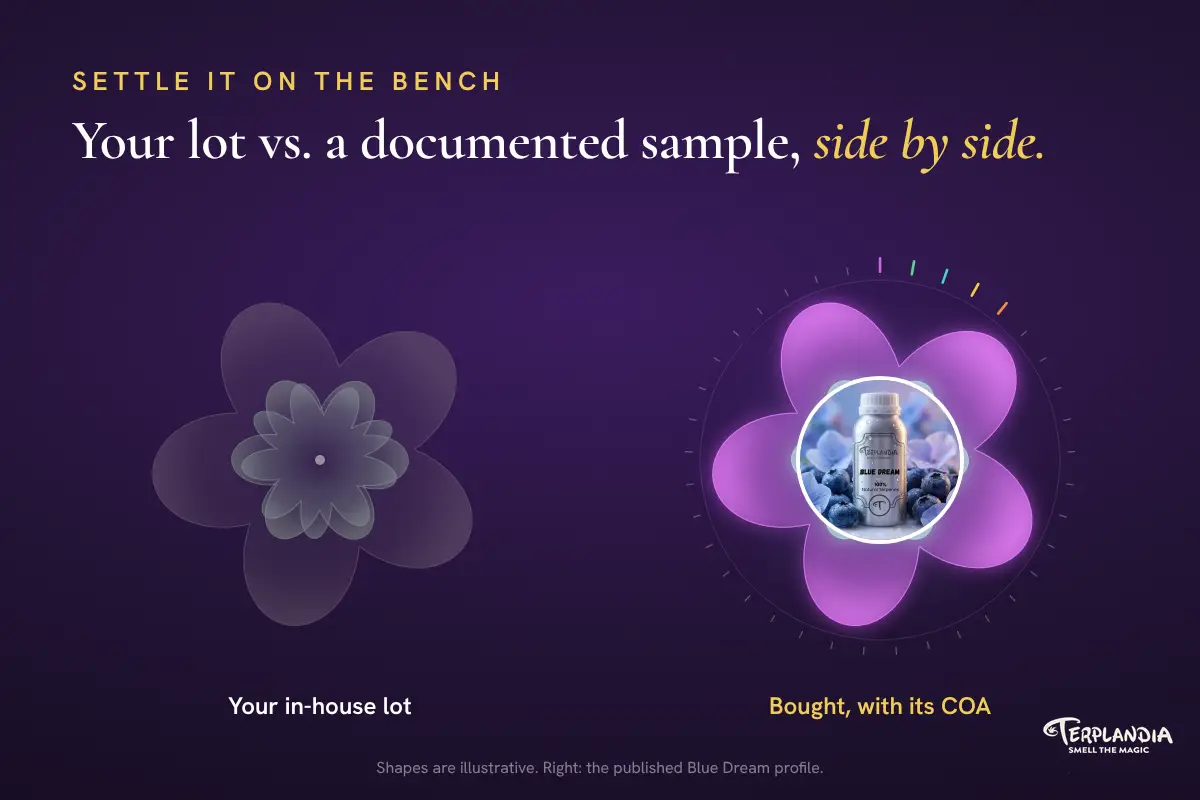
If you already run an in-house fraction, the fairest way to decide is a side-by-side on your own bench. Put a bought sample of the closest cultivar next to your own lot, on matching strips and then in your own base at your own load, and judge them against the same written target. Our bench protocol covers the full method.
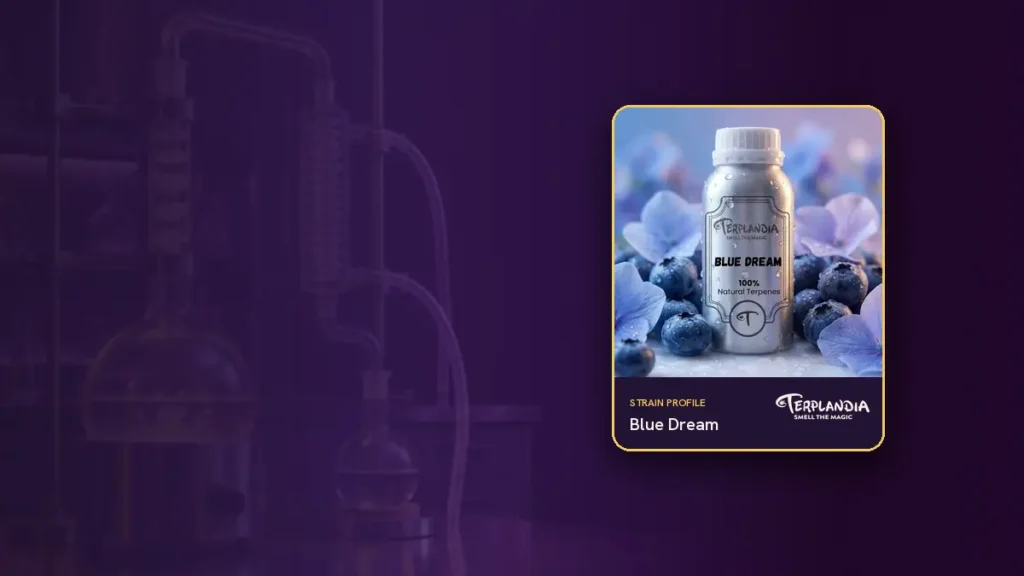
Start with a cultivar close to what you already make, such as our Blue Dream for a myrcene-led profile, so the comparison is about the oil and not about the strain.
When the bulk order arrives, check it the same way you would check your own lot: seals intact, nothing leaking, batch number matching the COA. Every Terplandia bottle gets a nitrogen top-off before sealing, which helps prevent degradation, and every bottle is double vacuum sealed and every shipment double boxed. It arrives at room temperature, so you can open it and smell it right away if you want to; ideally it stays closed until you use it. Our guide to inspecting a terpene shipment lists the receiving checks.
What should you settle before you buy a still?
Six questions for a make-or-buy decision
- How many ml of finished terpene do you use a month, and of how many profiles? Volume spread across many profiles rarely justifies a line.
- Do you hold biomass of the right cultivars, every month? A fraction can only carry what the input carried.
- Who runs the equipment, and what does it do when they are out? Count operator hours and backup.
- What will testing every lot cost you, including the lots that fail? Price the tests you will run, not just the ones that pass.
- What is your cost per usable ml once write-offs are counted? Compare that number, not the equipment quote, with a published per-ml price.
- Can you get the profile you need, documented, from a supplier today? If yes, test that sample first. Our supplier questions cover what to ask.
Which profiles should you bench against your own fraction?
Three cultivars with different leads, so you can compare a bought fraction against whatever your own line produces. The cards show the published profile on each product page; the batch COA shows the full panel.

Blue Dream
Myrcene-led at 52.2% with 87.9% total terpenes. A good first comparison for a myrcene-heavy in-house fraction.
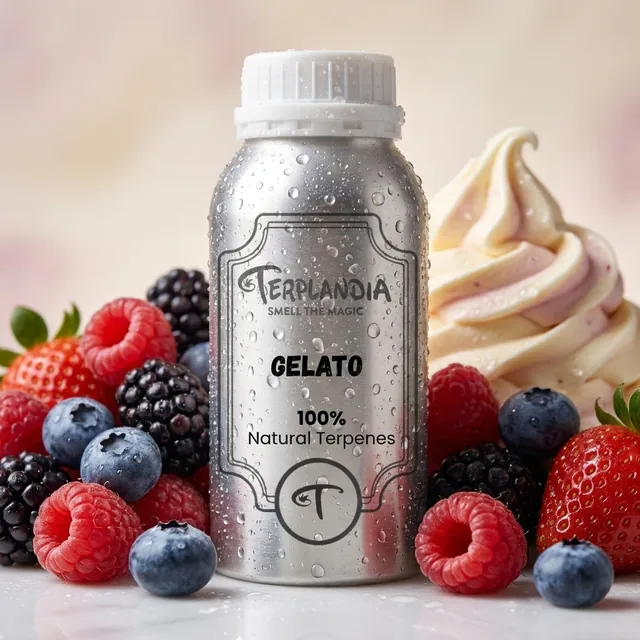
Gelato
Limonene and caryophyllene almost level at 20.9% and 20.4%. A balanced profile that shows how much a single run has to get right.
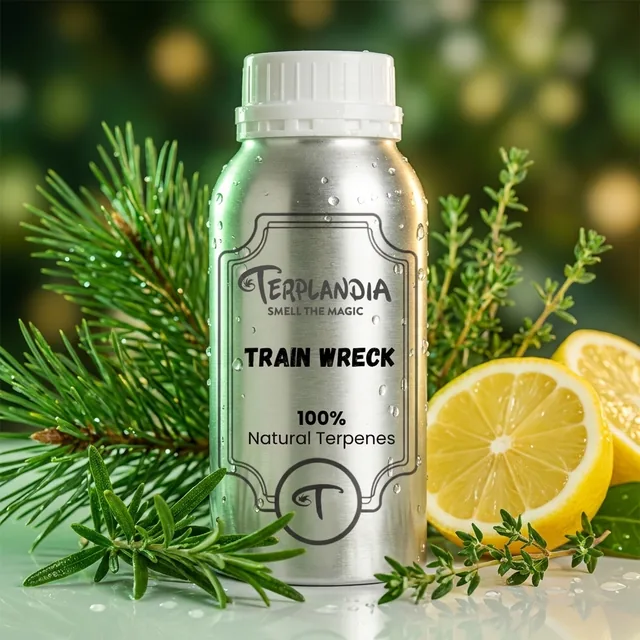
Train Wreck
Myrcene-led at 32.7% with terpinolene at 22.3%. A bright, piney profile to bench against your own top notes.
The quickest way to settle make or buy is on your own bench. Request a sample and its batch COA, and compare it with your own lot.
Frequently asked questions
Is it cheaper to make your own terpenes?
Sometimes, but rarely for most brands and processors. In-house fractioning only beats buying when you run very large volume of one profile, hold your own biomass, already own the equipment and need a profile nobody sells. Compare cost per usable ml, including testing and write-offs, not the equipment price.
What is terpene fractionation?
It is the step that separates the volatile terpene fraction from the rest of a plant extract or from the plant material itself, so it can be used as an ingredient. Methods vary; ours is vacuum-assisted steam distillation on real cannabis material, which is solventless.
What should come with bought terpenes?
A batch COA covering the full terpene panel with LOD and LOQ for each analyte, a pesticide panel, a batch number that ties the bottle to its COA, an SDS per strain and batch production records on request.
How much do Terplandia terpenes cost?
Under 1,000 ml, $5 per ml. For 1,000 ml and above, contact us for a bulk quote. Samples are $25 for 2 ml and $250 for 50 ml.
How do I compare a bought terpene with my own fraction?
Run them side by side: matching blotter strips first, then in your own base at your own load and in your own hardware, judged against the same written target. Read both COAs so you are comparing documented profiles.
How much biomass does it take to make 1 kg of terpenes?
It depends on the cultivar and the plant parts, but published steam distillation yields for hemp run from 0.37% to 1.85% of dry biomass (Zheljazkov and Maggi, 2021). At a 1% yield that is about 100 kg of dry material for 1 kg of oil, before any losses.
Does drying cannabis before distillation change the terpenes?
Yes. Drying and storage cost a profile its volatile top notes first. In Ross and ElSohly (1996), the monoterpene share of cannabis volatile oil fell from 92.48% in fresh buds to 62.02% after a week of drying and three months of storage.
Make or buy · settle it on the bench
Bench a documented fraction against your own
Every Terplandia profile is recovered from real cannabis of the named cultivar by vacuum-assisted steam distillation, with a batch COA covering 37 terpene analytes and a full pesticide panel.
Sources & further reading
- Terplandia · Blue Dream product page (published terpene profile)
- Terplandia · Gelato product page
- Terplandia · Train Wreck product page
- Terplandia · How to read a terpene COA
- Zheljazkov V.D., Maggi F. (2021). Valorization of CBD-hemp through distillation to provide essential oil and improved cannabinoids profile. Scientific Reports 11: 19890
- Ross S.A., ElSohly M.A. (1996). The volatile oil composition of fresh and air-dried buds of Cannabis sativa. Journal of Natural Products 59(1): 49-51
- Smith C.J. et al. (2022). The phytochemical diversity of commercial Cannabis in the United States. PLOS ONE 17(5): e0267498
- Booth J.K., Page J.E., Bohlmann J. (2017). Terpene synthases from Cannabis sativa. PLOS ONE 12(3): e0173911
- Booth J.K. et al. (2020). Terpene synthases and terpene variation in Cannabis sativa. Plant Physiology 184(1)
- Terpene flavor and aroma compounds containing 0% THC and 0% CBD, sold as ingredients to manufacturers and formulators, not as finished consumer products. Certificates of analysis available for every batch on request. Made in the USA, ships nationwide. Guidance on this page is a general starting point, not a specification, and must be confirmed against the buyer’s own formulation, equipment and testing. Nothing on this page constitutes medical, therapeutic, legal or regulatory advice. It is the buyer’s responsibility to ensure the conditions and uses of the product conform to local laws and regulations.

Taher Afghani is the founder of Terplandia, a Humboldt-based supplier of cannabis-derived terpenes for brands and manufacturers across the U.S. Founder, Terplandia