

Gas Terpenes: Which Cannabis-Derived Profiles Actually Deliver Gas, Diesel and OG
There is no single gas terpene. Which cannabis-derived profiles deliver OG, diesel and skunk, why real gas is hard to find, and how to test a gas sample.
 By Taher Afghani · Terplandia · 14 min read · · Updated
The short version
- There is no single gas terpene. Gas, diesel and skunk are patterns across a whole profile. Our OG Kush is caryophyllene-led; our Pineapple Diesel and Lemon Skunk are terpinolene-led; our Lemon Diesel Cake is myrcene-led.
- Gas is the hardest direction to rebuild. It depends on the whole oil, not a headline compound, which is why so many gas-labelled samples come back sweet, minty or fruity.
- Read the lead terpenes, then smell the dry-down. The batch COA tells you which gas direction you are buying; the base notes after twenty minutes tell you whether it holds.
- Test gas where it will live. A cart, a pre-roll and a distillate add-back each change how fuel reads, so judge it in your own base and hardware.
The short answer: cannabis-derived terpenes can deliver gas, diesel and OG, but the fuel comes from the cultivar and its whole profile, not from one compound you can buy on its own. A profile reads as gas when a peppery, woody base sits under a sharp citrus or pine top, and the rest of the oil fills in the funk. If you want gas that smells like the flower, start with a gas cultivar and read its lead terpenes. If a sample marketed as gas smells mostly of candy, mint or fresh fruit, it was probably built toward a flavor target rather than recovered from a gas plant.
This guide is for brands, processors and formulators planning a gas, diesel or OG line in vapes, pre-rolls or distillate. It covers what makes a profile read as gas, which gas directions cannabis-derived terpenes can carry, why real gas is hard to find, and how to evaluate a gas sample before it goes into a batch. It is the companion to our guide to fruit terpenes, from the other end of the aroma spectrum.
Updated November 10, 2026. Product figures come from our live product pages; outside figures come from the peer-reviewed studies linked in the text and listed under Sources.
What makes a terpene profile read as gas?
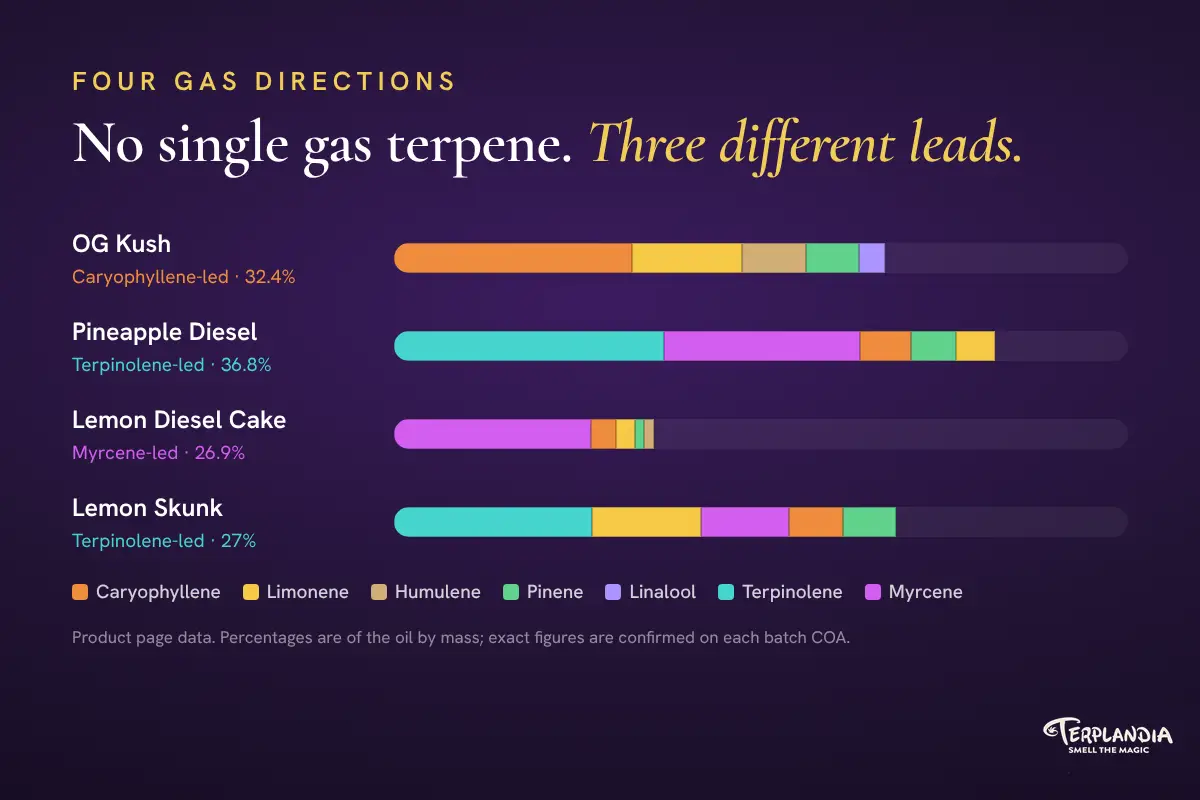
Not one terpene. Buyers often search for a gas terpene or a diesel terpene as if there were a single compound that smells like fuel. On a standard terpene panel there is not. What the nose reads as gas is a pattern: a dry, peppery or woody base, a sharp top that cuts through it, and the low, funky notes that the whole oil carries underneath.
In cannabis, the peppery base usually comes from caryophyllene, which on its own reads as black pepper and dry wood, and from humulene, which reads dry, hoppy and woody. The sharp top often comes from limonene, which reads as lemon peel, from pinene, which reads as pine and resin, or from terpinolene, which reads fresh, herbal and a little green. Myrcene sits in the middle and reads earthy and musky, which is part of why so many diesel cultivars feel heavy rather than bright.
The clearest proof is in our own catalog. Our OG Kush is led by caryophyllene. It is one of four profiles we sell that carry fuel in their names or aroma notes, and those four are led by three different terpenes. If gas were one compound, they would all be led by it.
What does the research say about gas and terpene chemotypes?

Research backs up what buyers notice on the bench: cannabis falls into a small number of terpene patterns, and the name on the label does not always tell you which one you are holding. The largest published chemical survey of commercial US cannabis flower, Smith and colleagues in PLOS ONE (2022), analyzed 89,923 samples and found that THC-dominant products sort into three main terpene groups: a caryophyllene and limonene group, a myrcene and pinene group, and a terpinolene and myrcene group. The same study found that commercial labels do not consistently line up with that chemistry.
Those three groups map neatly onto the gas directions in our catalog. Our OG Kush is led by caryophyllene with limonene behind it, which puts it in the first group. Our Pineapple Diesel and Lemon Skunk are led by terpinolene, the signature of the third. Lemon Diesel Cake is myrcene-led, closer to the second. In other words, “gas” is not one chemotype. It shows up in different terpene families, and each one smells like a different kind of fuel.
Why does each cultivar land where it does? The plant makes its terpenes with its own enzymes. Booth and colleagues (PLOS ONE, 2017) identified the terpene synthase enzymes in cannabis that produce compounds such as myrcene, limonene and caryophyllene, and follow-up work in Plant Physiology (2020) tied differences in those genes to differences in cultivar terpene profiles. That is the practical case for recovering gas from a gas cultivar: the ratio is set by the plant, and a cannabis-derived terpene keeps it.
Which gas directions can cannabis-derived terpenes actually deliver?
Four gas directions show up clearly in our catalog. The figures below are the published profiles on each product page; your batch COA is the number that counts.
| Gas direction | What leads it | Terplandia example | What to listen for |
|---|---|---|---|
| Classic OG | Caryophyllene, with limonene and humulene behind it | OG Kush: caryophyllene 32.4%, limonene 15.0% | Pepper, pine and earth with a lemon edge; the closest to a dry gas |
| Tropical with fuel | Terpinolene first, myrcene close behind | Pineapple Diesel: terpinolene 36.8%, myrcene 26.7% | Pineapple up front, diesel underneath |
| Lemon diesel | Myrcene, with a thin peppery and citrus layer | Lemon Diesel Cake: myrcene 26.9%, caryophyllene 3.29% | Lemon and fuel over a sweet, heavy base |
| Skunk | Terpinolene, with limonene and myrcene behind it | Lemon Skunk: terpinolene 27.0%, limonene 14.8% | Sharp lemon and skunk that sits forward in the nose |
Notice what the table does not show: one gas compound that every gas profile shares at the top. The fuel note in each of these comes from the pattern, which is the signature of a cannabis profile. Our OG Kush terpene profile guide walks through the classic OG direction in more depth.
Two gas profiles, two different leads
OG Kush and Pineapple Diesel both carry fuel, but they get there from opposite ends of the terpene spectrum. That is why the lead terpenes on the COA matter more than the word on the label.
The honest part
Why is real gas so hard to find?
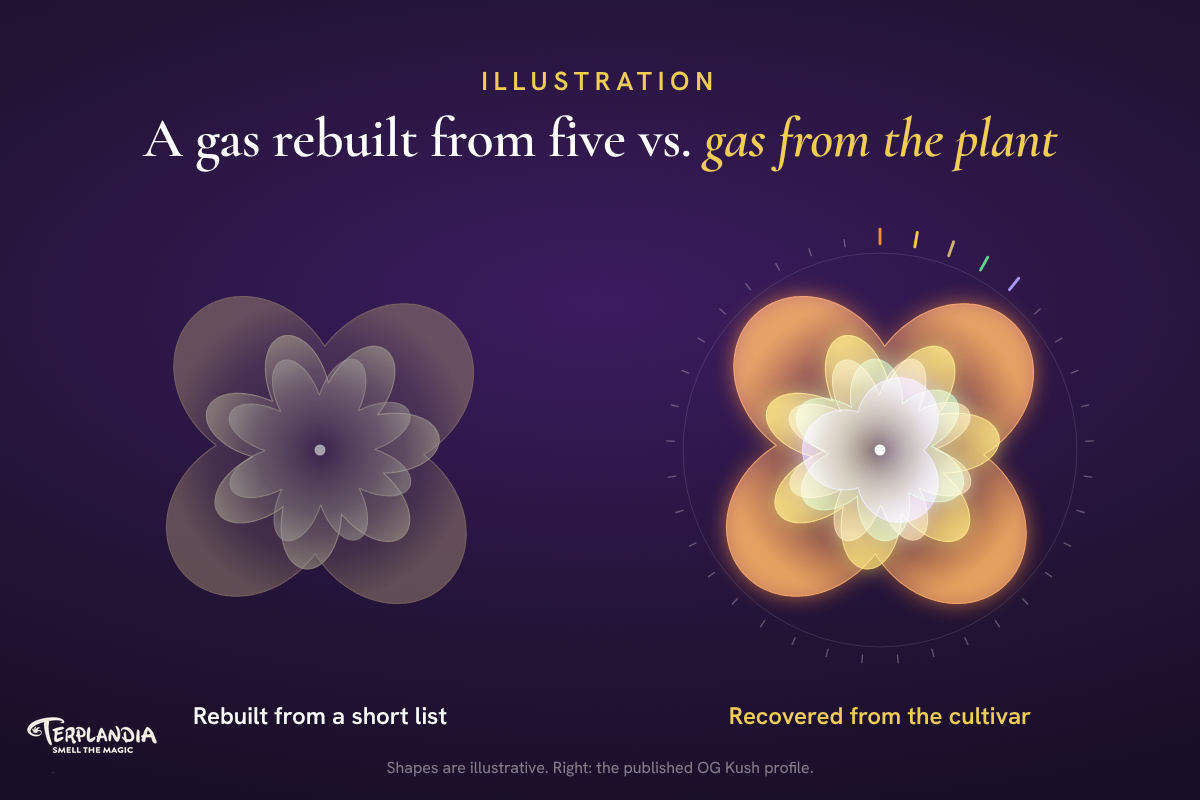
Because gas is the direction that falls apart first when a profile is rebuilt from a short list. A fruit or candy target can be assembled from a handful of bright, well-known compounds, and it will smell convincing on a strip. Gas depends much more on the low end of the profile and on the minor compounds in the whole oil, and a five-compound rebuild leaves most of that out.
That is why buyers who ask for a true gas or OG so often get something sweet, minty or fresh instead. The lead terpenes on the label may look right, but the funk underneath was never there. It is also why a gas sample can smell right in the first minute and then flatten into pepper and citrus as it dries down.
A cannabis-derived gas profile is recovered from a cultivar that grew that way, so the base comes along with the top. It carries the ratio the plant made. That is the difference between recovering a profile and rebuilding one.
If the brief says gas, buy a gas cultivar. A gas label on a candy profile is still a candy profile.
#terpsdontlie
Why does gas fade during the dry-down?

Because the bright top of a gas profile is made of the most volatile compounds, and they leave first. Monoterpenes such as limonene, pinene, myrcene and terpinolene are lighter and evaporate faster than sesquiterpenes such as caryophyllene and humulene, which form the peppery, woody base.
A classic study of cannabis volatile oil shows how strong that effect is. In Ross and ElSohly (Journal of Natural Products, 1996), monoterpenes made up 92.48% of the oil from fresh buds but 62.02% after a week of air drying and three months of storage, while the sesquiterpene share rose from 6.84% to 35.63%. The plant did not gain base notes; it lost top notes.
The same thing happens on a blotter strip in twenty minutes, and in an open bottle over weeks. For a buyer that means two things:
- Judge gas at the dry-down, not the first sniff. A gas that holds once the citrus top has flashed off has a real base under it.
- Protect the top notes in storage. Keep the bottle closed until you use it. Our terpenes ship with a nitrogen top-off, double vacuum sealed and double boxed, and arrive at room temperature, so the profile you open is the profile we bottled. Our shipment inspection guide covers what to check on arrival.
What can’t cannabis-derived gas terpenes do?
An honest read before you plan a gas line.
- They will not strip out the rest of the cultivar. Pineapple Diesel brings its pineapple along with the fuel. Lemon Diesel Cake brings its sweet base. You choose the cultivar, and the cultivar brings its whole profile.
- They will not turn a fruit cultivar into gas. If the source plant did not carry fuel, no amount of loading will add it.
- They will not be louder than the plant made them. Intensity comes from the cultivar and the batch. Chasing more gas by loading more terpene changes viscosity and burn in other ways; test it rather than assume it.
- They will vary a little between harvests. The leading terpenes and their order should hold. The decimals will move, and the COA for each batch will show it.
How do you match a gas profile to the product format?
Start with how the product is consumed, because heat changes which part of a gas profile survives. In a vape cart the sharp top notes are front and center, so a terpinolene-led gas like Pineapple Diesel or Lemon Skunk can read loud and forward. Our guide to the best terpenes for vape carts walks through the profile directions that hold up in hardware.
Combustion is kinder to base notes than to bright ones. Our guide to terpenes for pre-rolls explains why base-heavy profiles survive the flame better than top-heavy ones, which makes a caryophyllene-led OG a natural place to start for infused flower and pre-rolls.
In distillate add-back, gas has to stand up to the base itself. Start with the published lead terpenes, add in small steps, and judge the finished oil rather than the neat terpene. Whatever the format, write the target down in plain words, such as dry OG with a lemon edge, before you choose the cultivar.
How should you evaluate a gas terpene sample?
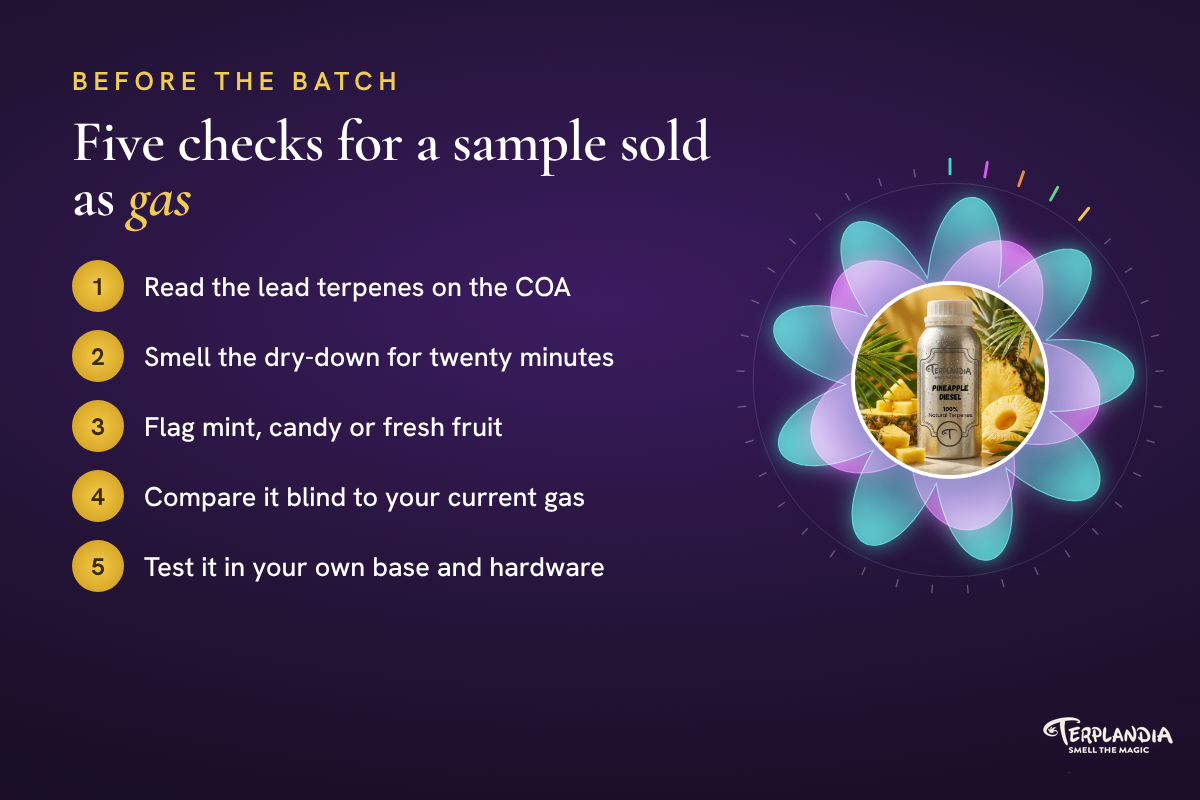
Gas is the part of a profile most likely to change between the first sniff and the dry-down, so evaluate it in stages. Our bench protocol for evaluating terpene samples has the full method; this is the short version for gas.
Evaluating a gas terpene sample
- Read the batch COA first. Confirm which terpenes lead and in what order, and that the panel lists every analyte with its own LOD and LOQ. Our line-by-line COA walkthrough explains each section.
- Smell it neat on a blotter strip over twenty minutes. Note the fuel at the open, then again as it dries down. A gas that turns into pepper and lemon alone after a few minutes is telling you about its base.
- Check for notes that should not be there. Fresh mint, candy or bright fruit on a profile sold as pure gas is a reason to ask how it was made.
- Compare it blind against your current profile, if you have one, on matching strips.
- Test it in your own base, load and hardware. Distillate, flower and carts all change how fuel reads, and a cart and a pre-roll are two different tests.
- Write down the target in plain words so the next batch is judged against the same brief.
How do you write a gas brief a supplier can actually hit?
Most gas projects go wrong at the brief, not the bench. “Make it gassy” gives a supplier nothing to aim at. A brief that names the direction, the format and the pass or fail test gets you a sample worth testing in the first round. Our guide to matching a terpene profile covers the full process; for gas, put these six lines on one page:
- The direction: classic OG, tropical with fuel, lemon diesel or skunk.
- The lead terpene and its order: for example caryophyllene first, limonene second.
- The format: cart, all-in-one, pre-roll or distillate add-back, with your hardware or flower.
- The dry-down test: what the strip should still smell like at twenty minutes.
- What fails: mint, candy or fresh fruit on a profile sold as pure gas.
- The label claim: if the cart carries a strain name, see how brands make the strain name true.
Which Terplandia profiles should you sample for a gas line?
These four cover the gas directions in our catalog: classic OG, tropical with fuel, lemon diesel and skunk. The terpene figures and aroma notes are the published profiles on each product page.

OG Kush
Caryophyllene-led at 32.4% with 74.3% total terpenes. The closest thing in our catalog to a dry, classic OG.
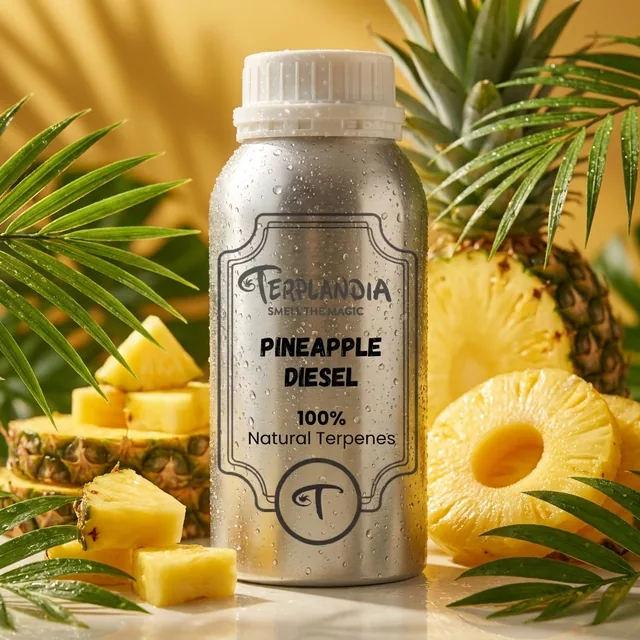
Pineapple Diesel
Terpinolene-led at 36.8% with myrcene close behind. Pineapple up front, fuel underneath.
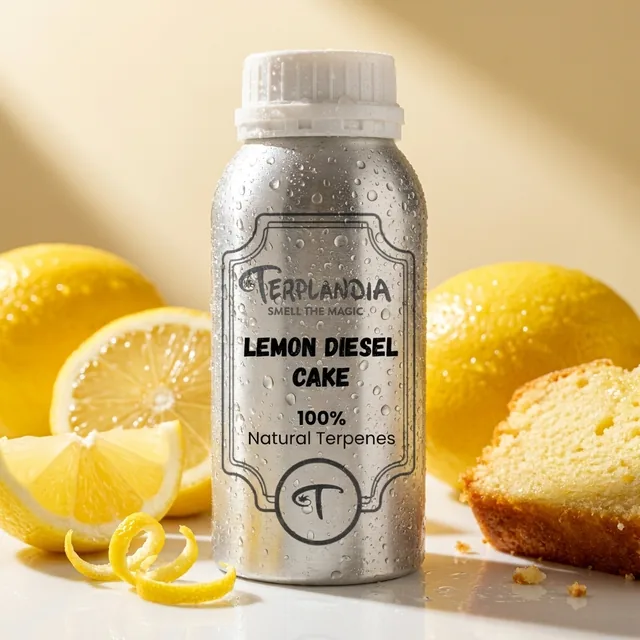
Lemon Diesel Cake
Myrcene-led at 26.9%. Lemon and diesel over a sweet, heavy base.

Lemon Skunk
Terpinolene-led at 27.0% with limonene behind it. Sharp lemon and skunk that sits forward.
The quickest way to judge a gas profile is to smell it next to what you run now, through the full dry-down. Request a sample and its batch COA.
Frequently asked questions
Is there a single terpene that smells like gas?
No. On a standard terpene panel no single compound smells like fuel on its own. Gas is a pattern across the whole profile: a peppery, woody base, a sharp top and the minor compounds the whole oil carries. In our catalog, gas profiles are led by caryophyllene, terpinolene or myrcene depending on the cultivar.
Which terpenes are in OG Kush?
The published profile on our OG Kush product page is led by caryophyllene at 32.4%, followed by limonene at 15.0%, humulene at 8.79%, pinene at 7.18% and linalool at 3.52%, with 74.3% total terpenes. The batch COA shows the exact numbers for each lot.
Why do so many gas terpenes smell sweet or minty?
Usually because the profile was built toward a flavor target from a short list of compounds rather than recovered from a gas cultivar. The bright top is easy to rebuild; the low, funky base that makes gas read as gas is not.
Which gas profile works best in pre-rolls?
Base-heavy profiles tend to survive combustion better than top-heavy ones, which makes a caryophyllene-led OG a natural starting point. Test any profile in your own flower at your own load before committing a batch.
Do gas terpenes change from batch to batch?
A little. The leading terpenes and their order should hold from harvest to harvest, while the exact percentages move. Nothing is added to standardize them, and the COA for each lot shows the numbers.
Are diesel terpenes the same as gas terpenes?
They overlap, but they are not identical. Diesel is one gas direction, usually sharper and more solvent-like, and in our catalog it often comes with a fruit or citrus top, as in Pineapple Diesel and Lemon Diesel Cake. Classic OG gas reads drier and more peppery, led by caryophyllene.
How much plant does it take to make cannabis-derived terpenes?
A lot. In a peer-reviewed steam distillation study of hemp, Zheljazkov and Maggi (Scientific Reports, 2021) reported essential oil yields of 0.37% to 1.85% of dry biomass depending on the cultivar and the plant parts used. That is one reason real cannabis-derived gas is scarcer than a flavor blend.
Real gas · from the plant
Smell real gas next to your current profile
Every Terplandia profile is recovered from real cannabis of the named cultivar, with a batch COA covering 37 terpene analytes and a full pesticide panel.
Sources & further reading
- Terplandia · OG Kush product page (published terpene profile)
- Terplandia · Pineapple Diesel product page
- Terplandia · Lemon Diesel Cake product page
- Terplandia · Lemon Skunk product page
- Terplandia · How to read a terpene COA
- Smith C.J. et al. (2022). The phytochemical diversity of commercial Cannabis in the United States. PLOS ONE 17(5): e0267498
- Booth J.K., Page J.E., Bohlmann J. (2017). Terpene synthases from Cannabis sativa. PLOS ONE 12(3): e0173911
- Booth J.K. et al. (2020). Terpene synthases and terpene variation in Cannabis sativa. Plant Physiology 184(1)
- Ross S.A., ElSohly M.A. (1996). The volatile oil composition of fresh and air-dried buds of Cannabis sativa. Journal of Natural Products 59(1): 49-51
- Zheljazkov V.D., Maggi F. (2021). Valorization of CBD-hemp through distillation to provide essential oil and improved cannabinoids profile. Scientific Reports 11: 19890
- Terpene flavor and aroma compounds containing 0% THC and 0% CBD, sold as ingredients to manufacturers and formulators, not as finished consumer products. Certificates of analysis available for every batch on request. Made in the USA, ships nationwide. Guidance on this page is a general starting point, not a specification, and must be confirmed against the buyer’s own formulation, equipment and testing. Nothing on this page constitutes medical, therapeutic, legal or regulatory advice. It is the buyer’s responsibility to ensure the conditions and uses of the product conform to local laws and regulations.

Taher Afghani is the founder of Terplandia, a Humboldt-based supplier of cannabis-derived terpenes for brands and manufacturers across the U.S. Founder, Terplandia