What Should Be in the Box: How to Inspect a Terpene Shipment Before It Touches a Batch
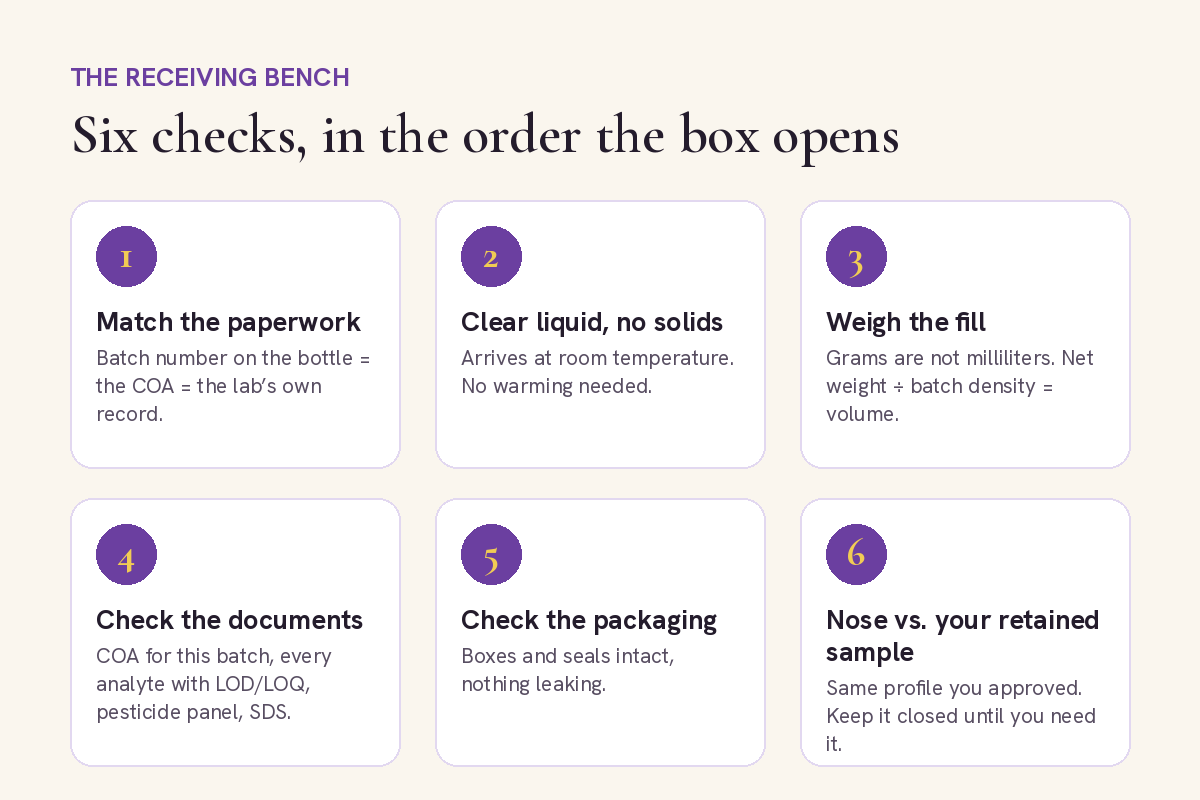
Six checks for the receiving bench: label against paperwork, clarity and solids, fill by weight, the documents, the packaging, and the nose against your retained sample.
 By Taher Afghani · Terplandia · 12 min read ·
The short answer: before a bulk bottle of cannabis-derived terpenes goes anywhere near a batch, run six checks at the receiving bench. Match the batch number on the bottle to the COA and to the lab’s own record. Confirm it is a clear liquid with no solids. Weigh the fill instead of eyeballing it. Confirm the documents cover this batch, not just the product. Check that the boxes and seals arrived intact. Then compare it against the sample you approved. The whole routine takes about twenty minutes, and it is the last cheap place to catch a problem.
Most buying advice stops at the sample. Then the bulk shipment arrives, someone signs for it, and the bottle goes straight to the blending room. The sample proved the profile. The shipment has to prove it again.
Why should you inspect a terpene shipment at all?
Because the receiving bench is the cheapest place to say no. Before the seal is broken, a problem lot costs a phone call and a return. After it is blended, it costs the distillate, the hardware and the fill time.
Buyers in the forums report the same problems again and again: solids in the bottle, a short fill, a storage instruction that made no sense. All of them are visible at the receiving bench if someone is looking. The checks below apply to any supplier, including us.
Six checks, in the order the box opens
Does the label match the paperwork?
Before the seal is broken, read the label against the invoice and the certificate of analysis. Four things should match exactly, and a mismatch on any of them is a reason to stop before going further.
| On the bottle | Should match | If it does not |
|---|---|---|
| Batch or lot number | The batch number on the COA, and the record on the lab’s own site | Stop. A COA for a different batch tells you nothing about this bottle |
| Cultivar or profile name | The profile you approved at sample stage, and the invoice line | Ask before opening. A substitution should never arrive as a surprise |
| Volume | The invoice quantity | Weigh it before raising it (see the fill check below) |
| Packaging or batch date | A date that makes sense against the COA test date | Ask how long the lot sat and how it was stored |
A supplier who batch-numbers every bottle makes this a thirty-second check. A supplier who sends one certificate per product, rather than per batch, makes it impossible, because you cannot tie the document to the oil in front of you. Our guide to choosing a terpene supplier explains why per-batch documentation is the line that matters most when you vet a new source.
Check the profile too. If the spec says myrcene-dominant, the COA for your batch should say so. Our Blue Dream, for example, is published as myrcene-dominant at 52.2%, so a Blue Dream COA that leads with anything else is a question to send back. Percentages move between harvests; the order of the leading terpenes should not swing wildly.
Is cloudy terpene oil or solids in the bottle a problem?
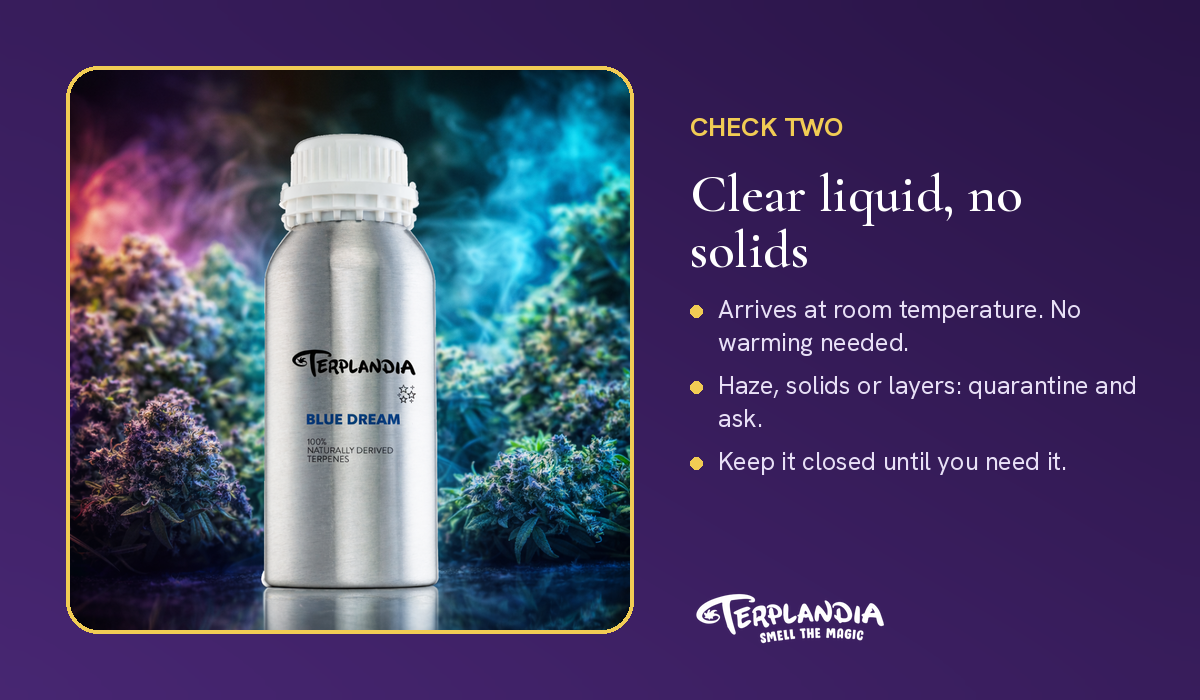
It depends on what you see. Terpenes arrive at room temperature, so there is nothing to warm and nothing to wait for: if you want to check the oil or smell it on arrival, you can open the bottle right away. Ideally, though, it stays closed until you need it, so many buyers run this check once, when they draw the first batch.
A cannabis-derived terpene should be a clear liquid. Slight differences in tint between cultivars and between batches are normal. What you are looking for is anything that is not clear liquid: haze or cloudiness, floating particles, a layer on the bottom, or a film on the walls.
| What you see | What it can mean | What to do |
|---|---|---|
| Haze or cloudiness | Water, or material that should have been removed during processing | Quarantine. Ask the supplier for the batch record and what the haze is |
| Solids, flakes or a layer on the bottom | Plant waxes or lipids carried through, or foreign particulate | Do not blend. Photograph it, quarantine the lot, ask in writing |
| Two distinct liquid layers | Water or an incompatible carrier in the bottle | Do not blend. Ask what else is in it |
An answer that the oil simply comes out of the machine that way is not an explanation. A supplier who extracts in-house should be able to tell you what the material is and why it is there. The same applies to dilution: our guide to diluted and cut terpenes covers the checks for a profile that has been stretched with a carrier.
How do you check the fill on a bulk terpene bottle?
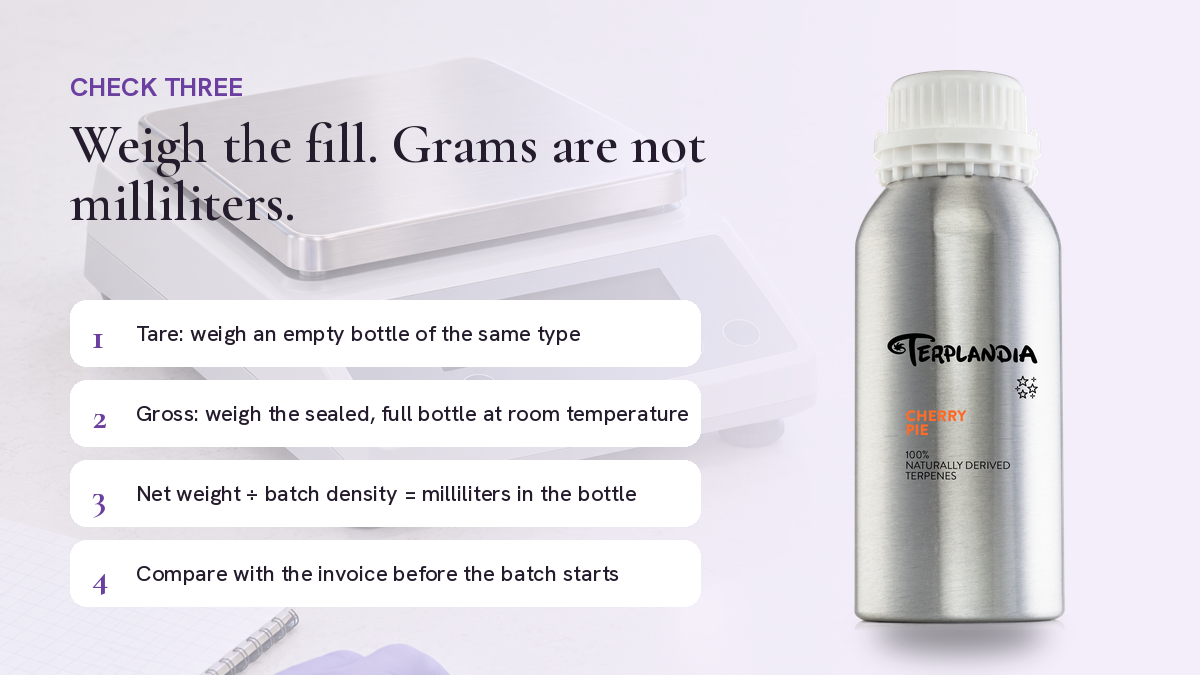
Weigh it. Short fill is the complaint almost nobody writes about, and it is the easiest one to catch. Volume is hard to read by eye in an opaque aluminum bottle, and a scale does not care what the label says.
Terpenes are lighter than water
A milliliter of terpene weighs less than a gram, so a scale reading in grams is not the same number as the milliliters on the invoice. The exact density depends on the profile and on what leads it, so it changes from strain to strain.
The point is not to argue over a few milliliters. It is to catch the bottle that is clearly short before you plan a production run around the invoice. If the gap is bigger than your measurements can explain, raise it with the batch number attached.
Which documents should come with a bulk terpene order?
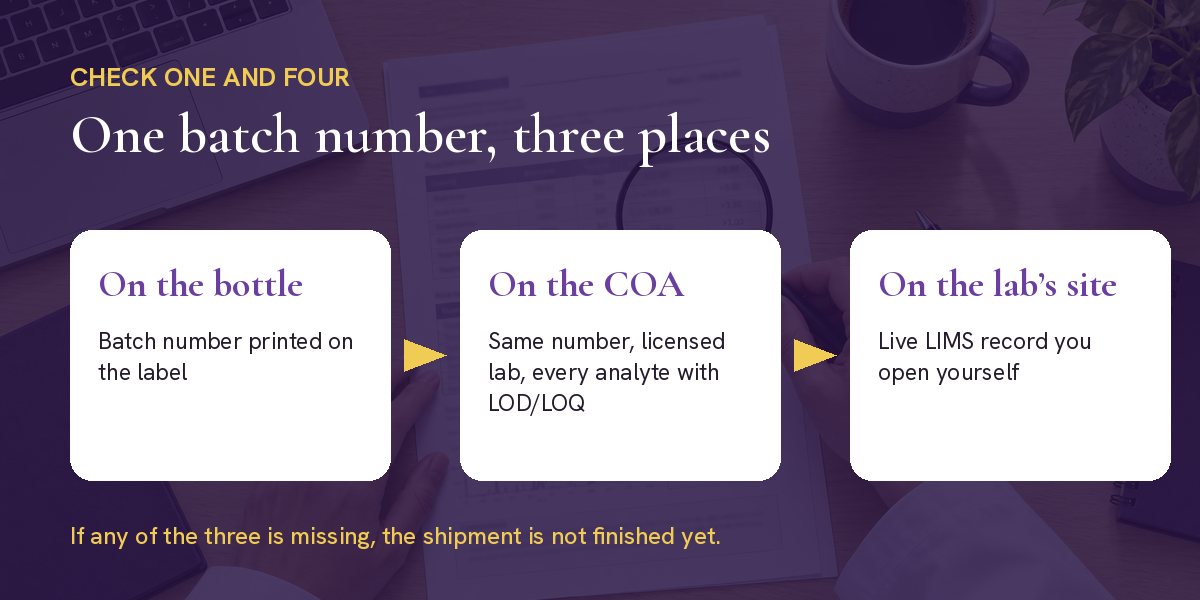
A bulk shipment should arrive with, or be followed the same day by, documents that cover the batch in the bottle. Our line-by-line COA walkthrough explains what each section of a certificate means. On the receiving bench the question is simpler: is it here, and is it for this batch?
Documents to file with every lot
- A COA for this batch number, from a licensed third-party laboratory, with the lab named and its license number printed on it.
- A terpene panel with an LOD and LOQ for every analyte, so that ND reads as a measured statement, not a marketing one.
- A pesticide panel, with each analyte listed rather than a single pass line.
- A verification link that opens the result on the laboratory’s own system, not on the supplier’s website. Open it, and check the batch number and the numbers against the PDF.
- A safety data sheet for the profile, for your own files. Our guide to terpene safety data sheets covers what to keep.
- Batch production records on request. You may never need them, but a supplier who cannot produce them is telling you something.
How should a terpene shipment be packed?
Well enough that nothing can get in or out. Heat, light and oxygen are what flatten a profile, so look at what actually arrives: the boxes intact, the bottle sealed, nothing leaking. Terpenes arrive at room temperature and need no warming. If you want to, you can open the bottle and smell it on arrival, but ideally it stays closed until you need it.
Here is how we pack every Terplandia order: each bottle gets a nitrogen top-off before it is sealed, which helps prevent degradation; every bottle is double vacuum sealed; and every shipment is double boxed.
A supplier telling you not to keep terpenes cold should be able to tell you why. Cold slows every degradation pathway at once. Without a reason, that instruction is a warning, not advice.
#terpsdontlie
Once the lot passes, how you store it matters just as much. Our own guidance is in how to store cannabis-derived terpenes: anything not actively in use goes in the freezer at −20°C, sealed and upright, and stays closed until you need it. Draw what the batch needs in one pull and recap immediately.
Does the shipment smell like the sample you approved?
This is the check that needs planning ahead. Keep a little of the sample you approved, sealed and frozen, for exactly this moment. Put the retained sample and the shipment side by side on blotter strips, blind if you can, and compare them over twenty minutes, not two seconds. Then compare them in your own formulation at your production load.
The bulk lot does not have to be identical to the sample to the decimal. Batches of a real cannabis-derived terpene vary from harvest to harvest, and the COA will show it. It does have to be recognizably the profile you approved. Our bench protocol for evaluating terpene samples has the full method and the vocabulary for describing what changed.
If any of the six checks fails, you have a documented reason to hold the lot. If you want a baseline to hold your current supplier to, start with our sample and its certificate.
What should a receiving checklist include?
Print this and keep it at the bench. Every line is a yes or a no, and every lot gets a line in the log with its batch number and the date.
Receiving a terpene shipment
- Match the label to the paperwork. Batch number, profile name, volume and date against the invoice and the COA.
- Check the packaging. Boxes and seals intact, nothing leaking.
- Look for solids and haze. Clear liquid, no layers. Photograph anything that is not. Otherwise keep the bottle closed until you need it.
- Weigh the fill. Net weight divided by batch density, compared against the invoice.
- Open the lab’s verification link. Same batch number, same numbers as the PDF.
- File the documents. COA, pesticide panel, SDS, and the batch record if you asked for one.
- Compare to the retained sample. Neat on a strip and in formulation, before the full batch.
- Release or quarantine. Log the decision with the batch number and the date.
Which Terplandia profiles should you run these checks on?
To try the checklist on a known baseline, these three profiles cover the common cases: one clearly myrcene-dominant, one with a strong second terpene, and one with two terpenes almost level at the top. The terpene figures are the published profiles on each product page; your batch COA is the number that counts.

Blue Dream
A myrcene-led profile, so the receiving check is simple: myrcene should sit clearly at the top of your batch COA, with pinene and terpinolene behind it.
Cherry Pie
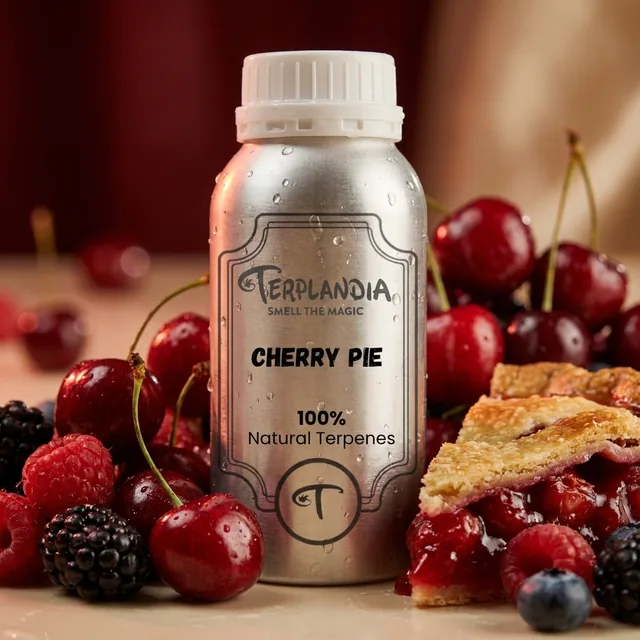
Myrcene first and pinene a strong second. On arrival, confirm that order on the batch COA and compare the nose against your retained sample of the same profile.

Gelato
Limonene and caryophyllene sit almost level at the top, so watch that pairing on the batch COA. A lot that swings hard toward one of them is worth a question before it is blended.
What should you do when a check fails?
- Quarantine the lot. Label it, keep it sealed, and keep it out of the blending room.
- Document it. Photos of the bottle and label, the scale readings, and the batch number.
- Ask in writing. Send the supplier the batch number, what you found, and three questions: what is it, how did it happen, and what will you do about it.
- Ask for the batch production record and, where it applies, a comparison against their own retained sample of the same lot.
- Decide on the evidence. A supplier that extracts in-house can usually answer within a day. Silence is an answer too.
What does a Terplandia shipment arrive with?
We extract our cannabis-derived terpenes in-house from single-source Humboldt County cannabis. Every bottle carries a batch number. Every batch is tested by Infinite Chemical Analysis, a licensed California laboratory (C8-0000047-LIC), on a 37-analyte terpene panel with an LOD and LOQ for each analyte, plus a full pesticide panel, and every certificate carries a LIMS link that opens on the lab’s own system. We keep an SDS for every strain and provide batch production records on request. Every bottle gets a nitrogen top-off before it is sealed, which helps prevent degradation, every bottle is double vacuum sealed, and every shipment is double boxed. It arrives at room temperature, ready to open whenever you need it.
The three profile cards above show what that looks like in practice: the published terpene profile, the price ladder and the product page for each.
Pricing is published: under 1,000 mL is $5 per mL, and 1,000 mL and above is $4 per mL. If you would rather start with a conversation about what you are formulating, request a sample here and run the six checks on it yourself.
Frequently asked questions
Why are there solids in my terpenes?
Solids in the bottle can be plant waxes or lipids that were not fully removed during processing, or foreign particulate. Either way, ask the supplier what the material is, in writing, before the lot is blended.
Is cloudy terpene oil bad?
It is always worth a question. Terpenes arrive at room temperature and should be a clear liquid. If the oil is cloudy or separates into layers, keep the bottle closed, quarantine it and ask the supplier for the batch record.
How do I check the fill volume of a terpene bottle?
Weigh it. Subtract the empty bottle weight, then divide the net weight in grams by the batch density in grams per milliliter. Terpenes are lighter than water, so grams and milliliters are not interchangeable. Ask the supplier for the density of your batch.
What documents should come with a bulk terpene order?
A certificate of analysis for that exact batch from a licensed third-party lab, with an LOD and LOQ for every analyte, a pesticide panel, a verification link to the lab’s own system, and an SDS for the profile. Batch production records should be available on request.
Should the bulk lot match the sample exactly?
Not to the decimal. Real cannabis-derived terpenes vary from harvest to harvest. The leading terpenes should be the same and in roughly the same order, and the aroma should be recognizably the profile you approved, both neat and in your formulation.
Manufacturer-Direct · Humboldt County
A batch number on every bottle, and the COA to match
Single-source Humboldt cannabis, extracted in-house, third-party tested at a licensed California lab. Put a sample on your own receiving bench and run the six checks.
Sources & further reading
- Terplandia, inside the COA · one real batch certificate, read line by line.
- Terplandia, how to evaluate a terpene sample · the bench protocol for the retained-sample comparison.
- Terplandia, how to store cannabis-derived terpenes · cold, capped, blended low.
- Terplandia, how to choose a terpene supplier · the questions to ask before the first order.
- Terplandia, diluted and cut terpenes · how to catch a stretched profile.
- Terplandia, terpene safety data sheets · what to keep on file.
- Terpene profile figures are the published profiles on the Blue Dream, Cherry Pie and Gelato product pages.
- Terpene flavor and aroma compounds containing 0% THC and 0% CBD, sold as ingredients to manufacturers and formulators, not as finished consumer products. Certificates of analysis available for every batch on request. Made in the USA, ships nationwide. Inspection guidance on this page is a general starting point, not a specification, and must be confirmed against the buyer’s own quality procedures, equipment and testing. Nothing on this page constitutes medical, therapeutic, legal or regulatory advice. It is the buyer’s responsibility to ensure the conditions and uses of the product conform to local laws and regulations.

Taher Afghani is the founder of Terplandia, a Humboldt-based supplier of cannabis-derived terpenes for brands and manufacturers across the U.S. Founder, Terplandia